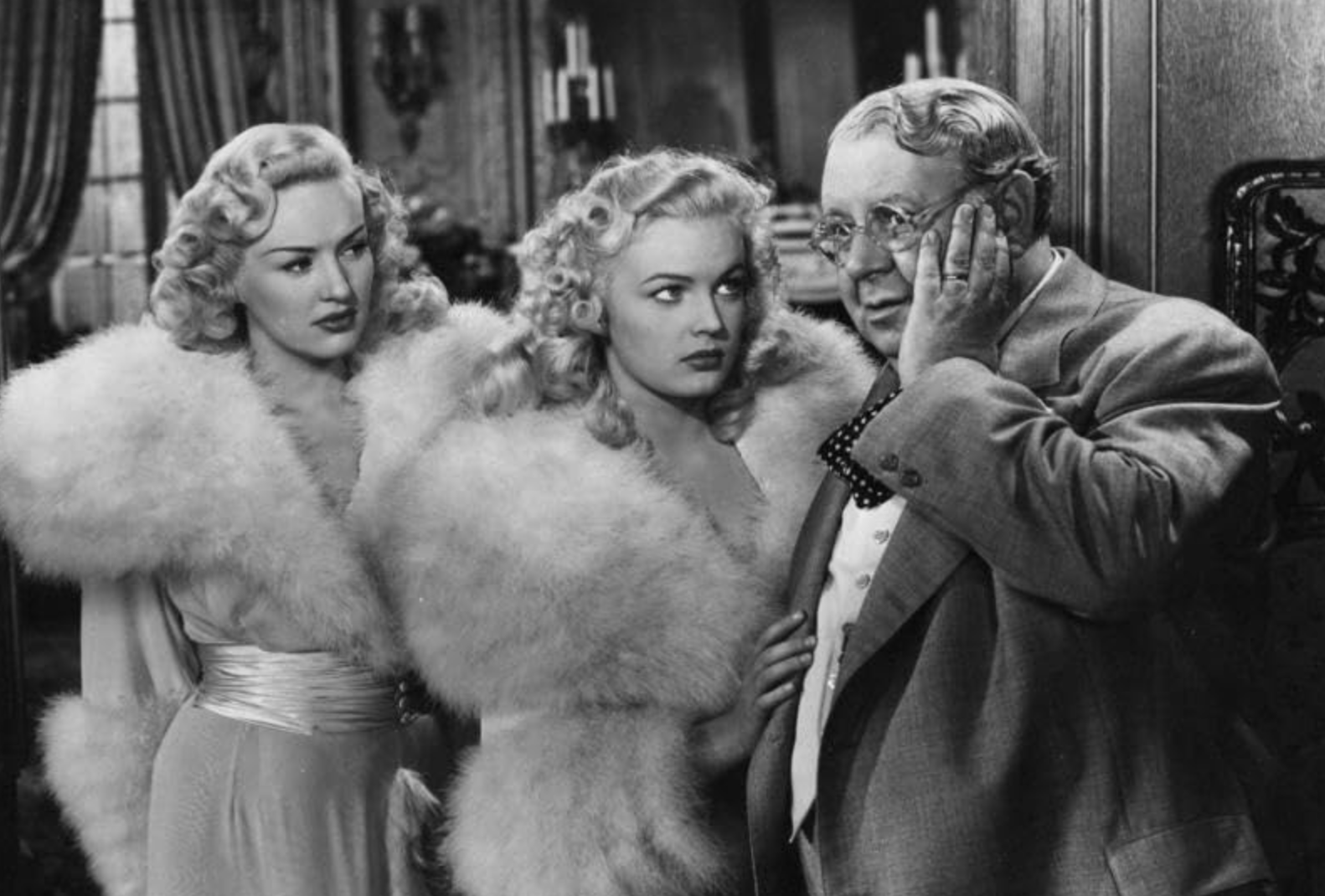
Betty Grable (l) with June Haver and S.Z. Sakall. Image: IMDb
Four years after Jenny Dolly died, Twentieth Century-Fox released a musical based on her life with her sister, Rosie.
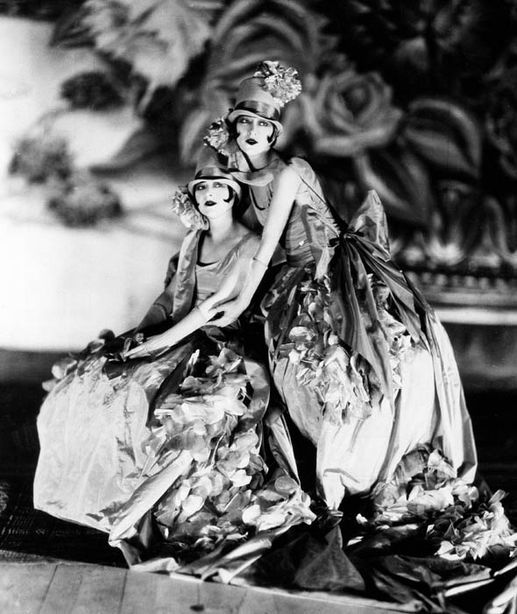
The pair, identical twins born in 1892, emigrated to the United States from Hungary as children. As youngsters, they toured with a vaudeville company, singing and dancing, and, as young women, they appeared for two seasons with the Ziegfeld Follies. They made a couple of films during WWI before moving to France where they became Very Famous and Rich performers.
Why wouldn’t Hollywood make a film about them?
The real Dolly sisters. Image: Pinterest
The Dolly Sisters (1945) is a film that doesn’t Tell you everything. It Hints. In fact, this film glosses over so much it’s astounding.
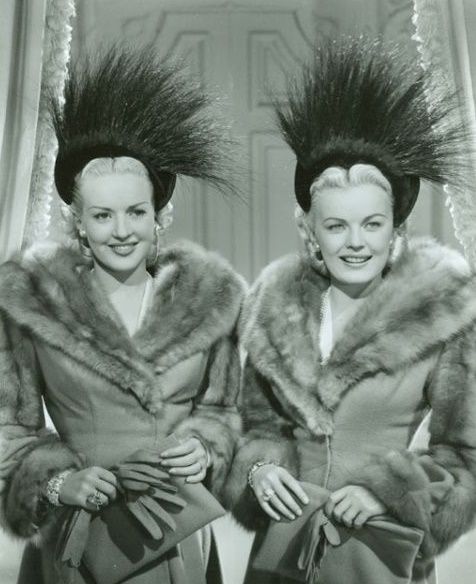
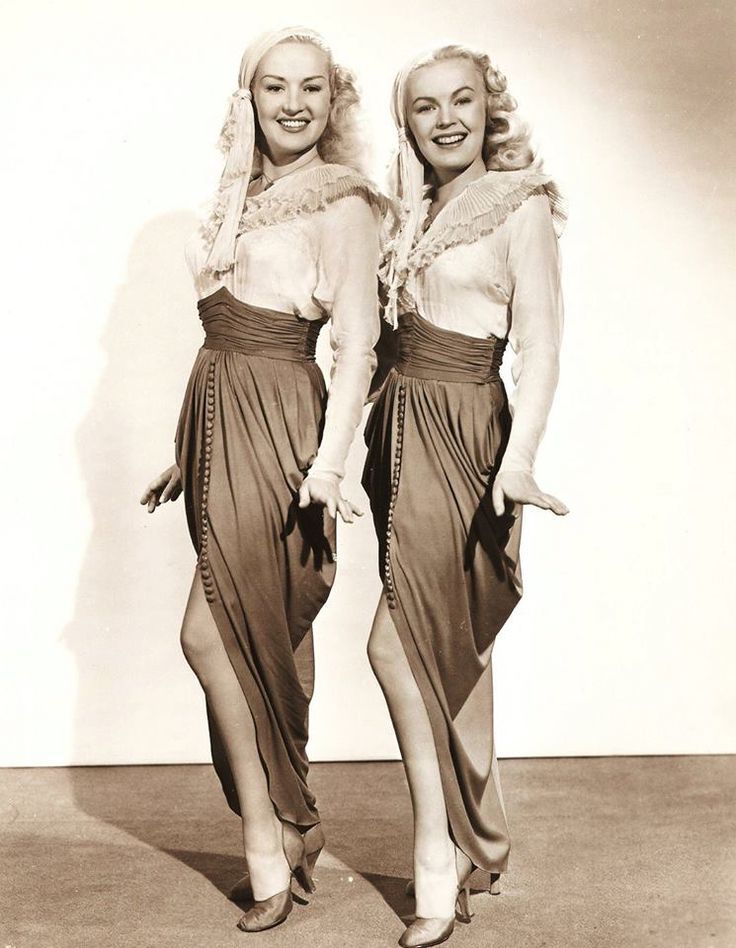
The sisters are played by Betty Grable and June Haver, and, instead of being depicted as identical twins, they are shown to be a year apart in age. However, the film’s designers created the same hairstyle, makeup, and wardrobe for the two women, so in many scenes they look almost identical.
The women are portrayed as almost saintly, although Haver’s character is a little more ambitious and cynical. For example, Haver is Extremely Disapproving when vaudevillian John Payne falls in love with Grable, because if Grable marries Payne, the couple will start their own stage act and leave Haver in the Lurch.
As for Grable, she plays the elder Dolly sister with piety, a gentle soul who seems Too Good To Be True. Remarkably, Grable pulls it off, and when her character suffers heartbreak, we feel for her.
In a film about glamour with a soupçon of sadness, Grable is the perfect choice. Her buoyancy and goodness keep the film aloft and well-grounded, as strange as that sounds.
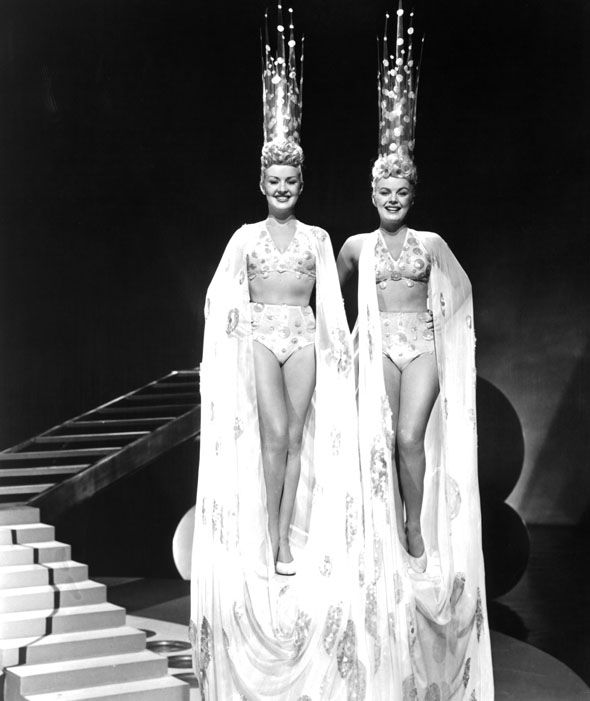
Frankly, The Dolly Sisters is as much about the clothes as it is about the women, and it leads to some surreal scenes including, unfortunately, a blackface routine which may or may not have been a “tribute” to entertainer Josephine Baker.
Here’s what the film hints at, but doesn’t tell you.
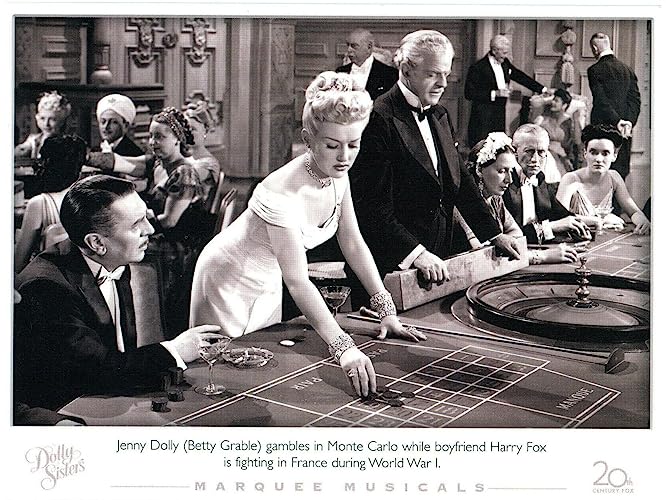
The Dolly Sisters’s act was far from Wholesome, which the film does suggest, and it hints at Jenny’s gambling habits which made her even more Wealthy. (She was, apparently, a freakishly lucky gambler.)
Jenny also became known for her lavish collection of jewellery, some of which she bought herself and some of which were gifts from grateful, uh, friends.
Yet, the sisters did have a philanthropic bent. For example, in 1926, they hosted a gala to raise money for France – as in The Nation Of. Among the performers was their pal, Josephine Baker.
Later in life, after Jennie’s death, Rosie returned to Hungary where she became involved with charity work for kids.
What the movie Will Not Get Into was Jenny’s untimely death in 1941, by suicide.
Image: IMDb
Audiences likely knew of Jenny’s depression and suicide, and, on the face of it, a lighthearted musical devoted to fashion seems an odd way to chronicle the lives of these remarkable women.
Why did Twentieth Century-Fox choose this seemingly dismissive approach?
Our opinion: When the film was released in October, 1945, women were, perhaps, conflicted. The cost of a war that lasted nearly six years was incredibly high, both financially and personally. There would be jubilation regarding the end of the war, of course, but then there was the realization that many returning soldiers would never be the same.
The Dolly Sisters, as flawed as it is, tries to celebrate these women’s achievements and relationships, especially the relationship between the sisters. All of this is embodied by the charismatic, self-illuminating Grable who, in her way, reminds us there are still things to celebrate, even when the world turns dark.
The Dolly Sisters: starring Betty Grable, John Payne, June Haver. Directed by Irving Cummings. Written by John Francis Larkin & Marian Spitzer. Twentieth Century-Fox, 1945, B&W, 114 mins.
Fab post.. sonetimes I just hate it when a biopic only has the star name right.. see Frances on Frances Farmer and Gable and Lombard if you want two to dissect..
Ha! Loved what you said about having just the star name right. Can be quite annoying – and the thing is, people’s lives are often interesting enough that filmmakers don’t need to over-fictionalize.
Exactly. When I saw Frances they invented so much I thought why not go fictional all the way and include the name of the leading character… Rant continued on my blog.
Wonderful review, Ruth! I found very interesting how you compared it to the real-life events. I saw that film on the big screen with Samantha from Musings of a Classic Film Addict that one time I went to the TCM film festival. I don’t remember much from the film narratively speaking (I mean, in detail), but I remember visually it was quite magic, especially on nitrate.
Wow, what a great review! I’m really curious about this movie, even if it does play fast and loose. It seems like a different kind of role for Betty. Thanks again for joining the blogathon–it’s always a blast. 🙂
What’s even sadder is how many contemporary Hollywood movies still pursue this one-sided depiction of women: they’re either loving and good, or manipulative and “fallen.” The real stories of any person is so much richer and variedly layered as you’ve hinted at with the Dolly Sisters, who I’m sure had both their virtues and vices and a deeply complicated relationship with one another. The clothes the real Dolly sisters are wearing are immensely stunning, even captured in black and white, so I can see how this would inspire old Hollywood.
Ha! You’re so right about the portrayal of so many women in Hollywood movies. Like you said, the real story of the Dolly sisters is more complex than the movie allowed, and far more interesting too.
And those costumes! Aren’t they fabulous? So many beautiful clothes in this film.
Sounds like an entertaining frolic that could have been more. Sometimes we just have to sigh over those studio choices. Still, this sounds like it could be enjoyable for what it is, at least!
Yeah, you’re right – this movie is enjoyable for what it is. Betty Grable and June Haver give an audience their money’s worth. The fashions are definitely worth it too!
Very interesting ladies. I do though enjoy just the positive and the glamour/clothes often when watching an old movie. I tend to look up the real story as I’m watching though. You are right – another biopic could be quite interesting!
The costumes in this film are pretty distracting, and I mean that in a good way. A person almost has to watch the film twice – once for the costumes, and a second time for the plot!




I enjoyed your post, Ruth. I don’t anything about The Dolly Sisters, but now I want to know more. Does Grable’s Jenny die in the movie?
LikeLiked by 1 person
No, she doesn’t die in the movie, but – spoiler! – she does end up with Payne after all. Never saw it coming! 😉
LikeLiked by 1 person
Even though they’re not related, those two actresses really look alike!
LikeLiked by 1 person
Yeah, they look SO similar!
LikeLiked by 1 person
Fab post.. sonetimes I just hate it when a biopic only has the star name right.. see Frances on Frances Farmer and Gable and Lombard if you want two to dissect..
LikeLiked by 1 person
Ha! Loved what you said about having just the star name right. Can be quite annoying – and the thing is, people’s lives are often interesting enough that filmmakers don’t need to over-fictionalize.
LikeLiked by 1 person
Exactly. When I saw Frances they invented so much I thought why not go fictional all the way and include the name of the leading character… Rant continued on my blog.
LikeLiked by 1 person
Wonderful review, Ruth! I found very interesting how you compared it to the real-life events. I saw that film on the big screen with Samantha from Musings of a Classic Film Addict that one time I went to the TCM film festival. I don’t remember much from the film narratively speaking (I mean, in detail), but I remember visually it was quite magic, especially on nitrate.
LikeLiked by 1 person
Oh wow – that would be wonderful to see this film on on the big screen, especially if it’s nitrate. The costumes and colours!
LikeLiked by 1 person
Wow, what a great review! I’m really curious about this movie, even if it does play fast and loose. It seems like a different kind of role for Betty. Thanks again for joining the blogathon–it’s always a blast. 🙂
LikeLiked by 1 person
Thanks, Rebecca! This is a crazy movie in many ways, but especially when it comes to glossing over certain life events. Facts? Who needs ’em!
LikeLiked by 1 person
That’s right, we don’t need no stinkin’ facts! Lol.
LikeLiked by 1 person
Bahaha!
LikeLiked by 1 person
What’s even sadder is how many contemporary Hollywood movies still pursue this one-sided depiction of women: they’re either loving and good, or manipulative and “fallen.” The real stories of any person is so much richer and variedly layered as you’ve hinted at with the Dolly Sisters, who I’m sure had both their virtues and vices and a deeply complicated relationship with one another. The clothes the real Dolly sisters are wearing are immensely stunning, even captured in black and white, so I can see how this would inspire old Hollywood.
LikeLiked by 1 person
Ha! You’re so right about the portrayal of so many women in Hollywood movies. Like you said, the real story of the Dolly sisters is more complex than the movie allowed, and far more interesting too.
And those costumes! Aren’t they fabulous? So many beautiful clothes in this film.
LikeLiked by 1 person
Sounds like an entertaining frolic that could have been more. Sometimes we just have to sigh over those studio choices. Still, this sounds like it could be enjoyable for what it is, at least!
LikeLiked by 1 person
Yeah, you’re right – this movie is enjoyable for what it is. Betty Grable and June Haver give an audience their money’s worth. The fashions are definitely worth it too!
LikeLike
The Dolly Sisters was a great biopic, and a fairy dark one for its times all. Great write up of this compelling classic.
LikeLiked by 1 person
Thanks! I sorta hope there will be another biopic of these sisters – if handled well.
LikeLiked by 1 person
Very interesting ladies. I do though enjoy just the positive and the glamour/clothes often when watching an old movie. I tend to look up the real story as I’m watching though. You are right – another biopic could be quite interesting!
LikeLiked by 1 person
The costumes in this film are pretty distracting, and I mean that in a good way. A person almost has to watch the film twice – once for the costumes, and a second time for the plot!
LikeLike