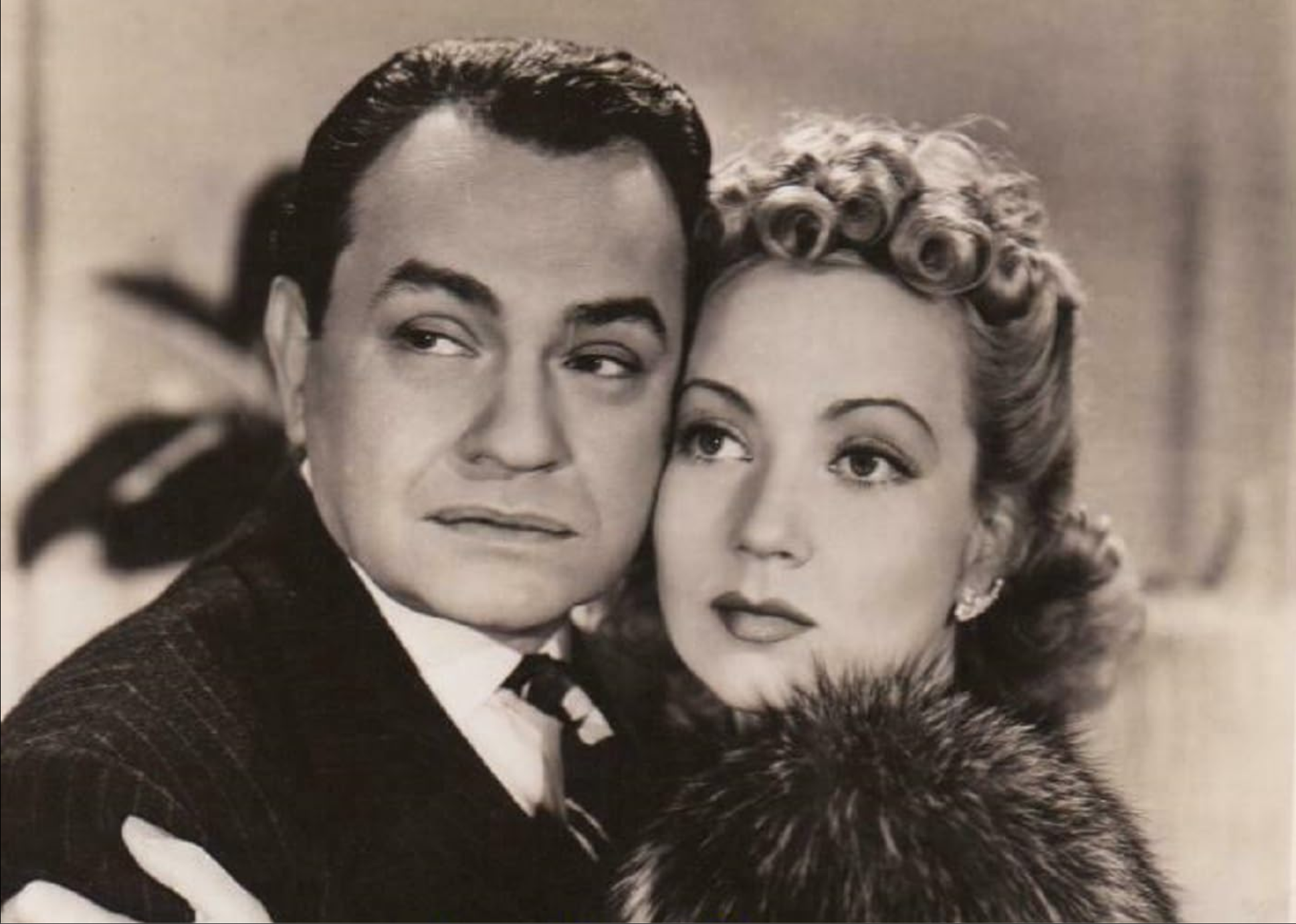
Edward G. Robinson (centre) meets with the boys. Image: Album Online
Depression-era Warner Bros. gangster movies are as much about reformation as they are about crime.
You know the drill: A ruthless gangster/criminal is hammered with bad luck, and these circumstances force him to become a Better Person.
We (yours truly) have a soft spot for these stories. They never get old, even if the studio recycled many of them, but the pace is so quick and the language so gangster-y, a person doesn’t mind.
Take, for example, Brother Orchid (1940) a comedy starring Edward G. Robinson as Little Johnny Sarto, a mobster who suddenly decides to retire.
There’s not much in this film that goes Robinson’s way. He calls it Quits after being caught off-guard by a business closure, then he travels to Europe where he’s repeatedly swindled.
When he returns to the U.S., he finds his old business has been taken over by subordinate Humphrey Bogart, who’d rather kill than surrender any ground.
His bad luck continues to pile up – he ends up getting shot and being left for dead – and the wounded Robinson finds himself at the door of a monastery. The brothers take him in and nurse his wounds, no Questions asked.
The extortionist quickly realizes what a perfect hideout the monastery is. All he has to do are milk cows and tend orchids; thus he dubs himself Brother Orchid.
Now, did we mention Robinson’s former “business” is a protection racket? The Sarto Protective Association, to be exact.
How ironic, then, that he’s forced to seek shelter in a charitable organization which, alas, will run afoul of his old protection scheme.
Robinson works the angles. Image: IMDb
You’ve already guessed where this movie is headed.
Robinson sees great value in the sequestered life. He thinks the brothers are “the biggest chumps in the world,” and he’s found ways to game the System in the monastery.
But there are a lot of Moving Pieces in this film, and although Robinson tries to maneuver everything to his benefit, he cannot succeed. Indeed, the first 20 minutes of this film prove he’s somewhat reckless, especially in his relationships with his long-time (and long-suffering) girlfriend, Ann Sothern, and Bogart his Arch-Nemesis.
So when Robinson ducks out on his worldly life, is he really pursuing a Greater Cause? Is he admitting defeat?
Or is it a little of both?
What does Ann Sothern see in this mug? Image: IMDB
Brother Orchid is a textbook example of the Warner Bros. mobster language and brisk, No-Nonsense delivery. It also has deliberately ridiculous phrases like, “These mugs couldn’t protect a nurse in a baby parade.”
The fabulous Sothern has some of the best lines in the film. For example, she gives a rabbit’s foot to Robinson for good luck and he asks where she got it. “From my mother,” she replies. “With her own hands she took it off of my uncle after they hung him.”
Brother Orchid is the fourth of five films in which Robinson and Bogart starred together, with Robinson as Hero and Bogart as Adversary. Their last pairing would be eight years later in Key Largo (1948), and although Bogart would have Top Billing, Robinson would steal the film.
Of Brother Orchid, however, we noticed New York Times film reviewer Bosley Crowther offered unexpected and well-written insight.
“The sublime—and essential—thing about Mr. Robinson’s comic gangsters is that they are cultural snobs, superior to the sloppy muggs around them,” he wrote, “and for this reason they are the inevitable prey of an incongruous situation.”¹
Of course we urge you to see Brother Orchid. It’s a playful movie that pokes fun at organized crime, but it also prods us, too, asking if we ourselves might contribute to a greater societal cause.
Brother Orchid: starring Edward G. Robinson, Humphrey Bogart, Ann Sothern. Directed by Lloyd Bacon. Written by Earl Baldwin, Richard Connell & Richard Macaulay. Warner Bros., 1940, B&W, 88 mins.
I’m a sucker for a good redemption story. Best line ever: “These mugs couldn’t protect a nurse in a baby parade.” Which I will now be stealing to use at all appropriate and inappropriate occasions.
I finally saw Brother Orchid for the first time last year, and boy was I surprised! I don’t know why I’d never really been interested seeing this, but I didn’t expect to enjoy it as much as I did — or to tear up at the end! Your write-up makes me want to watch it again!
I was surprised, too, when I saw Brother Orchid. I didn’t know what to expect, and I was a little sad when the movie ended too soon. It’s ended up on my “To Watch Regularly” list!






 Silver Screenings
It’s useless to say all I can think about now is Sister Act XD
LikeLiked by 1 person
Bahaha! Excellent!
LikeLiked by 1 person
Brother Orchid is a quirky little mobster flick, really enjoyed this one, it was refreshingly different.t
LikeLiked by 1 person
It never gets bogged down, does it? The pace zips along, which makes for a really enjoyable movie.
LikeLiked by 1 person
I saw this flick years ago. I remember thinking that Robinson was a superb comic actor.
LikeLiked by 1 person
You said it! Did you ever seen him in Larceny, Inc.? Another Robinson gangster/comedy, which is also terrific.
LikeLiked by 1 person
Haven’t seen it.
LikeLiked by 1 person
I’m a sucker for a good redemption story. Best line ever: “These mugs couldn’t protect a nurse in a baby parade.” Which I will now be stealing to use at all appropriate and inappropriate occasions.
LikeLiked by 1 person
Haha! Awesome! It’s a great line, isn’t it?
I’m a sucker for redemption stories, too. They give a person hope, which society doesn’t always do.
LikeLiked by 1 person
I adore Brother Orchid! Robinson is such a versatile actor his comedic work is especially endearing.
LikeLiked by 2 people
Robinson has really good comedic
LikeLike
Ack! Premature send.
Anyhoo, Robinson has fab comedic timing, doesn’t he? He’s all the more funny because he normally is so menacing, hey?
LikeLike
Absolutely! He seems to be able to manifest both sinister and witty! He is one of my favorite actors.
LikeLiked by 1 person
I finally saw Brother Orchid for the first time last year, and boy was I surprised! I don’t know why I’d never really been interested seeing this, but I didn’t expect to enjoy it as much as I did — or to tear up at the end! Your write-up makes me want to watch it again!
Karen
LikeLiked by 2 people
I was surprised, too, when I saw Brother Orchid. I didn’t know what to expect, and I was a little sad when the movie ended too soon. It’s ended up on my “To Watch Regularly” list!
LikeLike