When citizens cooperate and follow the Rules, society has a turbulence-free sheen. Even when a nation is embroiled in a foreign war, its society can, more or less, function as expected when norms are Adhered To.
Yet, it’s surprising how quickly societies Fall Apart when people act contrary to the rules. One could argue history is a scorecard of failed civilizations.
We were mulling this over after we saw the 1922 comedy Cops, starring the legendary Buster Keaton as a young man who nearly brings down a police force.
The troubling thing is, he does so without really trying.
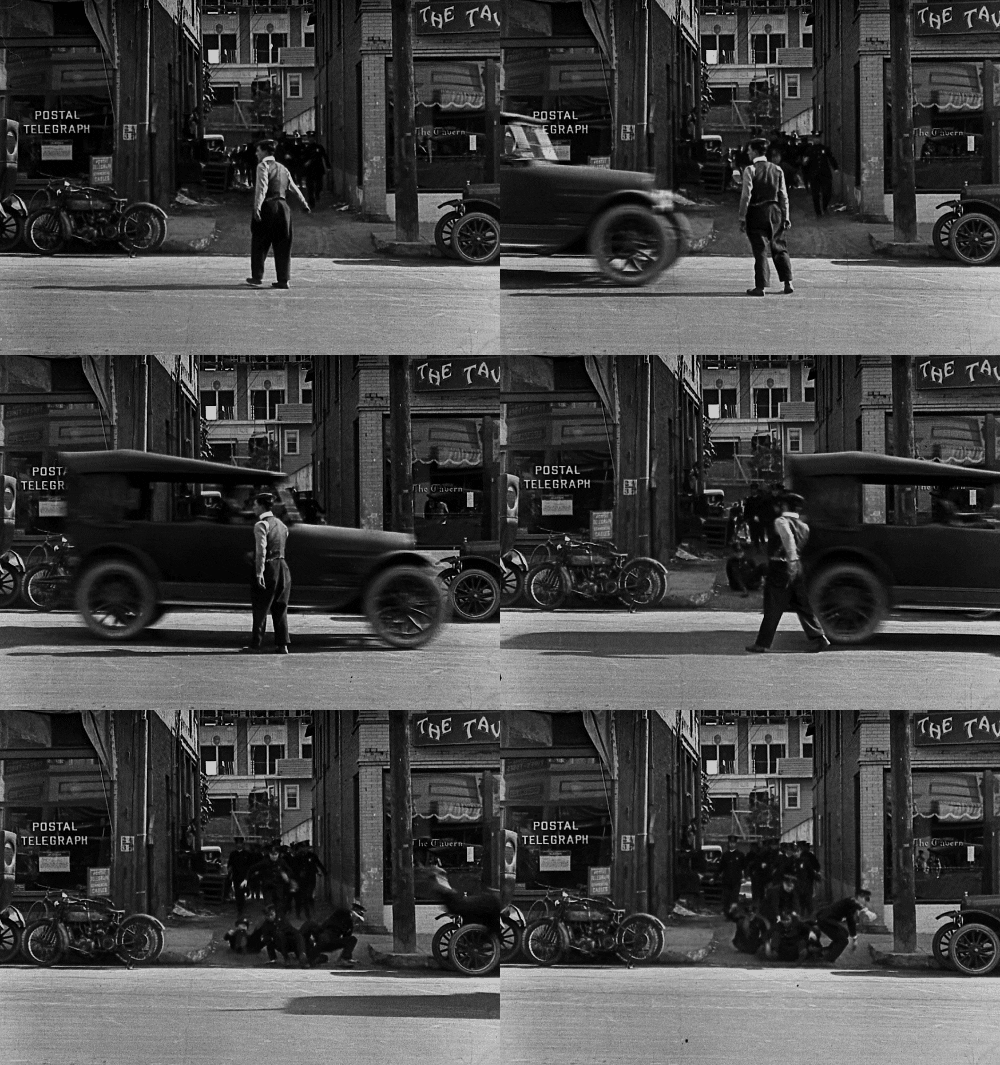
A get-away car. Image: Giphy
Most of the people in Cops are opportunists.
Keaton’s character is in love with a young woman who declares she Will Not marry him unless he becomes a “big businessman”.
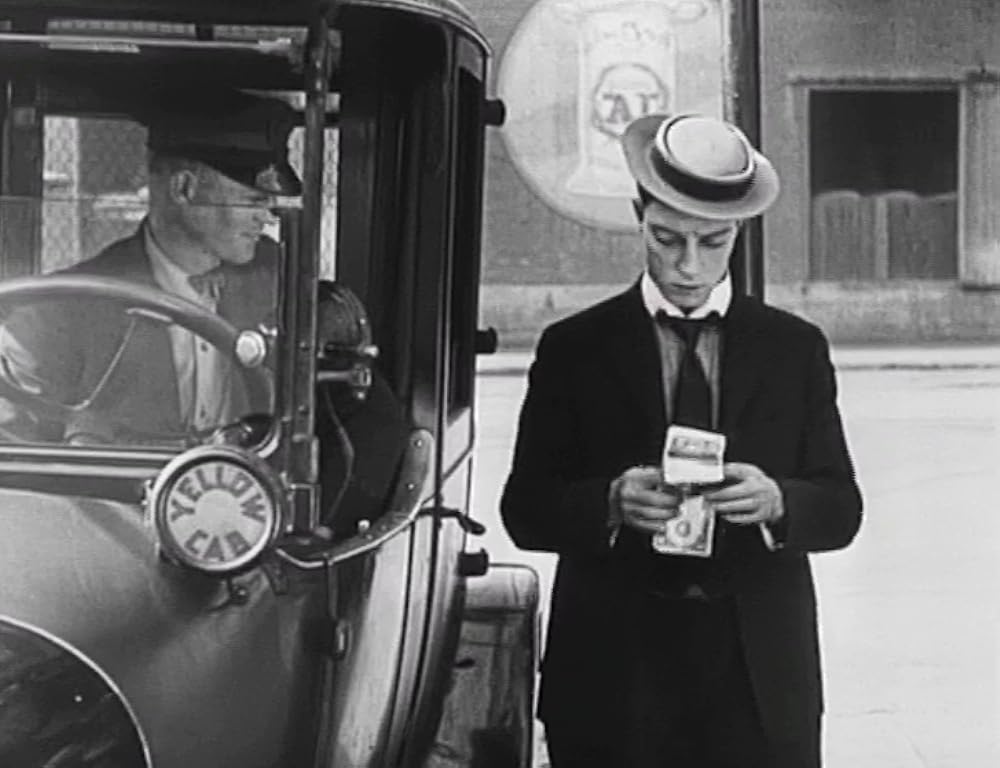
Fresh from this rebuke, he has a slight altercation with an ill-mannered man who accuses Keaton of stealing his wallet. Keaton, an opportunist himself, appropriates the man’s money, only to have it swindled from him moments later.
The real trouble begins when Keaton, driving a horse-drawn wagon, takes a wrong turn and finds himself in the middle of a policeman’s parade.
Alas! An anarchist throws a lit bomb onto his wagon, and Keaton, seemingly unaware the device is an explosive, uses the fuse to light a cigarette, then tosses the bomb away.
(Note: It’s inconceivable that Keaton’s character doesn’t know what a movie bomb looks like, but let’s go with it.)
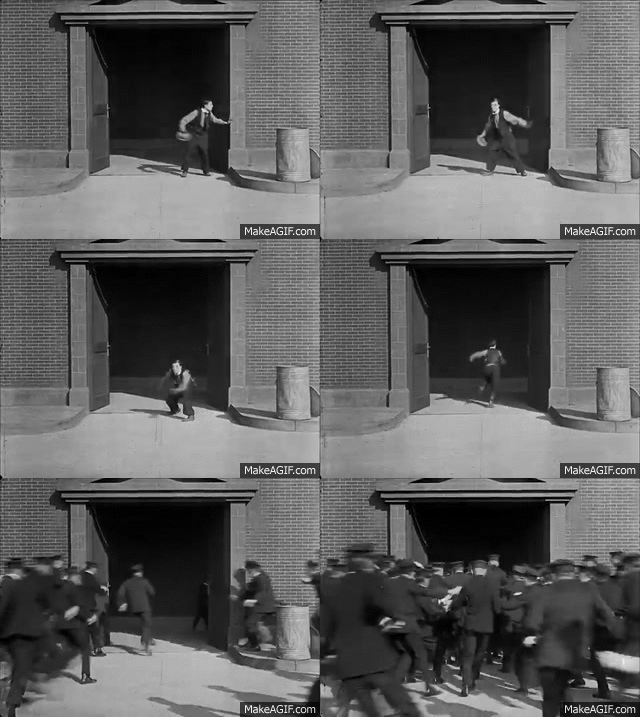
Naturally, lobbing a bomb into a police parade is ill-advised. The men in blue don’t react well to it, and soon he’s being chased, on foot, by every policeman in town. The sight of it is ridiculous, with burly officers chasing a slight man in a pork pie hat.
Keaton makes the chaos completely believable. As a filmmaker, he shows us how each small decision, each unfortunate circumstance, leads to a specific disaster.
Isn’t that often the nature of disasters?
The worst kind of trouble. Image: MakeAGif
Cops has been called “Kafkaesque”, with which we respectfully disagree. This isn’t a film about a sinister bureaucracy conspiring against an innocent victim; this is a film about a not-entirely-innocent fellow who’s in the Wrong place at the Wrong time.
Film historians note Cops was made during a sensational Hollywood murder trial. Keaton’s friend, the popular comedic filmmaker, Roscoe Arbuckle, was accused of manslaughter in the death of actress Virginia Rappe. (You can read more about it here.) Both Keaton and Charlie Chaplin defended Roscoe during the scandal which, unsurprisingly, was a boon to American media.
The railroading of Keaton’s character in this film could be a reflection of the intense interest in the Arbuckle case. It should be noted that Arbuckle was acquitted in 1922, after three trials, but his career was ruined.
Cops, however, isn’t designed to analyze the justice system. It’s a laugh-out-loud romp with Keaton’s signature derring-do.
If you haven’t yet seen this film, you should treat yourself to this madcap adventure.
Cops: starring Buster Keaton, Edward F. Cline, Virginia Fox. Directed by Edward F. Cline & Buster Keaton. Written by Buster Keaton & Edward F. Cline. Joseph M. Schenck Productions, 1922, B&W, 18 mins.
This sounds like a winner — and your insights are so interesting! I haven’t seen many Keaton productions (only one, I think), but I’d like to find this one and check it out.
I hadn’t seen this one until a couple of weeks ago. But that’s the thing about Keaton (I think): you want to see ’em all, but also want to spread ’em out so there are still new films to discover. Thankfully, we have access to so many of his films, hey?
I had never thought about Cops being a commentary about Arbuckle’s trial, but it makes some sense. What I love about Buster’s works is that there is always something to write about, to appreciate and, sometimes, even to learn.
I agree with Le that I had never thought that Roscoe’s travails might have influenced this film. Movie comics always had trouble with cops, but in “Cops,” the trouble grows exponentially. Thank you for sharing your thoughts.
I love your use of understatement here: “Naturally, lobbing a bomb into a police parade is ill-advised.” I laughed out loud. Interesting, the timing. I wonder if he just needed to focus on what he felt was the absurdity of the accusations against his friend to get through it? It must have been a terrible time for him.
Terms like “Kafkaesque,” “absurd,” and “existentialist” tend to get thrown at Keaton’s work whether they apply or no, I find. That aside, this is one of Buster’s best. I love how the insanity builds and builds until we get to that hilariously dark finale.
You know you’ve got a classic short when it makes you ponder like this! I agree with your conclusions, too. Thanks for contributing this to the blogathon, much appreciated!!
I remember reading about that Arbuckle case when I was quite young–horrible. I wonder if he would have been acquitted today. At any rate Keaton was certainly an interesting and talented actor!
The Arbuckle case was a tragedy for everyone, wasn’t it? Especially for the young woman who died. But Buster was Talented with a capital “T”. His films never get old for me, because there’s so much to appreciate.
Great post about Keaton! In the book Camera Man by Dana Stevens, I read that Cops might allude to the Wall Street bombing of 1920. We can’t really be sure though, since Keaton never explicitly states anything in his works. It’s fascinating to think that the director may also be defending Arbuckle, since he was his mentor of sorts.
Funny you should mention the book Camera Man. I just bought it a few weeks ago, and can’t wait to dive in. I think you’re right, though, about this film referencing the Wall Streer bombing.
Wow, what a coincidence! I found it a very informative book on not only the topic of silent cinema or Keaton, but also the 20th century. Hope you enjoy it!






Fascinating look at Cops starring Buster Keaton, what a classic comedy this was!
LikeLiked by 1 person
A definite classic, like you said. And he made the whole thing seem easy!
LikeLiked by 1 person
Keaton was a huge talent. Movie lovers are fortunate that he existed.
LikeLiked by 1 person
Nicely said. Movie lovers are indeed fortunate that he existed.
LikeLiked by 1 person
This sounds like a winner — and your insights are so interesting! I haven’t seen many Keaton productions (only one, I think), but I’d like to find this one and check it out.
— Karen
LikeLiked by 1 person
It’s a great film, with lots of Buster Keaton stunts. It’s also interesting to see LA streets/buildings in 1920.
LikeLike
I watched a lot of Keaton stuff in college but I don’t think I got around to this one! Such a great he was!
LikeLiked by 1 person
I hadn’t seen this one until a couple of weeks ago. But that’s the thing about Keaton (I think): you want to see ’em all, but also want to spread ’em out so there are still new films to discover. Thankfully, we have access to so many of his films, hey?
LikeLiked by 1 person
I had never thought about Cops being a commentary about Arbuckle’s trial, but it makes some sense. What I love about Buster’s works is that there is always something to write about, to appreciate and, sometimes, even to learn.
Cheers!
Le
LikeLiked by 1 person
So true, Le. There’s always lots to explore in a Buster Keaton movie, even if it’s one you’ve seen before. 🙂
LikeLike
I agree with Le that I had never thought that Roscoe’s travails might have influenced this film. Movie comics always had trouble with cops, but in “Cops,” the trouble grows exponentially. Thank you for sharing your thoughts.
LikeLiked by 1 person
Ha! Yes, the trouble in this movie grows exponentially, indeed!
LikeLike
I love your use of understatement here: “Naturally, lobbing a bomb into a police parade is ill-advised.” I laughed out loud. Interesting, the timing. I wonder if he just needed to focus on what he felt was the absurdity of the accusations against his friend to get through it? It must have been a terrible time for him.
LikeLiked by 1 person
You’re right – it must’ve been a terrible time for Buster and many others in Hollywood. Even so, many excellent films made during that period, hey?
LikeLike
Terms like “Kafkaesque,” “absurd,” and “existentialist” tend to get thrown at Keaton’s work whether they apply or no, I find. That aside, this is one of Buster’s best. I love how the insanity builds and builds until we get to that hilariously dark finale.
LikeLiked by 1 person
Beautifuly said: “that hilariously dark finale”. It’s a perfect conclusion to the madness.
LikeLiked by 1 person
You know you’ve got a classic short when it makes you ponder like this! I agree with your conclusions, too. Thanks for contributing this to the blogathon, much appreciated!!
LikeLiked by 1 person
Hi Lea, thanks to your annual Buster Keaton Blogathon, I’m making my way through Buster’s impressive filmography. Always so much to appreciate.
LikeLiked by 1 person
I remember reading about that Arbuckle case when I was quite young–horrible. I wonder if he would have been acquitted today. At any rate Keaton was certainly an interesting and talented actor!
LikeLiked by 1 person
The Arbuckle case was a tragedy for everyone, wasn’t it? Especially for the young woman who died. But Buster was Talented with a capital “T”. His films never get old for me, because there’s so much to appreciate.
LikeLiked by 1 person
That first clip! Fab write up. I saw a fascinating documentary on him. So curious to see Cops.
LikeLiked by 2 people
Did you happen to see The Great Buster doc, by chance? A Peter Bogdanovich love letter to Buster Keaton.
LikeLike
Not tat one I saw but I wish it was! Also, I just saw Paper Moon. What a delight that film was.
LikeLiked by 1 person
It has a sweetness, doesn’t it? And I mean that in the best possible way.
LikeLike
It does. And what a performance by them both!
LikeLiked by 1 person
Great post about Keaton! In the book Camera Man by Dana Stevens, I read that Cops might allude to the Wall Street bombing of 1920. We can’t really be sure though, since Keaton never explicitly states anything in his works. It’s fascinating to think that the director may also be defending Arbuckle, since he was his mentor of sorts.
LikeLiked by 1 person
Funny you should mention the book Camera Man. I just bought it a few weeks ago, and can’t wait to dive in. I think you’re right, though, about this film referencing the Wall Streer bombing.
LikeLiked by 1 person
Wow, what a coincidence! I found it a very informative book on not only the topic of silent cinema or Keaton, but also the 20th century. Hope you enjoy it!
LikeLiked by 1 person