We’ve been watching some remarkable short films from 1923.
One features an on-stage comedian launching a barrage of jokes, e.g. “No matter how much the boss likes you, you can’t work in a bank and bring home samples.”
Another short features legendary pianist and composer Eubie Blake, who plays with truly dazzling skill and wit.
Ah, now here are black vaudevillians, Sissle and Blake, singing two songs from their 1921 hit Broadway production, Shuffle Along. (Wikipedia says this show was so popular, it caused “curtain time traffic jams” outside the theatre.1)
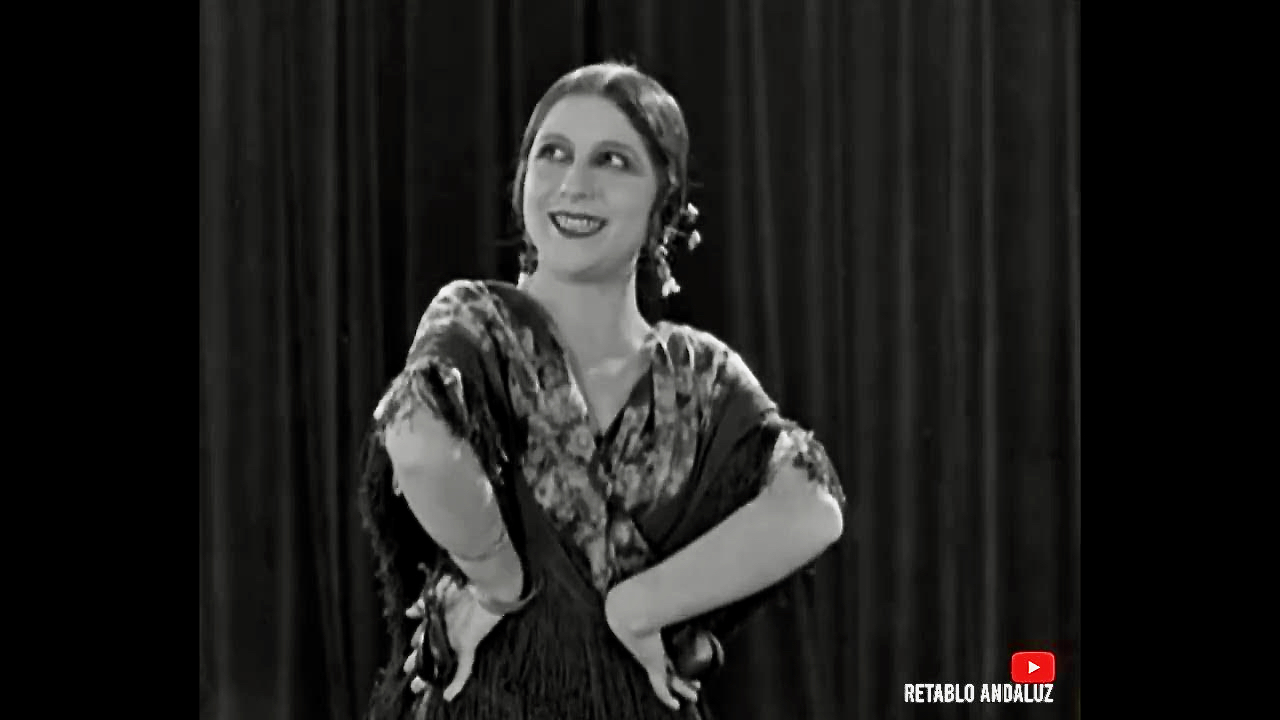
And let us not overlook the charismatic Spanish entertainer, Concha Piquer, who sings and dances and looks fabulous in the most outlandish costumes.
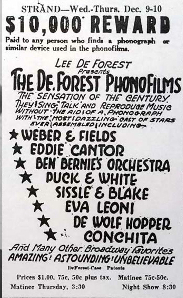
These short films, and more, debuted on a single bill at a New York theatre in 1923. They featured some of the Biggest performers of the Day.
As fascinating as these shorts are, they look rather primitive to us today. The camera is fixed, the sets are uninspired, the sound is tinny.
Wait. The sound?
Yes, you read that right. Four years before the release of The Jazz Singer (1927) – often considered the first sound feature film – filmmaker Lee de Forest unveiled his Phonofilm system to New Yorkers, in the hopes of selling his technology to Hollywood studios.
Ultimately, the gamble didn’t work and, by 1930, de Forest’s company went Belly Up. He also had an acrimonious split with his partner and spent the next couple of decades in near-obscurity.
But! Phonofilm did prove to the world that sound could be imprinted on film.
The legendary Eubie Blake, performing in 1923. Image: The Syncopated Times
It’s not our purpose to exhaustively research the development of motion picture sound. (You’re welcome.) But let’s dip our toes in historical waters for a second.
Film historian Scott Eyman says the first American sound films, made with a Cameraphone, debuted in Rhode Island in 1907. These shorts were projected on the screen, and were synchronized with two Thomas Edison phonographs. The whole enterprise depended on the operators’ ability to lip-read the actors on screen.
“The system needed two men,” writes Eyman, “one to man the twin phonographs behind the stage, another in the booth, with a buzzer system enabling them to communicate.”2 It was a frustrating and inefficient process.
Many filmmakers worked on matching image + sound on film, with varying degrees of success. The aforementioned de Forest was a notable participant in the race, for de Forest billed himself as The Father of Radio. (About this: He wasn’t wrong, he just wasn’t the only one.)
de Forest – a fascinating character not always portrayed charitably by historians – had introduced the world to the Audion Vacuum Tube in 1906. This tube made it possible to receive long-distance radio signals and, apparently, laid groundwork for modern electronics.
But, by 1919, de Forest, a man unafraid of lawsuits or questionable business practices, felt shunted aside in the competitive radio industry. He began experimenting with converting sound into light, which eventually led to making movies.
“To develop his idea for sound motion pictures,” writes Tom Lewis in Empire of the Air, “de Forest had to engage not only in invention but full-scale promotion and film production.”3
This he did, at considerable personal expense and, by April 1923, he had a collection of short films ready for Public Consumption, with beautifully synchronized sound.
By 1924, writes Lewis, de Forest had kitted out 30 theatres with Phonofilm technology, and had signed contracts for 50 more.4
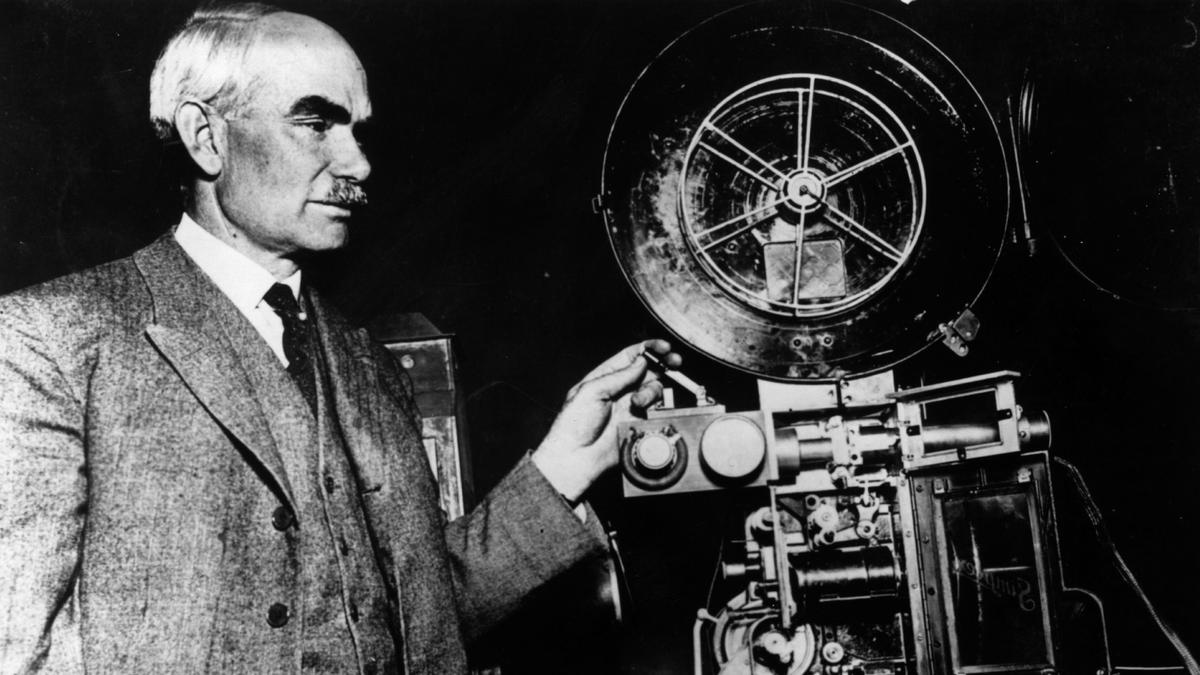
Inventor Lee de Forest and his Phonofilm camera. Image: The Hindu
But just as de Forest wasn’t the only one pursuing the marriage of image + sound, he also wasn’t the only one at Phonofilm responsible for this process – a technicality he sometimes overlooked.
de Forest’s soon-to-be-ex partner, Theodore Case, began exploring the idea of movie sound when he was a student at Yale in 1911. In 1916, he began working with chemist Earl Sponable, and together they worked on the light necessary “for a variable-density sound track.”5
de Forest approached the men in 1920 in hopes of working together, but the pair didn’t sign a contract with Phonofilm until 1923. At first, when promoting the company/technology, de Forest admitted the work wasn’t entirely his own, but this modesty didn’t last long.
“In December 1923, de Forest gave an interview to some New York papers in which he took credit for the design and construction…[that] had actually been entirely the work of Case and Sponable,” writes Eyman.6
By the end of 1925, money had Dried Up, Case & Sponable split with de Forest, and the inventor sold an exclusive Phonofilm option to William Fox (of what was later 20th-Century Fox).
Alas! de Forest didn’t know that Case also sold his patents to Fox. de Forest sued the studio, and settled out of court for $60,000 – short of the $2 million he originally sought.7
Lee de Forest was a complex individual, one who never achieved the lasting Fame and Fortune he desired; many of his companies dissolved into bankruptcy. He did, however, receive an Oscar in 1959 for his contributions to motion pictures. Sadly, he died two years later.
Yet, you can see de Forest’s passion for showbiz in the 1923 Phonofilm shorts, many of which are available on YouTube. They illustrate his desire to capture the magic of talented and charismatic performers.
For that reason, we tip our hat to this flawed, visionary man, one of many who proved Movies could Talk.
Sources
1Wikipedia. (Retrieved November 23, 2024.) Shuffle Along. 2Eyman, Scott. (1997) The Speed of Sound: Hollywood and the Talkie Revolution, 1926-1930. Baltimore, MD: John Hopkins University Press, p. 28. 3Lewis, Tom. (1991) Empire of the Air: The Men Who Made Radio. Ithaca, NY: Cornell University Press, p. 171. 4Ibid. 5Eyman, The Speed of Sound, pp. 47-48. 6Ibid, p. 49. 7Lewis, Empire of the Air, p. 173.
Never heard of Lee de Forest before until today, but he does sound like a man way ahead of his time with his experiments with early sound film. It’s a shame it didn’t work out for him in his lifetime, but at least people can now read about him and how he began the process for what film became. Up until today I always thought 1928’s The Lights of New York was the first 100% talking picture. Very interesting and important stuff for sure.
Blancanieves from 2012 is another great neo-silent. The best way I can describe it is, “What if Tod Browning made an adaptation of Snow White and the Seven Dwarfs set in 1920s Spain?”
The history of sound film is so fascinating. The Jazz Singer is important but it really gets too much credit for “introducing” the technology. For one thing, it’s more like a silent film with the occasional musical or “talking” sequence, and second, experiments with sound film date back to the earliest days of film, as you mention here.
Scott Eyman’s book on the subject really is a treasure.
What a FASCINATING post! I wasn’t familiar at all with De Forest’s initiatives and now I’m curious to check out his shorts. Thanks for introducing me to them!
I hadn’t heard of de Forest, either, until I came across him in the book, “Empire of the Air”. He was quite a complex and (probably) frustrating person.
Thanks for your post, it is a well-researched and meaningful. This site has now becomes my one of the favourite source and go to destination for movie. Would you mind checking my site OTT Release This Week, my blog focuses on latest release dates of OTT platforms. I hope it will help you find the latest movies and TV shows, anyways, have started following your blog. Keep up!







 Silver Screenings
Never heard of Lee de Forest before until today, but he does sound like a man way ahead of his time with his experiments with early sound film. It’s a shame it didn’t work out for him in his lifetime, but at least people can now read about him and how he began the process for what film became. Up until today I always thought 1928’s The Lights of New York was the first 100% talking picture. Very interesting and important stuff for sure.
LikeLiked by 1 person
These 1923 shorts are remarkable. They are primitive, but the sound & visual synchronization is incredible. Plus, they’re fun to watch.
LikeLiked by 1 person
Howdy. The occasional silent or nearly-silent film is still being made. A real good one, from 2011, is The Artist.
LikeLiked by 1 person
I love The Artist! Time to see it again.
LikeLiked by 1 person
Blancanieves from 2012 is another great neo-silent. The best way I can describe it is, “What if Tod Browning made an adaptation of Snow White and the Seven Dwarfs set in 1920s Spain?”
LikeLiked by 2 people
That sounds really intriguing!
LikeLike
The history of sound film is so fascinating. The Jazz Singer is important but it really gets too much credit for “introducing” the technology. For one thing, it’s more like a silent film with the occasional musical or “talking” sequence, and second, experiments with sound film date back to the earliest days of film, as you mention here.
Scott Eyman’s book on the subject really is a treasure.
LikeLiked by 2 people
You’re right about Eyman’s book. It is a comprehensive history, but not at all dry.
LikeLike
What a FASCINATING post! I wasn’t familiar at all with De Forest’s initiatives and now I’m curious to check out his shorts. Thanks for introducing me to them!
Cheers!
Le
LikeLiked by 1 person
I hadn’t heard of de Forest, either, until I came across him in the book, “Empire of the Air”. He was quite a complex and (probably) frustrating person.
LikeLiked by 1 person
This is so insightful!
LikeLiked by 1 person
Thank you – and thanks for dropping by. 🙂
LikeLiked by 2 people
Thanks for your post, it is a well-researched and meaningful. This site has now becomes my one of the favourite source and go to destination for movie. Would you mind checking my site OTT Release This Week, my blog focuses on latest release dates of OTT platforms. I hope it will help you find the latest movies and TV shows, anyways, have started following your blog. Keep up!
LikeLiked by 2 people
Thanks for stopping by. I’ll visit your site soon to check it out, and thanks for providing the link.
LikeLiked by 1 person