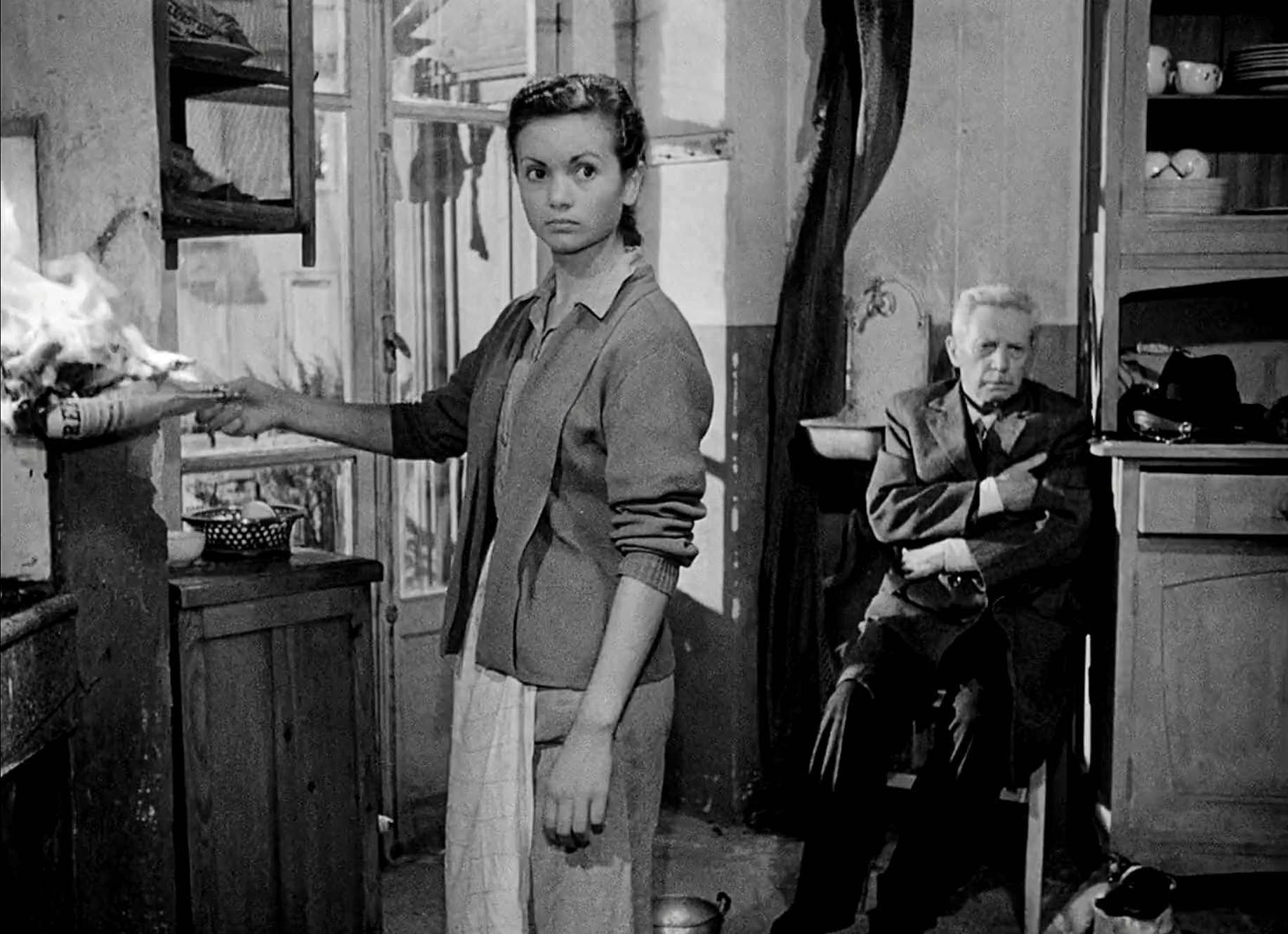
Dismantling a room as a life unravels. Image: Letterboxd
What happens when society squeezes you out?
This is the question raised by the Italian neorealism film, Umberto D. (1952). Umberto, the titular character, is a polite, agreeable man who was once a civil servant. But now that his government is Done with him, he struggles as a senior on a meager pension. He has no family, and his friends are in the same miserable circumstance.
Alas, Umberto is behind on his rent, and his landlady plans to evict him. (She hopes he’ll die, sparing her Eviction trouble.) In the meantime, she embarks on a renovation, and hires workmen to tear apart the walls of his room.
Umberto does have an ally in this boarding house, a young woman named Maria, who works as a maid. Maria fusses over Umberto like he’s her grandfather; in return, he guards her secret: She is pregnant. (When the landlady discovers this juicy morsel, Maria will undoubtedly be fired.)
During the course of the film, Umberto (deliberately) runs into former co-workers who are uncomfortable with his presence, but pretend otherwise. Ah! Here’s my bus, I’m already late.
Yet, Umberto has his pride. He considers begging on the street or throwing himself out of a window, but can’t bring himself to do either.
He refuses to move into a shelter, although he occasionally takes a meal at a soup kitchen, which he feeds to his dog, Flicke.
The bond between Umberto and Flicke is nearly unshakable. For example, when Umberto finally packs his large, awkward suitcase and leaves the boarding house, Flicke doesn’t argue. His home is with his master, wherever that may be.
The secretly pregnant Maria. Image: IMDb
Umberto D. is like a slow strangulation. When the film opens, Umberto is part of a protest with several other seniors demanding a larger pension. They’ll not stand for this! But the crowd quickly disburses when police arrive because the government must not be embarrassed.
This is our first clue of the little hope for Umberto. We do not know how he came to be in such dire straits, but it was not uncommon in post-war Italy. He is poor, and there is no way out of it.
Added to this is the landlady’s pressuring him to pay the 15,000 lire he owes, and it’s All or Nothing. She wants no half-hearted fiscal promises.
Umberto falls ill and is admitted to the hospital, where, he hopes, they might keep and care for him for a while. They do not. When he returns home, he discovers Flicke has run away.
His life has become very small, constricted. At every turn, Umberto is given a clearer view of his futility.
Neither his landlady nor the hospital will house him, Maria will eventually be preoccupied with her baby, and no one wants his belongings or his dog.
It’s as though he has already died or, worse, has never lived.
Umberto’s best friend, Flicke. Image: IMDb
Umberto D. was a failure at the Italian box office, and it’s not hard to imagine why. The country was still reeling after WWII, trying to establish a workable economy and shake away its fascist past. The Italian government was Not Pleased with this film, and audiences weren’t keen to be reminded of their struggles.
However. This film was a big hit internationally, with a Grand Prize nomination at the 1952 Cannes Film Festival, as well as a 1957 Oscar nomination for best screenplay.
Director Vittorio De Sica, who dedicated the film to his father, was known to hire “non-actors”. For example, the man who plays Umberto was a university professor, and the girl who plays Maria initially went to the film auditions as a curious bystander.
The most clever thing about Umberto D., in our opinion, is that it doesn’t resort to Cheap Theatrics. Here is a man, and these are the facts of his situation.
Umberto D. starring Carlo Battisti, Maria Pia Casilio, Lina Gennari. Directed by Vittorio De Sica. Written by Cesare Zavattini. Dear Film, 1953, B&W, 89 mins.
This is a hard hard movie, in the end you are so broken hearted you can’t even cry, it’s devastating. Impossible to forget, my favourite one in Italian Neorealism, even if I never thought about seeing it a second time.
Yes, exactly – so heartbreaking you can hardly cry. I was wondering what you thought of this film as I was working on this post. An unforgettable film. Thank you for stopping by.
Back again.. this was remade recently with Jean Paul Belmondo as I thought… Will definitely have to do a double bill.. Also saw the film posters for this .. thanks for bringing this to the blogathon.
Jean Paul Belmondo? That is truly interesting – will look for it. Thanks for dropping by, Gill. Can’t wait to read your entry when we get back from our road trip.
Sounds exciting, have a fabulous time. Here’s more about it, it’s called A Man and His Dog (Un Homme et Son Chien) – and has a great cast including Romy Schneider’s daughter, Sarah Biasini (which was how I discovered it).
It was also Belmondo’s swan song, and reading your review of the original this sounds a perfect send off, here’s the link… https://en.wikipedia.org/wiki/A_Man_and_His_Dog
Sorry got a bit crazy reading about this.. promise I won’t list all the cast. Thanks for inspiring me to hunt this down and the remake. Hope you are having a great break.
oh boy, sad movies are one thing, but sad movies with pets can just destroy you. Like the one I picked for this blogathon, this is another movie about aging and the small details of life and how much we need compassion for each other.
I did a minor degree in Film Studies along with my English degree. I took a class on Italian Neo-realism and we watched this film. I cried all the way home.
This sounds like an incredibly beautiful and haunting film. I just found it on HBO Max and I cannot wait to see it. I had no idea the lead actor never acted before and it was his only role. Amazing! 🙂
I am so sad reading your story that I’m not sure I can watch the film, but I will try because it feels like it’s an important film to see. You had me right from the cutline in the first photo and the first sentence in your story:
Dismantling a room as a life unravels. Image: Letterboxd
What happens when society squeezes you out?
I am already devastated as soon as I start reading your story. You have written in a way that makes us feel as much of the pain as we can through your words like “Umberto D. is like a slow strangulation.” What a punch in the gut! This is a beautifully written story.
Geez, Ruth — I was already feeling sad and then you put me over the edge with the dog running away! Still, I’ve recently embarked on an international film journey, and I hope I will be able to find this one and add it to my “seen it” column. It sounds excellent — as was your first-rate post.







 Silver Screenings
This is a hard hard movie, in the end you are so broken hearted you can’t even cry, it’s devastating. Impossible to forget, my favourite one in Italian Neorealism, even if I never thought about seeing it a second time.
LikeLiked by 1 person
Yes, exactly – so heartbreaking you can hardly cry. I was wondering what you thought of this film as I was working on this post. An unforgettable film. Thank you for stopping by.
LikeLiked by 1 person
This does sound like a heartbreaking watch. I got all teary reading this and the dog storyline too… Thanks xx
LikeLiked by 1 person
The dog is so cute, and he will absolutely break your heart.
LikeLiked by 1 person
You had me at your review and then seeing the film posters… I can so understand you getting emotional seeing this.
LikeLike
Back again.. this was remade recently with Jean Paul Belmondo as I thought… Will definitely have to do a double bill.. Also saw the film posters for this .. thanks for bringing this to the blogathon.
LikeLiked by 1 person
Jean Paul Belmondo? That is truly interesting – will look for it. Thanks for dropping by, Gill. Can’t wait to read your entry when we get back from our road trip.
LikeLiked by 1 person
Sounds exciting, have a fabulous time. Here’s more about it, it’s called A Man and His Dog (Un Homme et Son Chien) – and has a great cast including Romy Schneider’s daughter, Sarah Biasini (which was how I discovered it).
It was also Belmondo’s swan song, and reading your review of the original this sounds a perfect send off, here’s the link… https://en.wikipedia.org/wiki/A_Man_and_His_Dog
LikeLiked by 1 person
Ps and Alain Delons son… Anthony too.
LikeLiked by 1 person
No way! What a cast!
LikeLiked by 1 person
Thanks for the link.
LikeLiked by 1 person
Sorry got a bit crazy reading about this.. promise I won’t list all the cast. Thanks for inspiring me to hunt this down and the remake. Hope you are having a great break.
LikeLiked by 1 person
oh boy, sad movies are one thing, but sad movies with pets can just destroy you. Like the one I picked for this blogathon, this is another movie about aging and the small details of life and how much we need compassion for each other.
LikeLiked by 1 person
True, that. Sad movies with pets gets a person every. Single. Time.
LikeLiked by 1 person
I did a minor degree in Film Studies along with my English degree. I took a class on Italian Neo-realism and we watched this film. I cried all the way home.
LikeLiked by 1 person
I wasn’t prepared for the punch it packs. A powerful, unforgettable film.
LikeLiked by 1 person
What a great choice. It’s so heartbreaking because there is so much emotional truth.
LikeLiked by 1 person
That’s exactly right. It’s terrifying to think Umberto’s situation could still happen to anyone.
LikeLike
This film physically hurts, especially for us who have more contact with the elderly.
“It’s as though he has already died or, worse, has never lived.”- this is a perfect sentence to describe this movie.
LikeLiked by 1 person
Thank you, Le. I can’t imagine how difficult this film must have been to watch, given your experience with the elderly.
LikeLike
This sounds like an incredibly beautiful and haunting film. I just found it on HBO Max and I cannot wait to see it. I had no idea the lead actor never acted before and it was his only role. Amazing! 🙂
LikeLiked by 1 person
The lead actor gives an incredible performance. He’ll break your heart. I’m curious to know what you think once you get a chance to see it.
LikeLiked by 1 person
Wow. Poor Umberto.
LikeLiked by 1 person
His circumstances are so sad, yet he never yields his dignity.
LikeLiked by 1 person
I am so sad reading your story that I’m not sure I can watch the film, but I will try because it feels like it’s an important film to see. You had me right from the cutline in the first photo and the first sentence in your story:
Dismantling a room as a life unravels. Image: Letterboxd
What happens when society squeezes you out?
I am already devastated as soon as I start reading your story. You have written in a way that makes us feel as much of the pain as we can through your words like “Umberto D. is like a slow strangulation.” What a punch in the gut! This is a beautifully written story.
Toni R.
LikeLiked by 1 person
Thank you so much for your kind words, Toni. I hope you get the chance to see this film…but you do have to be in the mood for it.
LikeLike
Geez, Ruth — I was already feeling sad and then you put me over the edge with the dog running away! Still, I’ve recently embarked on an international film journey, and I hope I will be able to find this one and add it to my “seen it” column. It sounds excellent — as was your first-rate post.
LikeLiked by 2 people
You have to be in the mood for this one, but it’s well worth it. There is a bit of humour – it’s not all sad – but keep the tissues ready!
LikeLike