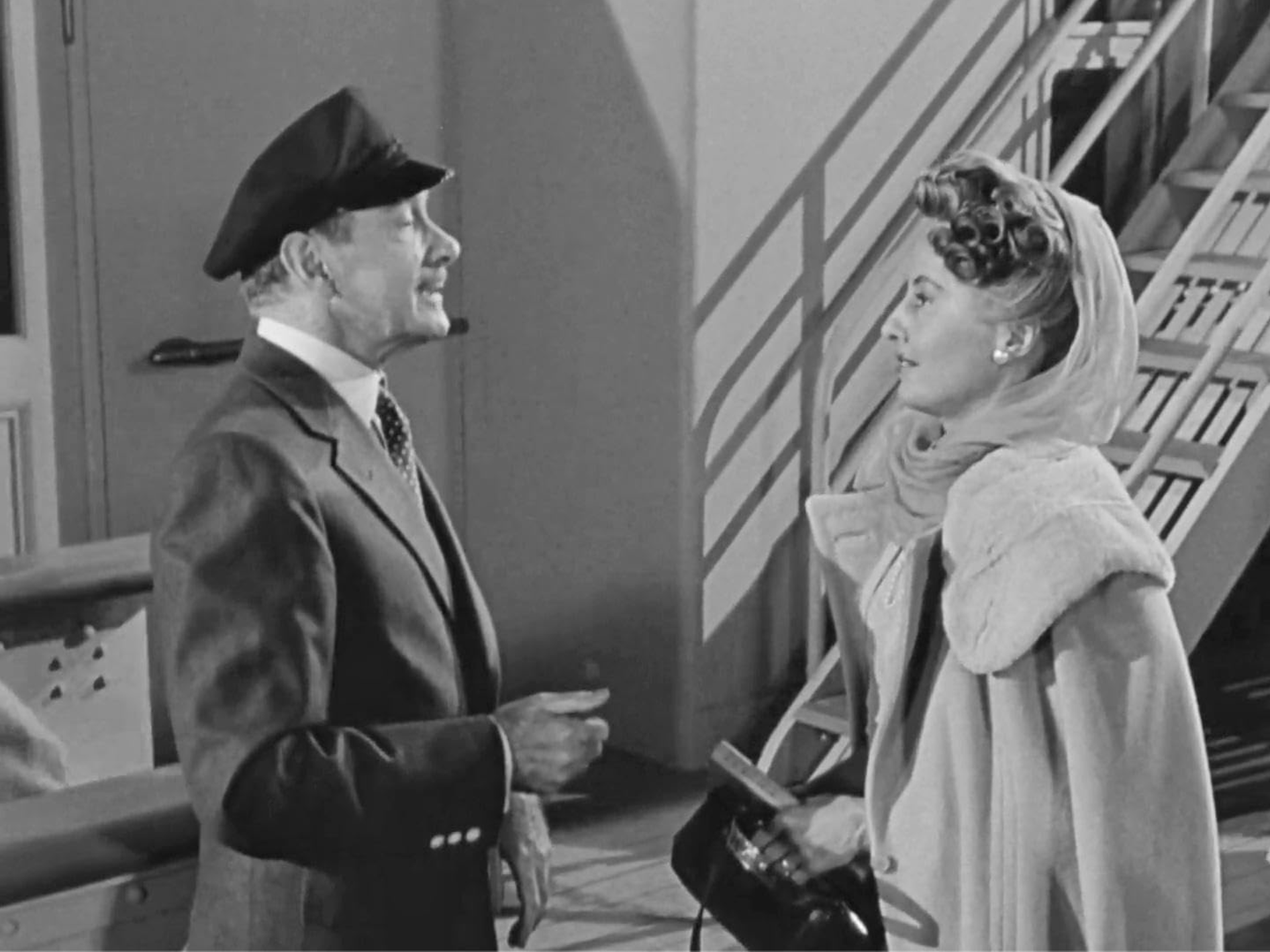
Clifton Webb and Barbara Stanwyck pretend not to argue. Image: IMDb
To date, there have been nearly 20 feature films about the Titanic, three of which were made in 1912, the year of the disaster. Rumour has it the first film was co-written by a survivor, released just 29 days after the vessel sank.
We just watched a version from 1953, titled, simply, Titanic, starring Clifton Webb and Barbara Stanwyck. The pair star as an unhappily married couple who are Done. Without telling her husband, Stanwyck’s character has packed up the children and boarded the Titanic to Start Over in America.
Webb plays a haughty, manipulative, and wealthy businessman who will not be outdone by anyone – even Barbara Stanwyck – and he wrangles his way aboard the vessel with the intention of returning his children to Europe.
We understand filmmakers put this miserable couple on the Titanic because the doomed ship is metaphoric of their relationship. But they aren’t the only passengers to which we’re introduced. We also meet a priest with a secret, a couple of Astors, and Thelma Ritter as a Montana mining magnate.
In the midst of this, director Jean Negulesco reminds us of European émigrés on the ship, as well as the personnel it takes to keep the thing afloat. We see wait staff, men shoveling coal, wireless operators, and officers navigating icebergs.
He presents the ocean as the equalizer between rich and poor, on this voyage to disaster.
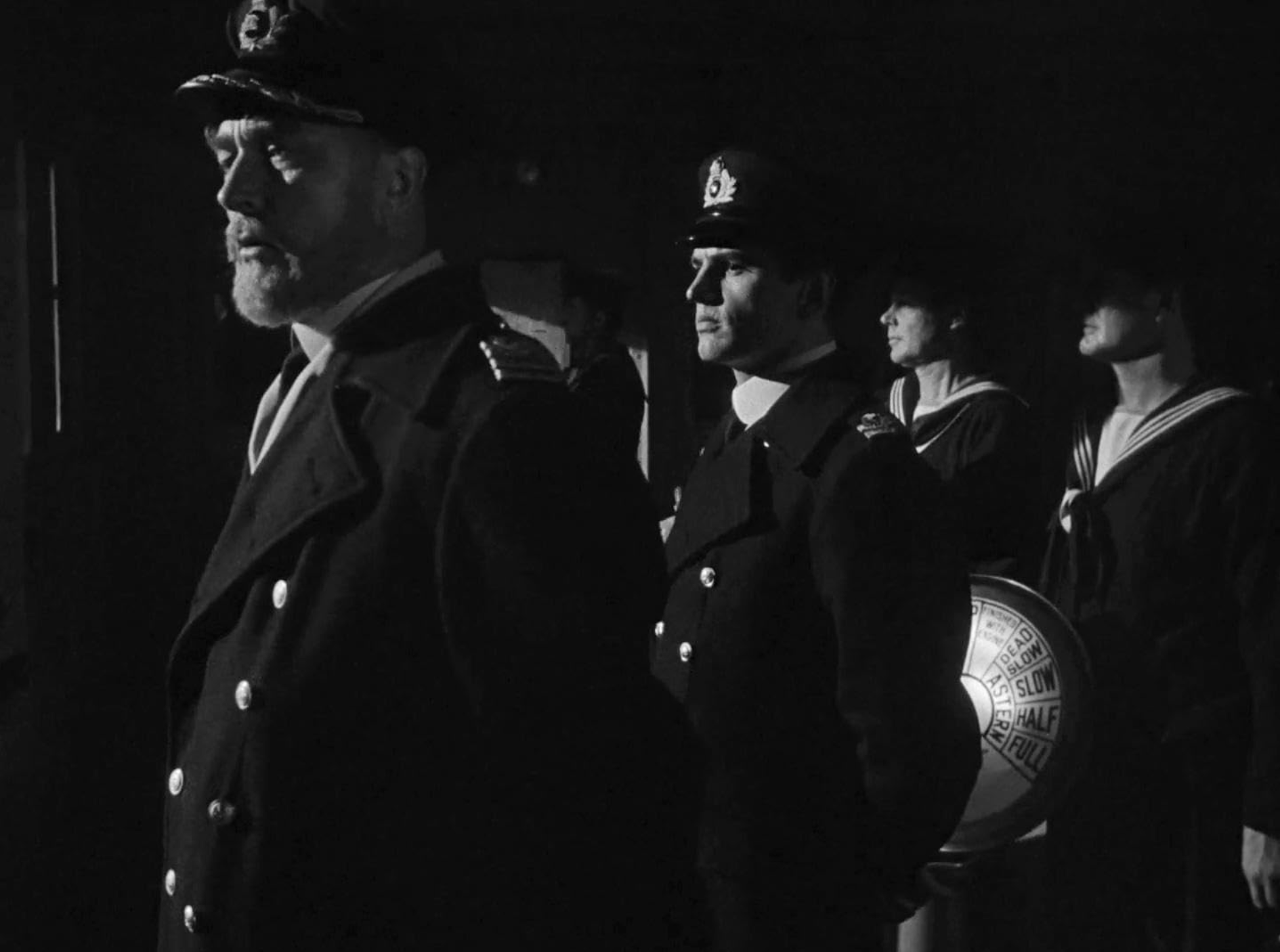
The captain in the moment of realization. Image: IMDb
The 1953 Titanic is an excellent film, and we feel a bit ashamed for having taken so long to see it. The script is thorough yet efficient; it never drags. It’s well cast, and the acting is even better.
Stanwyck and Webb seem, on the surface, an odd choice to play the fractious couple, but they convince us of their weariness for one other. Their arguments are smooth vitriol. “Twenty years ago I made the mistake of thinking I could civilize a girl who bought her hats out of a Sears Roebuck catalogue,” says Webb, and he could not be more disdainful.
Yet, both adore their children, although Stanwyck seems to have the more grounded parenting approach.
For example, on the first evening in the ship’s dining room, her spoiled daughter says, “Mamma, you should have protested. This is a really bad table. There’s not a person we know at this end of the room.” Stanwyck replies, “Be brave. Sometimes these tragedies happen in life.”
Our knowing the Fate of the ship increases our anxiety for these people. We subconsciously add meaning and foreshadowing to their words: Don’t they know they have such little time left? And: Who among them will survive?
Spoiler! Stanwyck’s character manages to escape in a lifeboat, and she gives us an exquisite moment. As the ship sinks, the orchestra begins to play, and she, hearing the music across the water, looks back at the Titanic with a mix of grief, disbelief, and horror.
This is one of many poignant moments in the film. Negulesco never gives the impression of exploiting his characters for spurious sympathy.
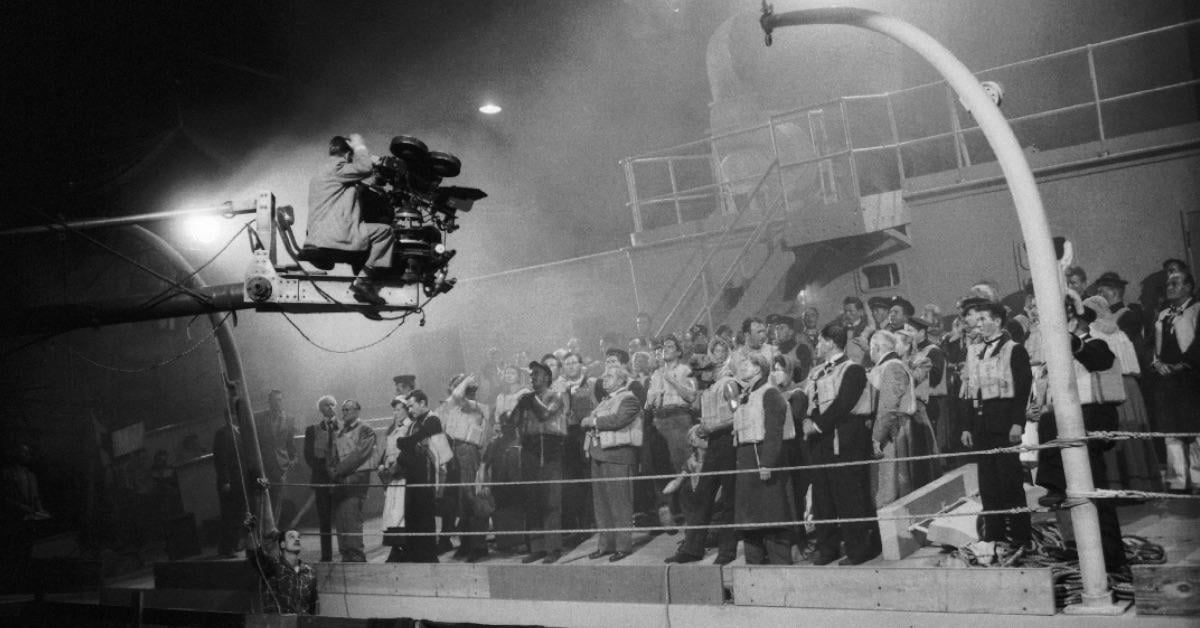
On the set of Titanic. Image: Reddit
Titanic (1953) has been criticized for historical inaccuracies. Filmmakers claimed the film was “60 per cent truth.”¹ The film defends itself with a title card: “All navigational details of this film – conversations, incidents and general data – are taken verbatim from the published reports of inquiries held in 1912…” Make of it what you will.
Stanwyck herself was struck by the scope of the tragedy whilst filming a scene in a lifeboat.
“The night we were making the scene of the dying ship in the outdoor tank at [the studio], it was bitter cold. I was 47 feet up in the air in a lifeboat swinging on the davits. The water below was agitated into a heavy rolling mass and it was thick with other lifeboats full of women and children. I looked down and thought: If one of these ropes snaps now, it’s goodbye for you. Then I looked up at the faces lined along the rail – those left behind to die with the ship. I thought of the men and women who had been through this thing in our time. We were re-creating an actual tragedy and I burst into tears. I shook with great racking sobs and couldn’t stop.”²
This film won an Oscar for Best Screenplay, and was nominated for Best Art/Set Decoration in Black and White.
If you haven’t seen this version of the Titanic story, we urge you to do so. It’s a disaster movie, yes, but also a thoughtful, underrated treasure.
Titanic starring Clifton Webb, Barbara Stanwyck, Robert Wagner. Directed by Jean Negulesco. Written by Charles Brackett, Walter Reisch & Richard Breen. 20th Century-Fox Studios, 1953, B&W, 98 mins.
Glad you enjoyed this one, Ruth. I think Clifton and Stany do some of their best work here. I agree with you about how we become so anxious for all of the characters knowing what they will all soon face.
Yay, read about this one in relation to Robert Wagner and Barbara Stanwyck’s off set relationship, but now I so want to see this movie – only seen them in their later roles, including Hart to Hart for him and The Colbys, The Thorn Birds etc for her…
Did they have any joint scenes…? As you know from my recent Christine review where Alain met Romy , as an incurable romantic, I do love looking for that (should be in italics) moment…
They did have a joint scene, where Wagner tries to not-so-subtily inquire about Stanwyck’s daughter, on whom he has a crush. I need to watch this scene again, now that I have new info…
Saw this one a while ago and remembered liking it. The marital drama angle was well done and the ending made me cry even though obviously anyone watching a Titanic movie knows how it’s going to end.
It’s been more than a minute since I saw this version of TITANIC, so it’s definitely time to experience it again. I found it heart wrenching to hear Barbara Stanwyck speak of her understandable breakdown during filming.
It would’ve been almost overwhelming to be re-enacting that scene, wouldn’t it? And all that effort to build the set, organize extras, etc. The production values are amazing, aren’t they? Hope you get the chance to see it again soon.
I saw this in my early teens, thirty years ago, and I honestly only really remember liking Thelma Ritter in it. Being more of a Stanwyck fan now than I was yet then, I should probably see it again. Lovely review!
Please tell me that the spoiled little girl went down with the ship! (Oh wait, did I write that out loud?) Seriously though, great art begins and ends with the emotions Stanwyck recalls in that quote. How is it that I, a huge Barbara Stanwyck fan, have not seen this film?
Great review! Barbara Stanwyck’s performance in this film is perfect, and I agree that there isn’t enough Thelma. Robert Wagner and Audrey Dalton were so cute together, too. So glad you could join the blogathon, Ruth. 🙂
Until this blogathon I hadn’t realised there were so many films about The Titanic. This sounds like one of the better ones and Barbara is always so watchable.







 Silver Screenings
Glad you enjoyed this one, Ruth. I think Clifton and Stany do some of their best work here. I agree with you about how we become so anxious for all of the characters knowing what they will all soon face.
LikeLiked by 1 person
Agreed. Their performances are pitch perfect. A truly remarkable and thoughtful film.
LikeLike
Yay, read about this one in relation to Robert Wagner and Barbara Stanwyck’s off set relationship, but now I so want to see this movie – only seen them in their later roles, including Hart to Hart for him and The Colbys, The Thorn Birds etc for her…
LikeLiked by 1 person
What? What’s this about an off-set relationship?
LikeLiked by 1 person
Did they have any joint scenes…? As you know from my recent Christine review where Alain met Romy , as an incurable romantic, I do love looking for that (should be in italics) moment…
LikeLike
They did have a joint scene, where Wagner tries to not-so-subtily inquire about Stanwyck’s daughter, on whom he has a crush. I need to watch this scene again, now that I have new info…
LikeLiked by 1 person
I remember seeing this 1953 Titanic a while ago as well. Found it while channel surfing one afternoon, great film.
LikeLiked by 1 person
It is a great film, isn’t it? Carefully and thoughtfully done.
LikeLiked by 1 person
Saw this one a while ago and remembered liking it. The marital drama angle was well done and the ending made me cry even though obviously anyone watching a Titanic movie knows how it’s going to end.
LikeLiked by 1 person
The ending is surprisingly sad, isn’t it? As it should be, I suppose.
LikeLike
Great review, Ruth!
It’s been more than a minute since I saw this version of TITANIC, so it’s definitely time to experience it again. I found it heart wrenching to hear Barbara Stanwyck speak of her understandable breakdown during filming.
LikeLiked by 1 person
It would’ve been almost overwhelming to be re-enacting that scene, wouldn’t it? And all that effort to build the set, organize extras, etc. The production values are amazing, aren’t they? Hope you get the chance to see it again soon.
LikeLike
Do her children make it to the boat with her? I haven’t seen it yet!
LikeLiked by 1 person
I can’t spoil it. There’s an unexpected twist in the last few minutes…
LikeLiked by 1 person
Ooh😳
LikeLiked by 1 person
I saw this in my early teens, thirty years ago, and I honestly only really remember liking Thelma Ritter in it. Being more of a Stanwyck fan now than I was yet then, I should probably see it again. Lovely review!
LikeLiked by 1 person
Thelma Ritter is criminally under-used in this film. I love her self-apprisal, basically, “I’ve got money, but I don’t have the face for it.”
LikeLike
Please tell me that the spoiled little girl went down with the ship! (Oh wait, did I write that out loud?) Seriously though, great art begins and ends with the emotions Stanwyck recalls in that quote. How is it that I, a huge Barbara Stanwyck fan, have not seen this film?
LikeLiked by 1 person
I asked myself the same question: How have I not seen this before? Ms Stanwyck is amazing here, as always. I hope you get the chance to see it soon.
LikeLike
Great review! Barbara Stanwyck’s performance in this film is perfect, and I agree that there isn’t enough Thelma. Robert Wagner and Audrey Dalton were so cute together, too. So glad you could join the blogathon, Ruth. 🙂
LikeLiked by 1 person
The casting here is perfect, isn’t it? Real pros, all of them.
LikeLike
Until this blogathon I hadn’t realised there were so many films about The Titanic. This sounds like one of the better ones and Barbara is always so watchable.
LikeLiked by 2 people
Agreed. I didn’t realize there were so many Titanic films either. I really liked this film. The casting is perfect.
LikeLiked by 1 person