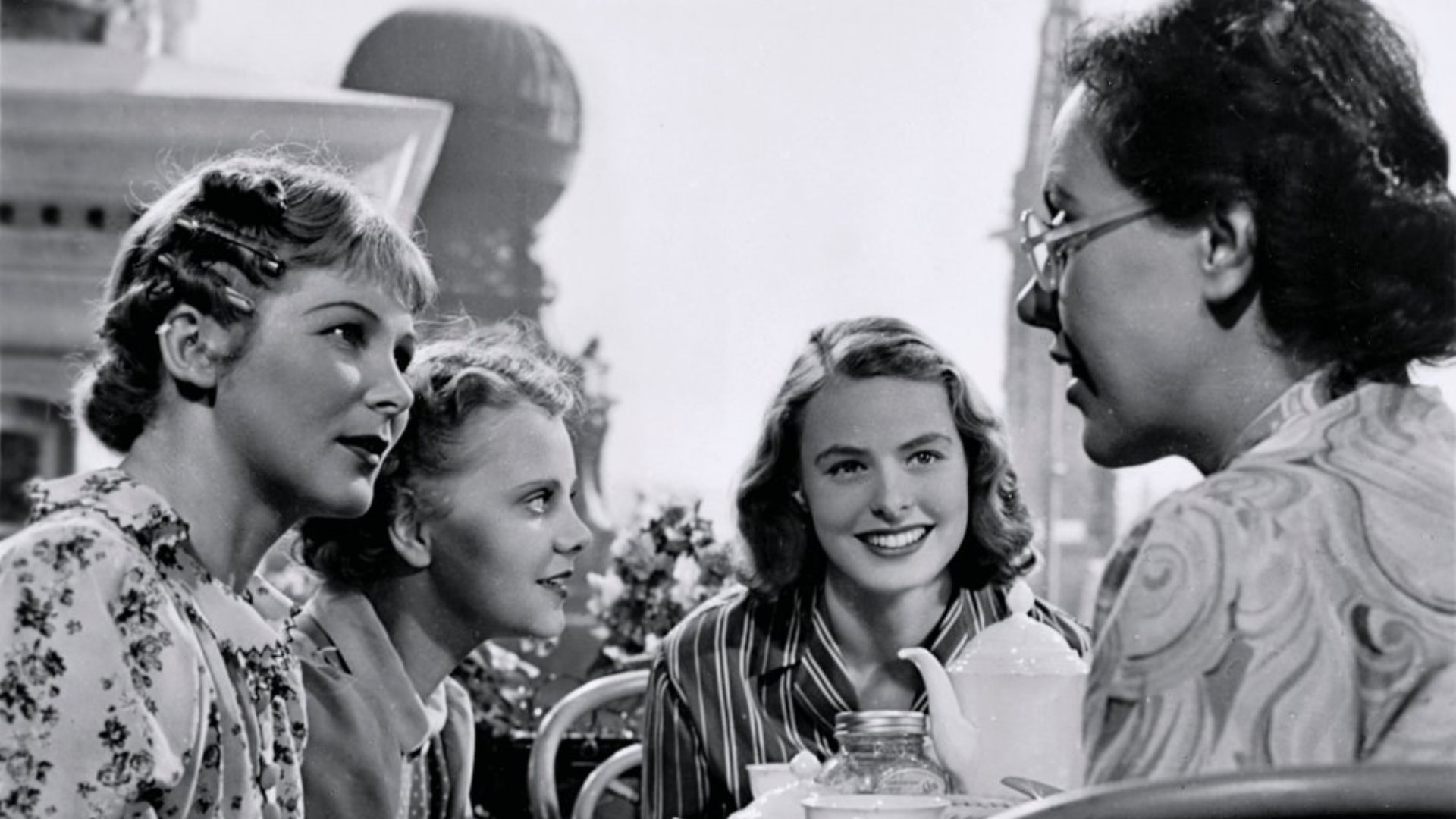
Ingrid Bergman and friends at breakfast. Image: Jerusalem Film Festival
In the 1930s, a young Ingrid Bergman went to Nazi Germany to make a romantic comedy.
The Four Companions (1938) is the tale of four female graphic design graduates who pool their resources to open their own marketing + promotions firm called The Four Companions. They start this business because they are unable to find employment elsewhere.
These are talented young women who work Day and Night to secure a big contract with a cigarette manufacturer based in Dresden. They win the contract, which enables them to produce all sorts of advertising materials and get paid handsomely in the process.
However. There’s more to the story.
Ingrid Bergman is the group’s leader. She organizes the office/living arrangements for the women – they live and work together in the same shared space, yuck – and she’s the Driving Force behind getting the cigarette contract.
Turns out Ingrid B. is a Slave Driver. Everyone must work hard, and no one is allowed to get married. Boyfriends are frowned upon because they often lead to marriage, and then where would we be?
Much to Ingrid’s chagrin, two of her companions meet men and fall in love, while the third is given the opportunity to exhibit her work at a prestigious art gallery. As a result, they resign, one after the other. So much for all that tobacco money.
But look at this: Ingrid herself has met a man, but she will not marry or become involved with him because Work Comes First.
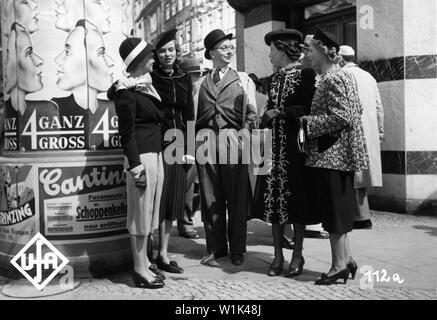
Ingrid is not marrying this man, no way. Photo by Ufa/Kobal/Shutterstock (5871145d)
You’re probably asking yourself: Why can’t these women work after they get married? Why did they have to quit their jobs?
In the 1930s, working outside the home wasn’t a thing married women did in Western countries. Jobs were hard to come by, and the prevailing theory was married women shouldn’t work when there were unemployed men.
There was more to it in Nationalist Socialist Germany, however. It was the leader’s belief that increasing the birthrate would lead to a more powerful country.
“On 5th July 1933 the Law for the Encouragement of Marriage was passed,” says the site, German Culture. “This act gave all newly wed couples a loan of 1000 marks which was reduced by 25% for each child they had. If the couple went on to have four children the loan was wiped out.”¹
The site goes on to say, “Three million women won a medal for having four or more children in 1939. It was thought to be particularly important to marry people who fit the physical ideal so that the German nation would remain pure.”²
The Four Companions neatly fits into this framework, where our heroines (A) struggle to find work and keep their firm afloat, then (B) struggle against marrying the men they love.
Circumstances continually work against our young women until they finally must give in to what their political leaders want them to do.
Clothes to wear when you hit the Big Time. Image: Alamy
An important aspect of this movie is Ingrid’s love interest. He was a professor at the vocational school she and her friends attended, and it wasn’t until after their graduation that he starts putting The Moves on her.
(He tells her his favourite dish, how his buttons need fixing, and that he loves a woman in a cute apron. This is courtship?)
Even so, this man’s, uh, charm weakens Ingrid’s resolve, and she finds herself marching to the altar.
Now, you’re probably also asking why Ingrid Bergman – who made a career playing independent-minded women – would make a film promoting Nazi domestic policies.
Ingrid was in her early twenties when she starred in this movie. She was already a film actress in her native Sweden; The Four Companions was meant to introduce her to German audiences.
However, it turns out an aspiring actor needed to be a member of the Nazi party, or have a Special Friend in the party, to have a film career. Once Ingrid realized this, she went back to Sweden and, as far as we can tell, never made another German film.
As for The Four Companions, it’s not a bad movie. It has beautiful production values, with some charming scenes and relatable characters.
We recommend this film as a glimpse at German society on the eve of WWII. Even though the German leader at the time reportedly didn’t like it, we encourage you to watch it and decide for yourself.
Die Vier Gesellen (The Four Companions) starring Ingrid Bergman, Carsta Löck, Sabine Peters. Directed by Carl Froelich. Written by Jocken Huth. Tonfilmstudio, 1938, B&W, 96 mins.
She is definitely beautiful, and believable as well. It’s too bad this film wasn’t made under different political circumstances, because it’s very well done.
It’s strange to think that Ingrid Bergman came close to becoming a Nazi star rather than a Hollywood star. She does look absolutely stunning here, as always.
So fascinating. I was just researching about pro-natalist policies in different countries now. How interesting to see them in this context–and the movie backing them up. Thank you!
Writing a memoir about not having kids. There are some fascinatingly weird pro-natalist policies. Your post reminded me I wasn’t looking into enough of their history.
As someone who works with graphic designers at my job, I’m curious to see that haha! But seriously it sounds like a very intriguing film and as always, you have a way to introduce us lesser-known film in a very entertaining and appealing way. I loved reading your article! And now I wonder if I shouldn’t make this my Ingrid Bergman film of the day… Do you know by any chance where I could find it? Anyway, thanks so much for participating in the blogathon!
There is a decent version on YouTube with English subtitles, happily. This is a truly intriguing film for a lot of reasons…but I fear you might think the graphic design aspect is farfetched and cringing. You’ll know what I mean when I see it.
This sounds like a fascinating movie – for the best and worst reasons. We all should be glad the Ingrid fled Germany quickly and became the international superstar we all know and love.
You said it, Le! Ingrid is fabulous in this movie, but it’s so unlike the films that made her a legend. If you get the chance to see it, I’d be glad to know what you think.
I watched the second half twice, because I was so angry at the end when she gave in. But I thought maybe I did not read the subtitles correctly. So I watched it once more.
Did it seem as if the man did come to understand her need/ want to succeed in business first? I might be less angry she gave in to him if he at least could finally see that
I do think he realized how driven & talented she was, but the politics of the day decreed he ought to be the boss and she ought to be to home building a stronger nation. I had difficulty figuring out what she saw in him.
This seems like one of those movies that you feel a little bit weird about watching but are intrigued by all the same because completionism. It still looks like an interesting part of Ingrid’s filmography.









 Silver Screenings
At least she was beautiful as always.
LikeLiked by 1 person
She is definitely beautiful, and believable as well. It’s too bad this film wasn’t made under different political circumstances, because it’s very well done.
LikeLike
Definitely worth watching just for the historical context!
LikeLiked by 1 person
I think so, too. It’s a fascinating historical document, if you can call it that.
LikeLiked by 1 person
It’s strange to think that Ingrid Bergman came close to becoming a Nazi star rather than a Hollywood star. She does look absolutely stunning here, as always.
LikeLiked by 1 person
It’s rather bizarre, isn’t it? Happily, she rejected stardom in that country at that time.
LikeLiked by 1 person
Never heard of this one. The historical context is certainly fascinating.
LikeLiked by 1 person
It really is. Such an unusual movie
LikeLiked by 1 person
Oops! Premature send. Anyhoo, it’s an unusual movie at an unusual time, especially for Ingrid. Well worth a watch for that alone.
LikeLiked by 1 person
It is interesting to read about this film. I just saw Ingrid in Cactus Flower and she’s a great comedienne.
LikeLiked by 1 person
She is, isn’t she? I have yet to see Cactus Flower.
LikeLiked by 1 person
So recommend it, writing up my review now.. so…
LikeLiked by 1 person
I also recommend Cactus Flower
LikeLiked by 1 person
I think I avoided it because I didn’t care for the fashions.
As shallow as that sounds…
LikeLike
So fascinating. I was just researching about pro-natalist policies in different countries now. How interesting to see them in this context–and the movie backing them up. Thank you!
LikeLiked by 1 person
Yeah, this movie is an excellent example of that. What prompted you to start researching these policies?
LikeLike
Writing a memoir about not having kids. There are some fascinatingly weird pro-natalist policies. Your post reminded me I wasn’t looking into enough of their history.
LikeLiked by 1 person
Disturbing too to see the policy paired with Nazism. I haven’t seen much of her very early work. I’ll have to catch it.
LikeLiked by 1 person
I hope you get the chance to see it. Ingrid B. is every bit the pro in this early film.
LikeLiked by 1 person
As someone who works with graphic designers at my job, I’m curious to see that haha! But seriously it sounds like a very intriguing film and as always, you have a way to introduce us lesser-known film in a very entertaining and appealing way. I loved reading your article! And now I wonder if I shouldn’t make this my Ingrid Bergman film of the day… Do you know by any chance where I could find it? Anyway, thanks so much for participating in the blogathon!
LikeLiked by 1 person
There is a decent version on YouTube with English subtitles, happily. This is a truly intriguing film for a lot of reasons…but I fear you might think the graphic design aspect is farfetched and cringing. You’ll know what I mean when I see it.
LikeLiked by 1 person
This sounds like a fascinating movie – for the best and worst reasons. We all should be glad the Ingrid fled Germany quickly and became the international superstar we all know and love.
Cheers!
Le
LikeLiked by 1 person
You said it, Le! Ingrid is fabulous in this movie, but it’s so unlike the films that made her a legend. If you get the chance to see it, I’d be glad to know what you think.
LikeLike
I watched the second half twice, because I was so angry at the end when she gave in. But I thought maybe I did not read the subtitles correctly. So I watched it once more.
Did it seem as if the man did come to understand her need/ want to succeed in business first? I might be less angry she gave in to him if he at least could finally see that
LikeLiked by 1 person
I do think he realized how driven & talented she was, but the politics of the day decreed he ought to be the boss and she ought to be to home building a stronger nation. I had difficulty figuring out what she saw in him.
LikeLiked by 1 person
This seems like one of those movies that you feel a little bit weird about watching but are intrigued by all the same because completionism. It still looks like an interesting part of Ingrid’s filmography.
LikeLiked by 2 people
It is interesting, and there are some touching and funny scenes. The acting is top-notch. But still – a bit weird.
LikeLiked by 1 person
Yeah, looks like it. Oh well. 🙂
LikeLiked by 1 person