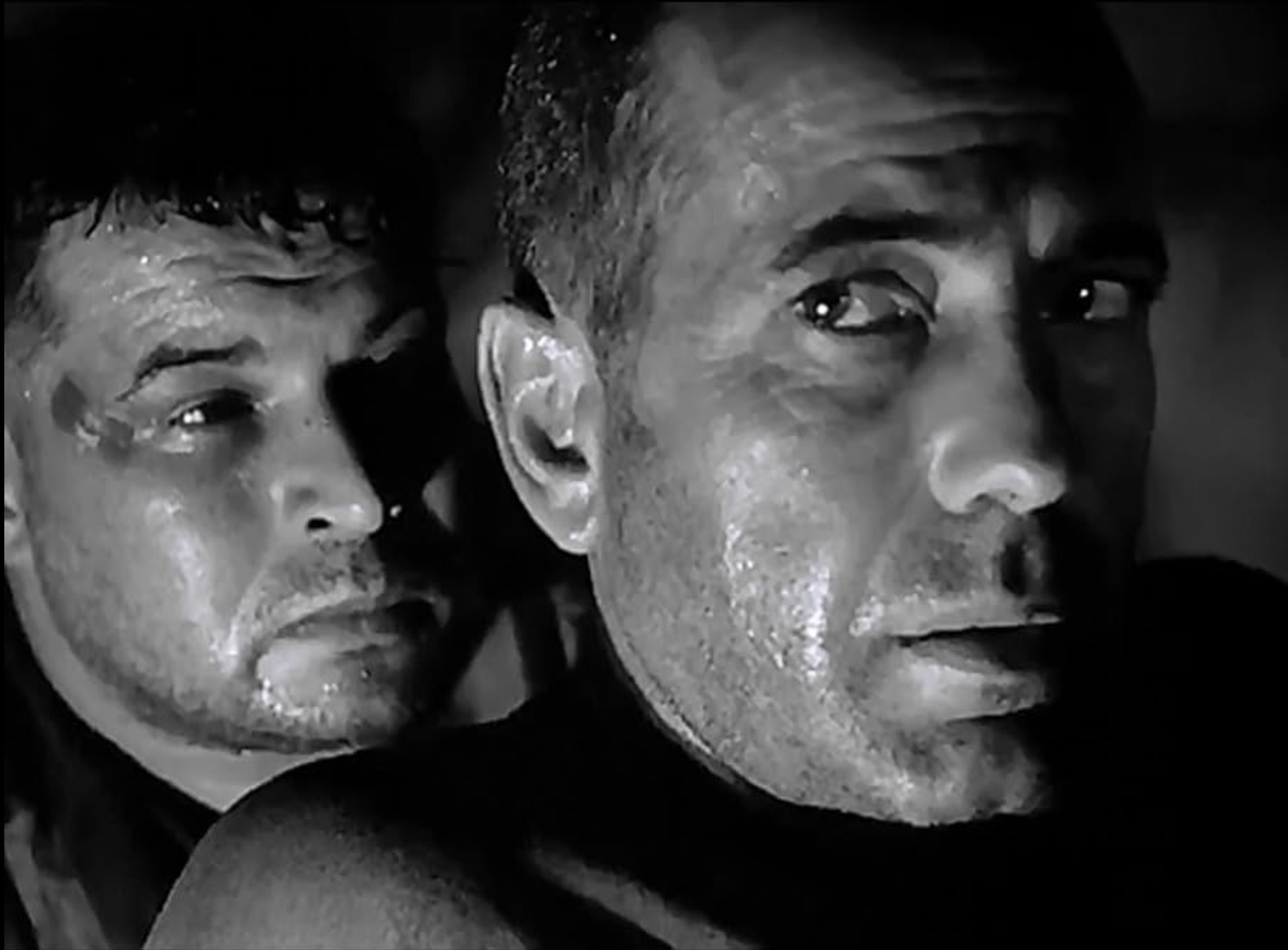
Humphrey Bogart as a prisoner on Devil’s Island. Image: IMDb
Once upon a time, the most notorious prison in the world was a French penal colony known as Devil’s Island.
Devil’s Island was actually three islands off the coast of French Guiana. In the 1700s, it was a refuge for people afflicted with yellow fever, but when Napoleon III came to power in France in 1852, he designated the islands as a penal colony.
Napoleon III’s political enemies were sent there, along with the worst criminals in France – at least in principle. Some men were murderers, while others were accused of petty crimes, and some were innocent, such as Alfred Dreyfuss.
It’s hard to imagine a worse place to be imprisoned, with malaria-infected mosquitoes, vicious guards, skimpy rations, and grueling labour. Prisoners were tasked with building a road to nowhere in the heat of the jungle, and the death toll was staggeringly high.
This infamous penal colony officially closed in 1953.
Warner Bros., a studio that rarely shied away from real-world nastiness, produced a WWII film that took place, in part, on Devil’s Island. The film, Passage to Marseille (1944), is about a group of convicts who escape the colony to return to Marseille to fight against the threat of German occupation. The film takes place in the weeks before France capitulated to Germany.
The convicts’ escape from Devil’s Island is remarkable in itself, but what’s even more remarkable is the desire of five men, exiled by their government, to defend the country that condemned them.
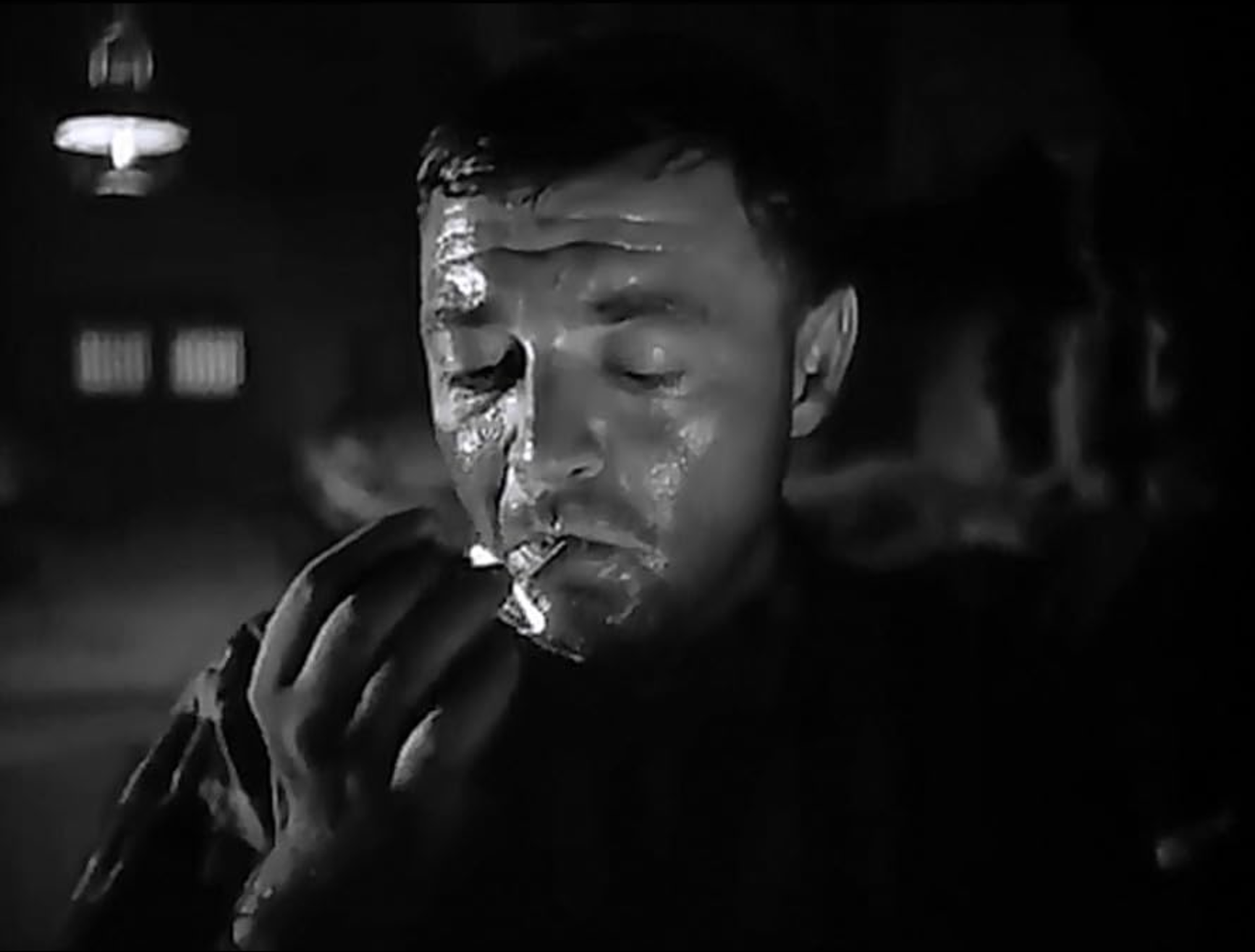
Peter Lorre lives by his own rules. Image: IMDb
Humphrey Bogart stars as the group’s leader, with Claude Rains as a French captain who joins their cause post-escape.
Sidney Greenstreet is here, too, as a Vichy-esque commandant who can’t wait to return to Marseille to cozy up to Nazis. (His appraisal of the escaped convicts is, “A more depraved and desperate set of individuals cannot be found.”)
Peter Lorre also stars, and this is our favourite Lorre role. He is an insouciant prisoner, a former thief/safe cracker who seems untouched by the camp’s brutal conditions. He’s disdainful and mockingly obsequious; his whole demeanor is a middle finger to authorities.
Also, he’s genuinely handsome, thanks to the cinematography of James Wong Howe.
Howe’s cinematography makes the film look surprisingly modern. Camera angles are fresh and innovative, and the lighting is breathtaking. You almost want to watch the film a second time just to study it.
You need this kind of talent for a movie seeped in humid wretchedness. Howe’s camera makes you feel the hot oppression of the jungle*, while giving you clues to each character’s frame of mind.
Two of the five convicts are murderers, while Bogart is, essentially, a Political prisoner. He’s accused of inciting a deadly riot when his newspaper prints a rebuke to the French government re: the 1938 Munich Agreement. (This agreement, signed by Italy, Great Britain, and France, allowed Germany to occupy the Sudetenland in Czechoslovakia.)
Interestingly, Bogart’s character arc is the opposite to those of the murderers. The killers become reformed and compliant, while Bogart forges an anger as hard and dangerous as iron.
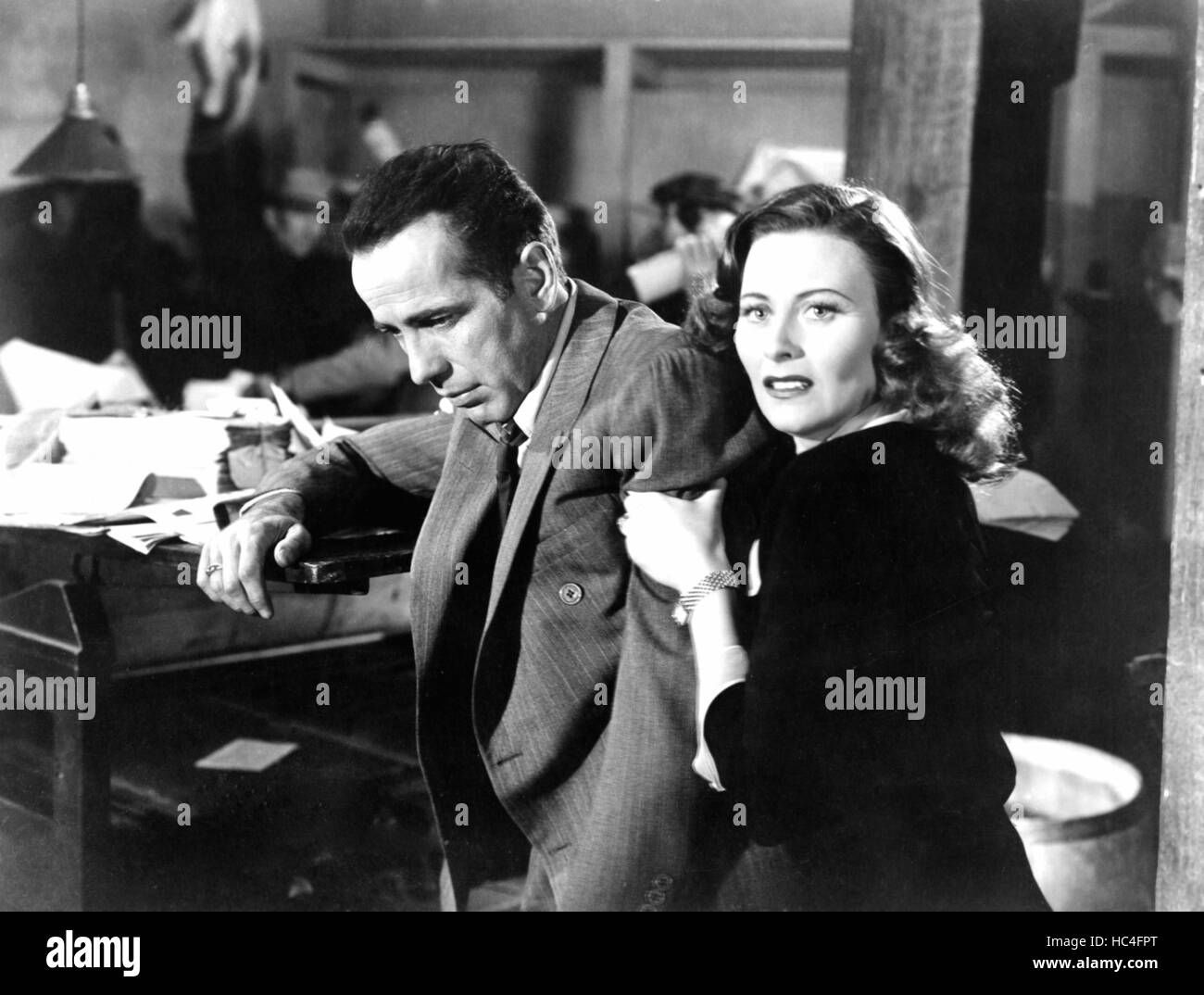
Michèle Morgan realizes Bogart is in deep doo-doo. Image: Alamy
Passage to Marseille is told in three flashbacks nestled inside each other, and the effect is like being submerged deeper under water, until you’re pulled back out to breathe again in the present day narrative.
This multi-flashback method has been criticized for being Too Much, but we (yours truly) think it’s marvelous. You learn more about these characters than you’re actually being told because you see where they are at key events in the story.
There are some terrific lines in this script. Claude Rains is delightful when he offers liquor to the tight-lipped convicts: “One cannot tell a glib story with a dry tongue.” Yet, in another scene, a bitter, seething Bogart snarls, “Decadent France! A country that gives birth to a bunch of rotten fascist panderers.”
We see themes of family, camaraderie, and self-sacrifice in this film. But none of these resonate as loudly as the desire to fight for one’s country, in spite of everything.
Our question to you this Remembrance Day is this: Would you fight for a country that condemned and exiled you?
Passage to Marseille starring Humphrey Bogart, Claude Rains, Michèle Morgan. Directed by Michael Curtiz. Written by Casey Robinson & Jack Moffitt. Warner Bros., 1944, B&W, 109 mins.
*The jungle scenes were shot in an arboretum and a botanical garden in California.
Thank you for reviewing this film for Remembrance Day Ruth. I’m a big fan of Passage to Marseille, and not just because that was the city of my birth. American patriotic films about France are rare, and this one manages that while still dramatizing the complex political and military issues that caused the mess during WW II. The cast is perfect also, with one of only two films that I know of that has Lorre in a good role. And as you point out, the flashbacks build the story and characterization that make this a great film. Christian, silverscreenmodes.com
The cast alone is enough for me to want to see this one. I’m interested in anything with Lorre, though my trek through his filmography is far from complete. And Claude Rains has that distinctive voice—both The Invisible Man and Phantom Of The Opera!—that elevates any dialogue.
Peter Lorre is a revelation in this movie. It’s my fave of his roles. And you’re 100% right about Claude Rains elevating any dialogue. He never disappoints, does he? Anyway, I hope you get the chance to see this. It’s well worth it.







 Silver Screenings
I’ll look for this on TCM. I haven’t seen it.
LikeLiked by 1 person
It’s really good. I love the wild flashbacks.
LikeLiked by 1 person
Thank you for reviewing this film for Remembrance Day Ruth. I’m a big fan of Passage to Marseille, and not just because that was the city of my birth. American patriotic films about France are rare, and this one manages that while still dramatizing the complex political and military issues that caused the mess during WW II. The cast is perfect also, with one of only two films that I know of that has Lorre in a good role. And as you point out, the flashbacks build the story and characterization that make this a great film. Christian, silverscreenmodes.com
LikeLiked by 1 person
Thanks for stopping by, Christian. This film juggles a lot of pieces, and does it expertly. And I absolutely love Peter Lorre in this film.
Marseille looks like such a beautiful city. Did you grow up there?
LikeLike
Personally, I love flashbacks 😊
LikeLiked by 1 person
Me too. The more the merrier!
LikeLiked by 1 person
I am watching this today. You have brought me so many movies I have not seen!
LikeLiked by 1 person
Excellent! I’m curious to know what you think about the unusual flashbacks.
LikeLiked by 1 person
I usually do not like flashbacks. Marvelous movie, it felt as it I were there
LikeLiked by 1 person
Yay! I glad to hear it. It’s a gem of flick that doesn’t get a lot of love these days.
LikeLike
The cast alone is enough for me to want to see this one. I’m interested in anything with Lorre, though my trek through his filmography is far from complete. And Claude Rains has that distinctive voice—both The Invisible Man and Phantom Of The Opera!—that elevates any dialogue.
LikeLiked by 3 people
Peter Lorre is a revelation in this movie. It’s my fave of his roles. And you’re 100% right about Claude Rains elevating any dialogue. He never disappoints, does he? Anyway, I hope you get the chance to see this. It’s well worth it.
LikeLike