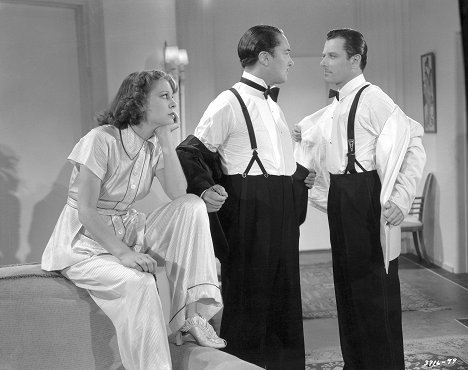
Anne Nagel is the axis of a love triangle. Image: CSFD.cz
The best thing about 1930s screwball comedies is the practical solutions they offer for everyday problems.
Look at A Bride for Henry (1937). Not only is it an excellent guide for choosing a marriage partner, it has useful advice on getting back at your fiancé.
Before we delve further into this business of revenge, there are a few prerequisites:
wealth.
youth and beauty.
no real demands on your time.
an expectation of the world to rearrange itself to suit you, and it does.
Such are the people of the 1930s screwball comedies, where wit is sharp, costumes are smooth, and escapades are deliciously over the top.
A Bride for Henry is a delightful example of the screwball-romantic comedy. Sheila (Anne Nagel) is a woman who’s been left at the altar by her fiancé. Get this: It ain’t the first time this swine has skipped their wedding!
But she’ll get even, our Sheila. She’ll show that good-for-nothing fiancé she’ll not be made a chump of in front of her wedding guests, again. She sends her mother downstairs to fetch Henry (Warren Hull), the young and handsome family lawyer, and she tells Henry they’re getting married.
Poor Henry is smitten with our heroine, and he eagerly accepts her proposal.
The two embark on a honeymoon at a holiday resort, but the marriage is in Name Only. Henry is ready to forsake all for his bride, but our Sheila still fancies herself in love with Eric (Henry Mollison), the man who jilted her.
But wait! There’s more:
Eric wants Sheila to leave Henry, but will he follow through with marriage?
Sheila starts to fall in love with Henry.
Henry runs into an old girlfriend whilst on his fake honeymoon, and they rekindle their friendship.
The old girlfriend adores Henry.
That’s a lot of romantic adventure in a 58-minute film, and for most of that time we the audience wonder these people see in each other.
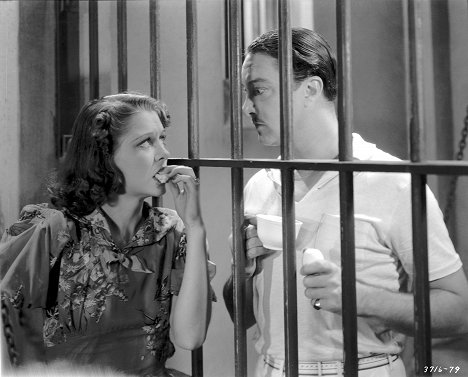
A sheriff asks Sheila the question we’d all like to ask. “What I don’t understand, young woman,” he says, “is why you go around with a sap like this when you have a nice husband like [Henry].”
A picnic lunch in jail. Image CSFD.cz
Let’s get back to Revenge of the Fiancé.
Sheila’s plan looks feasible on paper, we suppose. She wants to make Eric the cad as jealous as possible and, after she wins him back, she’ll divorce Henry.
Her message to Eric: I don’t need you, look at what you’re missing, I can marry anyone I want.
The problem is, though, Sheila is spoiled and selfish, and doesn’t Think things Through. While she’s on fake honeymoon with Henry, she sight-sees with Eric, dines with Eric, and dances with Eric. Eric, Eric, Eric!
Henry, naturally, does his best to make Sheila jealous of him, and it’s working. He’s beating her at her own game.
Meanwhile, all this gallivanting is scandalizing guests at the holiday resort. After all, it’s not every day you see newlyweds openly flirt with others.
Incidentally, this is one of the ways screwball comedies thumb their nose at the production code. For instance, married couples sort of have affairs and start divorce proceedings, but things are never taken Too Far.
The surprising thing about A Bride for Henry is not the public cavorting. It’s the decidedly pro-marriage stance. The flouting of convention paves the way for serious matrimony.
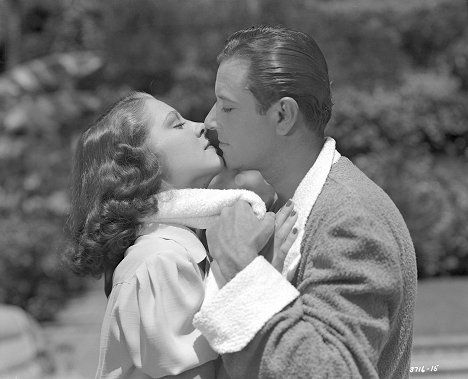
Henry woos his wife. Image: CSFD.cz
A Bride for Henry was produced by Monogram Pictures, one of the indie film studios located on Grover Street in Los Angeles, known as Poverty Row. These studios specialized in quickly made, low-budget movies.
Poverty Row studios produced westerns, comedies, crime, and horror flicks, often shown as part of a double feature with a film from a major studio. They say Monogram itself made an astonishing 40-50 movies per year in the late 1930s-40s.
A Bride for Henry was shot in about two weeks, and it was based on a short story published in Liberty magazine earlier that same year. This quick turnaround underscores the efficiency and skill of Monogram filmmakers. The prolific William Nigh directed the film from a script written by Marion Orth, a woman who joined Monogram in 1934 as a screenwriter.
Have you seen A Bride for Henry? If not, we hope you can set aside an hour to watch this charming, fast-paced comedy.
This post is part of the MAKE ‘EM LAUGH BLOGATHON, hosted by the Classic Movie Blog Association.
A Bride for Henry starring Anne Nagel, Warren Hull, Henry Mollison. Directed by William Nigh. Written by Marion Orth. Monogram Pictures, 1937, B&W, 58 mins.
Oh, I’m glad you found it a fun time. I thought the cast was terrific, and there were some very witty lines. What’s not to love about the outrageous shenanigans of a screwball comedy, right?
I really like this gem of a movie. Great pacing and script, fabulous cast, and beautiful scenery in the exteriors. Honestly, it deserves to be more well known.
You had me at: “Such are the people of the 1930s screwball comedies, where wit is sharp, costumes are smooth, and escapades are deliciously over the top.” That is such wonderful writing! This film sounds delightful and I can’t wait to watch it. Thanks for sharing it with us.




I like Sheila’s style! This sounds like a lot of fun.
This is a new one to me. Thanks so much for the intro, Ruth.
LikeLiked by 1 person
I think you’ll like this one, Maddy. You have to admire the truly efficient filmmaking here.
LikeLiked by 1 person
This does sound like fun Ruth! Thanks for the introduction…
LikeLiked by 1 person
This is a fun romp with fabulous on-location scenery. I think you’d get a kick out of it!
LikeLiked by 1 person
A Bride for Henry was a brilliant wacky and fun comedy! Great choice!
LikeLiked by 2 people
Isn’t it a fun movie? I wish I’d discovered it sooner.
LikeLiked by 2 people
This was a great deal of funfun. I’m glad you suggested it
LikeLiked by 2 people
Oh, I’m glad you found it a fun time. I thought the cast was terrific, and there were some very witty lines. What’s not to love about the outrageous shenanigans of a screwball comedy, right?
LikeLiked by 2 people
especially in hard times
LikeLiked by 1 person
Thank you! Sounds like a perfect lazy-day film, doesn’t it? I’m in.
LikeLiked by 2 people
Yup, you’re exactly right. Perfect for a rainy, lazy weekend afternoon. (Which, come to think of it, is when I ended up watching it.)
LikeLiked by 2 people
This movie sounds fun! Poverty Row is quite the place, too.
LikeLiked by 2 people
I really like this gem of a movie. Great pacing and script, fabulous cast, and beautiful scenery in the exteriors. Honestly, it deserves to be more well known.
LikeLiked by 1 person
Might be worth watching just to see Anne Nagel. Never heard of her, but she is a cutie…
Quiggy
LikeLiked by 1 person
And she is truly funny. She reminds me a little of Carole Lombard.
LikeLike
You had me at: “Such are the people of the 1930s screwball comedies, where wit is sharp, costumes are smooth, and escapades are deliciously over the top.” That is such wonderful writing! This film sounds delightful and I can’t wait to watch it. Thanks for sharing it with us.
LikeLiked by 2 people
This movie is a fun ride, and very well done. That Monogram Studio hired top-notch talent for this one.
LikeLiked by 1 person
What a fun article! I feel like this is a kind of film I would immensely enjoy. The pacing sounds quite dynamic, as a screwball comedy should be!
LikeLiked by 2 people
Yup, the pacing here is brisk, but doesn’t feel rushed. The tempo is perfect, in my opinion.
LikeLiked by 2 people
Love a good screwball. And Poverty Row gems too. Will check this one out, loved your post.
LikeLiked by 2 people
Thanks! I think you’d get a real kick out of this one.
LikeLiked by 1 person