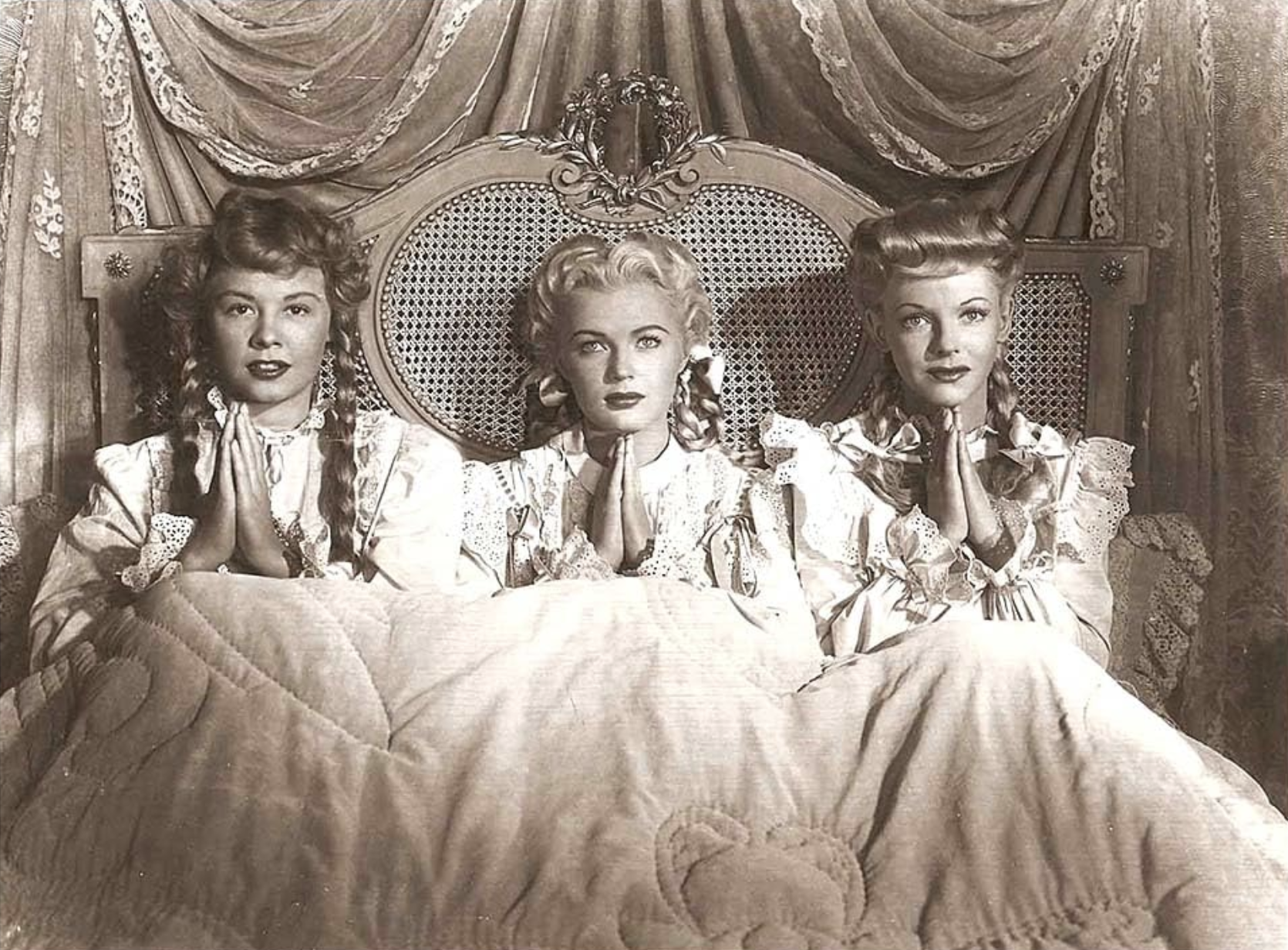
Three saintly, but inept, gold diggers. Image: IMDb
Flirtatious people in movies often get a bad rap, but sometimes these folks can right social wrongs.
Look at Three Little Girls in Blue (1946), a musical about three sisters stuck on a chicken farm. These gals remain perfectly coiffed despite the eggs, feathers, and muck of the poulty biz, but never mind. They do their best with the inheritance left by a deceased aunt.
The truth is, they cannot stand the chicken farm, and you can’t blame them. They’re young women who want to See The World. When their lawyer arrives with a meagre inheritance cheque, they realize it’s just enough to get them off the farm.
Now, they could invest the funds in bonds or real estate, but no. Their better idea is to spend it on clothes, shoes, and jewellery, so at least one of them can snare a millionaire. According to Hollywood economics, if one of ’em marries rich, they’ll all end up rich.
But you can’t trap wealth if you ain’t dressed for it. You also have to rent a lavish suite in Atlantic City where the smart money parks itself for the summer. To get in on the action, one of the sisters poses as a Woman of Means, while the other two pretend to be (1) her secretary and (2) her maid.
We’ve seen this caper before, in Moon Over Miami (1941), which is a remake of Three Blind Mice (1938), a film adaptation of the stage play. And we would see this enduring Hollywood concept again in How to Marry a Millionaire (1953).
Three Little Girls in Blue (a title so cringing we can barely stand to type it) is set at the turn of the twentieth century, and no expense was spared on wardrobe or curtain fabrics. Every cast member looks utterly fab in this lavish environment.
Turns out our carefully coiffed-and-clad heroines meet men easily enough but, alas, are not able to land them, which means they need a Flirting Superhero to save the day.
Fortunately for all of us, Celeste Holm arrives just in time to Set Things Right.
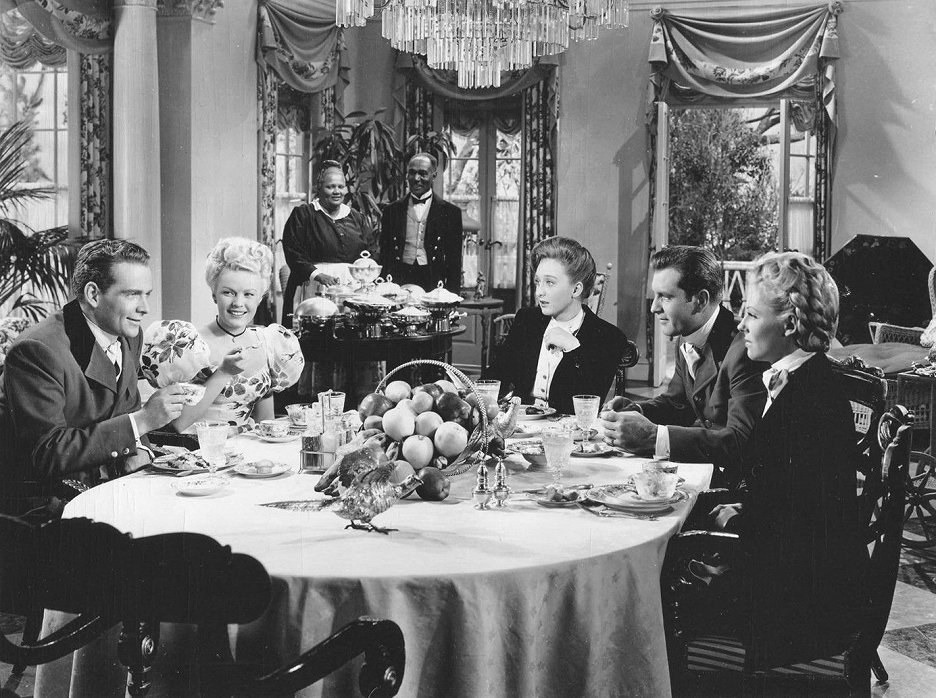
Celeste Holm (seated centre, right) wonders how everyone could be so dense. Image: csfd (dot) cz
Holm’s character is sister to one of the commitment-avoidant men in Atlantic City. When our trio of hapless females visit her family’s estate, it takes her less than four seconds to determine the best matrimonial match for her brother. Then she gets to work.
Let’s back up a bit. Holm doesn’t parachute into this movie for over an hour, yet, happily, things are not the same after she arrives. Here’s how it works:
Holm’s character flirts with every man in the vicinity, young or old, married or single. We believe she could seduce any man, but she doesn’t. Just knowing she could is enough.
Holm conceals her strategy, to give others plausible deniability. She reads people; she knows the personalities involved and how they’ll react, and she sallies forth accordingly.
She has unassailable confidence in (A) her judgment and (B) her flirting powers, and things naturally fall into place.
People depend on Holm’s breezy repartee and glib attentions. Here is a woman with Power, but doesn’t weaponize it.
Our three gold diggers are so ineffective, they’d have gotten nowhere had Holm not taken charge. Holm doesn’t have to help them – she doesn’t have to help anybody – but she does, because she secretly has a Heart o’ Gold.
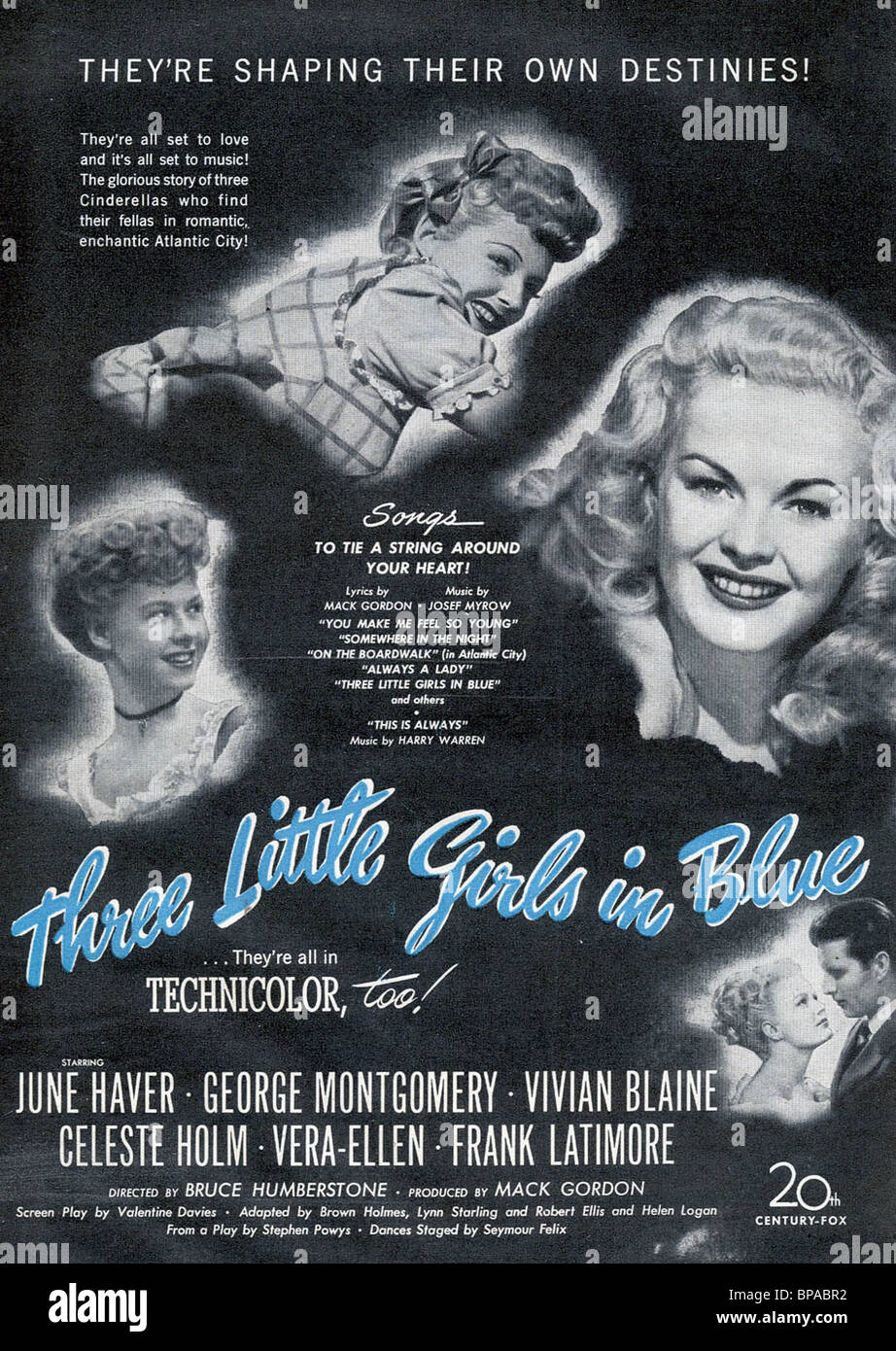
“They’re shaping their own destinies,” says the poster. Puh-lease. Image: Alamy
Celeste Holm studied acting at the University of Chicago and made her first appearance on Broadway at the age of 19. This film is her Hollywood debut, yet you’d never know it because she has that much charisma.
According to Wikipedia, this film cost $2.4 million* US to make, and was one of the few films that earned over $3,000,000 US** for 20th Century Fox that year.
Wikipedia also says that in the mid-1940s, turn-of-the-century themes were popular for musicals, which may be the reason this story was set in 1902. If you look at lists of top-grossing musicals of the mid-1940s, you’ll notice how many are set during, or before, WWI.
We’re remiss in telling you Vera-Ellen, the popular actress/dancer of the day, stars as one of the sisters. She has some marvellous dance scenes, along with an excellent stunt where the three sisters somersault over the back of a couch.
Should you see Three Little Girls in Blue? We think so. It’s a bit of light amusement that roars into high gear once Celeste Holm kicks open the door. She and Vera-Ellen elevate what might otherwise be a pleasant, but forgettable, musical.
Three Little Girls in Blue starring June Haver, George Montgomery, Vivian Blaine. Directed by H. Bruce Humberstone. Written by Valentine Davis (& 4 other writers) 20th Century Fox, 1946, Technicolor, 100 mins.
*Approx. $40.3 million US today. **Approx. $51.8 million US today.