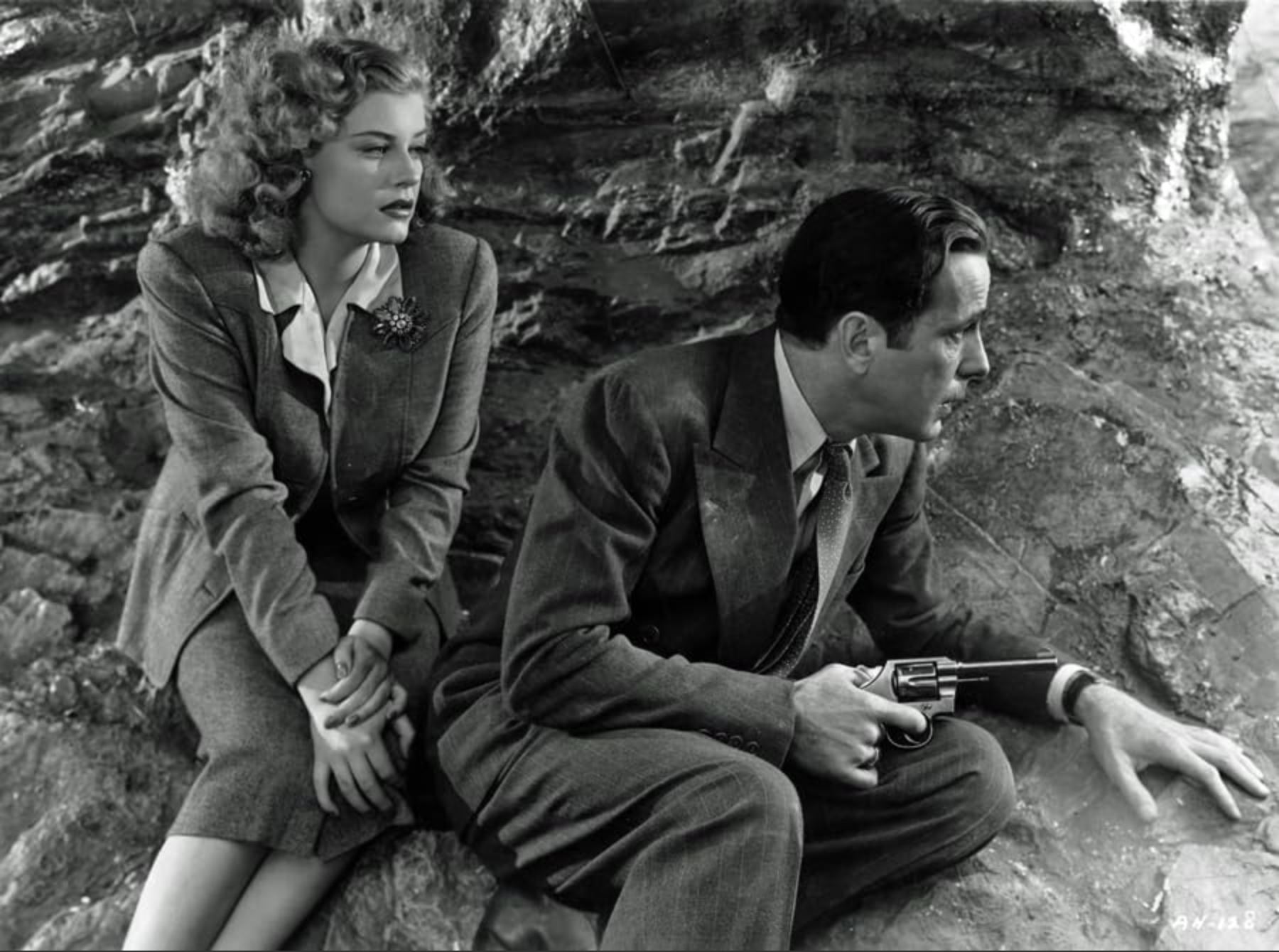
Humphrey Bogart with mysterious Kaaren Verne. Image: IMDb
All Through the Night (1942) is a comedy-gangster flick about a turf war in New York City.
The war is between fast-talking mobsters, who are used to getting their way in New York, and German Nazis, who are used to getting their way everywhere else.
Humphrey Bogart stars as a gangster boss nicknamed “Gloves”. We can’t help but like Gloves because he returns his mother’s phone calls, supports small business, and is fair to employees in his racketeering ventures. A gem of a mobster if ever there was one.
Bogart’s nemesis is Conrad Veidt, a German intellectual who uses an art auction house as a front for Nazi Activities. He’s smug, arrogant, and filled with disdain for America and inhabitants.
He also sees Bogart’s racketeering schemes for what they are, and is quick to point out the gangster’s hypocrisy. In his most chilling Conrad-Veidt voice, he asks Bogart why they shouldn’t Join Forces.
“You take what you want, and so do we,” he says. “You have no respect for democracy, neither do we. It’s clear we should be allies.”
This statement nicely summarizes the theme of this film: Power, which includes political power and the power of language.
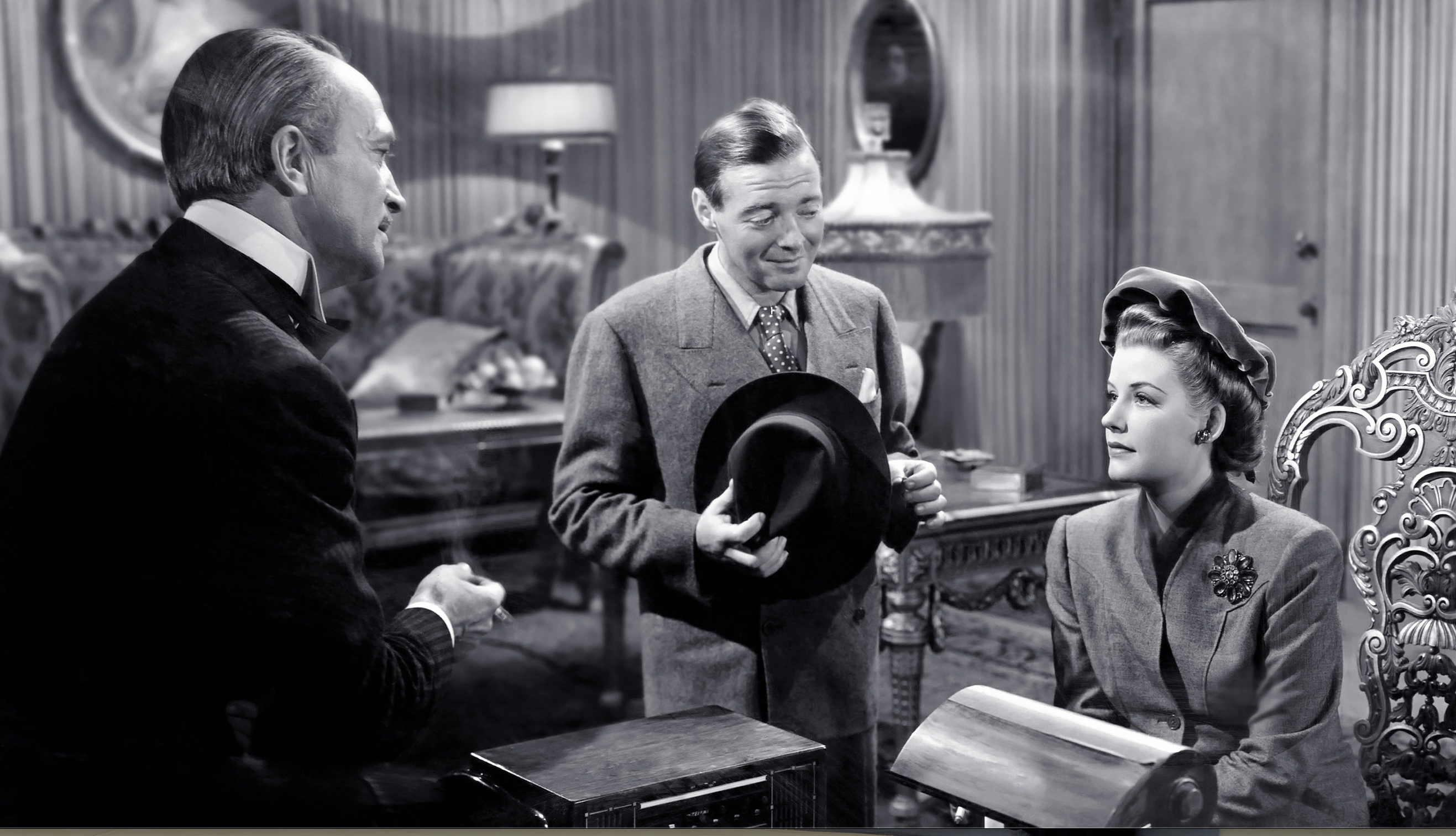
Conrad Veidt (L) and Peter Lorre plot to overthrow Americans. Image: Rotten Tomatoes
Who has the right to Power?
Do Bogart’s gangsters deserve power? They have determination, and they love their country. But that’s a weak argument, because Veidt’s Nazis also have determination, and they love their country, too.
Politics is a brutal sport, where the winner is often the most brutal of all. The film does not share the ugly details of how Bogart or Veidt gained their power, yet we cheer for Bogart & Co., because (A) they’re charming crooks, and (B) Humphrey Bogart.
However, gangsters – like Nazi occupiers – are not elected officials, and the average New Yorker will end up paying for either party’s Quest for Power, one way or another.
It’s not lost on us that New York, in this film, is a metaphor for the whole of North America, at a time when the threat of Nazi occupation was real.
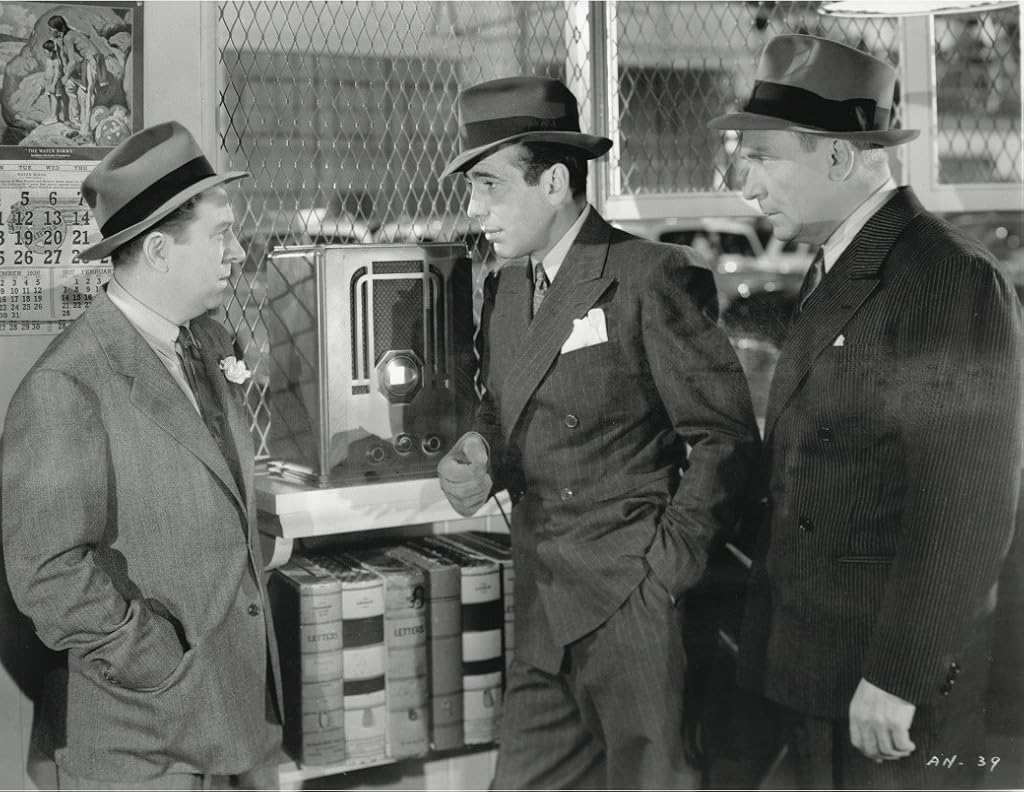
Bogart and the Boys. Image: IMDb
Nevertheless. All Through the Night is a very funny film, with Runyonesque* characters and dialogue. The one-liners are quick; one is barely out the door before the next sprints in.
The writing is so clever, in fact, that action sequences drain momentum from the wit. The script shows us the power of language without being heavy-handed.
One example is a scene with gibberish double talk, meant to confuse attendees at a Nazi meeting. The idea doesn’t look like much on paper, but on screen it’s a lot of fun. Producer Hal Wallis wanted to delete the scene, but director Vincent Sherman left part of it for preview audiences. Movie-goers loved what they saw, so Wallis told Sherman to put it back in.
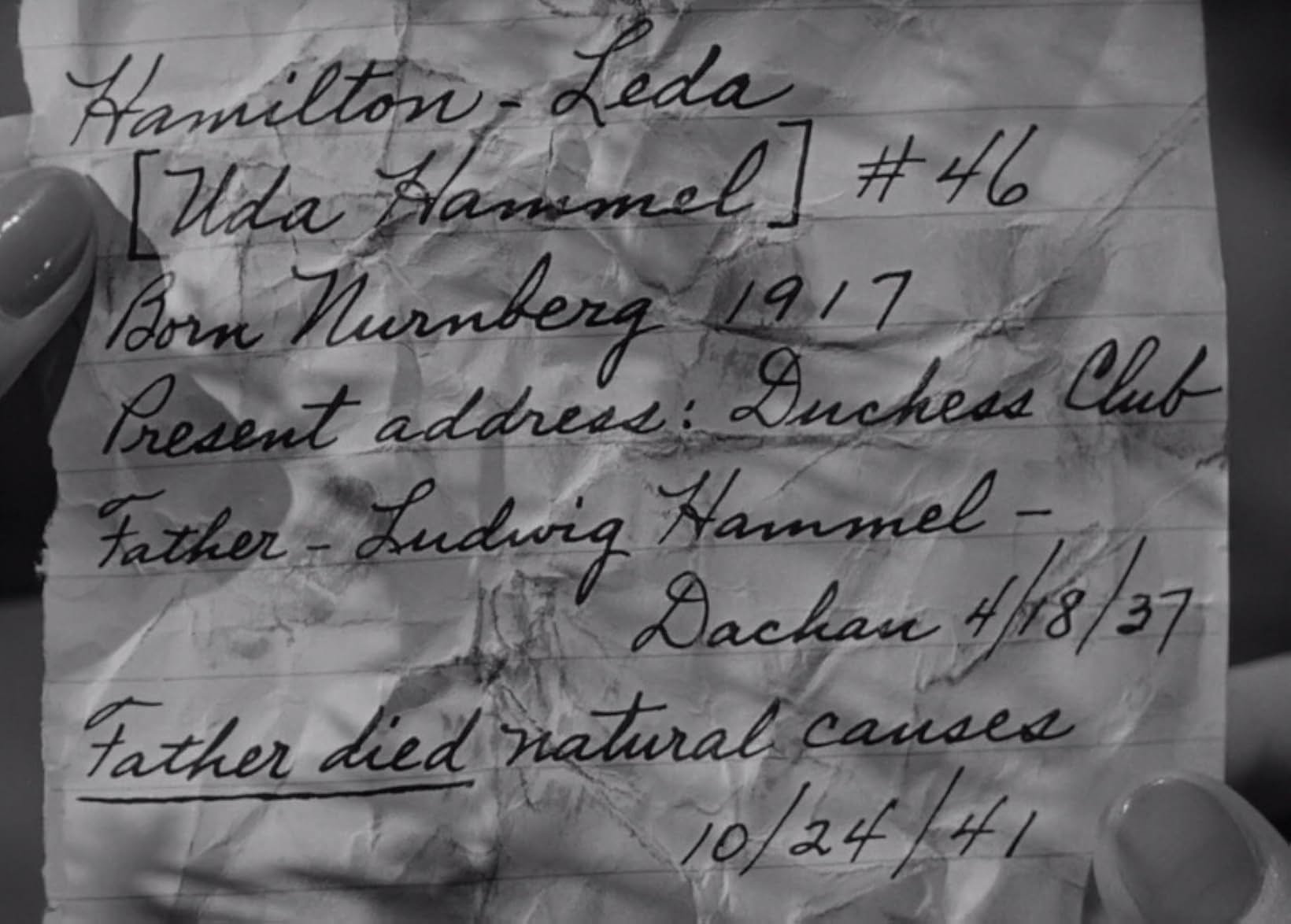
We also see how language can dramatically change the tone of a film, like the scene when Bogart reads this note:
Note the word “Dachau”. Image: IMDb
Bogart picks up on the word Dachau in the note. “What is this word, D-A-C-H-A-U?” he asks Verne, who tells him it’s a Nazi concentration camp. This is geopolitical awareness that Warner Bros., for all their faults, did not shy away from in the late 1930s and early 1940s.
The film was shot in 1941, but released in early 1942, shortly after the bombing of Pearl Harbor. This presented a dilemma in the amusing way the Nazis were originally depicted; however, the final cut presents no-nonsense, sinister Nazis.
Naturally, critic Bosley Crowther of the New York Times weighed in on the Nazi portrayal.
“One would hate to think that an enemy plot of such elaborate magnitude as the one presented here should be so completely overlooked by our capable F.B.I.,” he wrote, “and that the responsibility for licking it should fall upon a semi-gangster.”¹
(Crowther undoubtedly wanted to reassure folks that the FBI would never allow such Nefarious Activity to fester on American soil.)
Should you make time to watch this film? Definitely. It’s a treat to see Humphrey Bogart in a rare comedy, and the Warner Bros. stock players are their usual fabulous selves.
With gangsters, Nazis, and clever dialogue, All Through the Night has much to recommend it.
All Through the Night starring Humphrey Bogart, Conrad Veidt, Kaaren Verne. Directed by Vincent Sherman. Written by Leonard Spigelgass & Edwin Gilbert. Warner Bros, 1942, B&W, 107 mins.
Notes
*Runyonesque refers to American writer Damon Runyon, known for a unique dialogue style mixing formal English and slang. He also created Colourful Characters, such as gamblers, boxing promoters, gangsters, etc. ¹Toronto Film Society. (Retrieved August 5, 2024.) All Through the Night (1942), by Peter Poles.
Great review. I’ve never seen this Bogart film. Perhaps it hasn’t played the UK TV screens for a while. I watched Beat the Devil recently. Bogart and Lorre always complement each other so well on screen.
Personally, the comedy aspect is what appeals to me. I liked Bogart in some of his other comedies like Stand-In (1937) and We’re No Angels (1955), not to mention his quick cameo in Thank Your Lucky Stars (1943), so this one certainly sounds like it should be right up my alley!
wow! I’ve never heard of all through the night, but it sounds extremely entertaining! I mean, gangsters, Nazis and Humphrey Bogart! This will be put on my list asap!
Very nice handling of the moral ambiguities of gangsters vs. Nazis! It’s a rare movie where the action gets in the way of the witty language to the detriment of the film. Bogie is Bogie, but Veidt was a true actor’s actor, always mesmerizing (and usually sinister) on screen.
Oh yeah, Veidt is perfect and sinister, like he can be. Yet, this character is not a clone of Major Strasse – a testament to his acting abilites, as you mentioned.
It was so good, I saw it twice and showed it to my husband. The writing is so smart! How did they get so many silly gags in there with such and intelligent script? amazing
One of my favorite films and funny too. Great characters. I never thought of Gloves as a gangster though in the classic movie sense. As characterized in the film. He is a gambler and a promoter. With a heart of gold. A Broadway big shot. He has his gang of boys, he would have to because that character would certainly know all the mobsters.Very much more of a Runyonesque character.






 Silver Screenings
Great review. I’ve never seen this Bogart film. Perhaps it hasn’t played the UK TV screens for a while. I watched Beat the Devil recently. Bogart and Lorre always complement each other so well on screen.
LikeLiked by 2 people
Bogart and Lorre are terrific on screen, aren’t they? I would never have thought to cast them as adversaries.
I still need to see Beat the Devil. Have read many great reviews of it.
LikeLiked by 3 people
Not heard of this one, but it does sound a fabulous premise and cast – thanks for giving it a shout out in your lovely unique post.
LikeLiked by 2 people
It’s a lot of fun, but doesn’t make light of a serious situation. A real treat to see Bogart in a comedy.
LikeLiked by 2 people
I think you would like The Cheap Detective (1978), it has Peter Falk in a great comic homage to Bogie. Great cast too.
LikeLiked by 2 people
I think I’ve seen part of that – thanks for reminding me!
LikeLiked by 2 people
All Through The Night is a great little gem, and wonderful to see Bogart in a rare comedy role too.
LikeLiked by 2 people
When I saw it the other night, I thought, “Where has this movie been my entire life?”
LikeLiked by 3 people
IKWYM its one of those little gems that often get overlooked. 🙂
LikeLiked by 2 people
I haven’t seen this Bogart film yet, but you certainly make it sound like another good one! Hopefully, I’ll get a chance to see it one of these days!
LikeLiked by 2 people
I hope you do get the chance to see it. Lots of great lines and interesting characters, yet it doesn’t diminish a potential Nazi threat.
LikeLiked by 2 people
Personally, the comedy aspect is what appeals to me. I liked Bogart in some of his other comedies like Stand-In (1937) and We’re No Angels (1955), not to mention his quick cameo in Thank Your Lucky Stars (1943), so this one certainly sounds like it should be right up my alley!
LikeLiked by 2 people
great review. Must watch it again.
LikeLiked by 2 people
Can’t believe I never saw this film before and (*looks around, whispers*) I own it! 🤦♀️
LikeLiked by 2 people
Hi, you have been tagged…
LikeLiked by 2 people
That looks great! (Esp the Chunky Jumpers, and thanks for the nod.) I’ll explore more in-depth when I return home in a few days.
LikeLiked by 3 people
Looking forward to seeing what you think… Hope you are having a lovely trip away x
LikeLiked by 3 people
wow! I’ve never heard of all through the night, but it sounds extremely entertaining! I mean, gangsters, Nazis and Humphrey Bogart! This will be put on my list asap!
LikeLiked by 3 people
Oh yeah, this film does not disappoint.
LikeLiked by 3 people
This sounds fascinating! I’ll have to check it out.
LikeLiked by 2 people
It’s a gem of a movie, even though it drags in a few places. A treat to see so many Warner Bros. stock players all in one place.
LikeLiked by 3 people
Very nice handling of the moral ambiguities of gangsters vs. Nazis! It’s a rare movie where the action gets in the way of the witty language to the detriment of the film. Bogie is Bogie, but Veidt was a true actor’s actor, always mesmerizing (and usually sinister) on screen.
LikeLiked by 2 people
Oh yeah, Veidt is perfect and sinister, like he can be. Yet, this character is not a clone of Major Strasse – a testament to his acting abilites, as you mentioned.
LikeLiked by 2 people
I finally get to see this one. My library got it for me via inter-library loan
LikeLiked by 3 people
Excellent! I hope you enjoy.
LikeLiked by 3 people
It was so good, I saw it twice and showed it to my husband. The writing is so smart! How did they get so many silly gags in there with such and intelligent script? amazing
LikeLiked by 3 people
Yay! So glad you enjoyed it. It is a smart script, isn’t it? But one that knows how to have a good time.
LikeLiked by 2 people
😂🙋🏼♀️🌹
LikeLike
One of my favorite films and funny too. Great characters. I never thought of Gloves as a gangster though in the classic movie sense. As characterized in the film. He is a gambler and a promoter. With a heart of gold. A Broadway big shot. He has his gang of boys, he would have to because that character would certainly know all the mobsters.Very much more of a Runyonesque character.
LikeLiked by 2 people
Oh yes, that’s quite true. He is more of a Runyonesque character. Can’t believe it took so long to see this gem!
LikeLike