We’re here to make a case for black and white movies.
We know our position makes us sound like a Luddite, which we are, let’s face it.
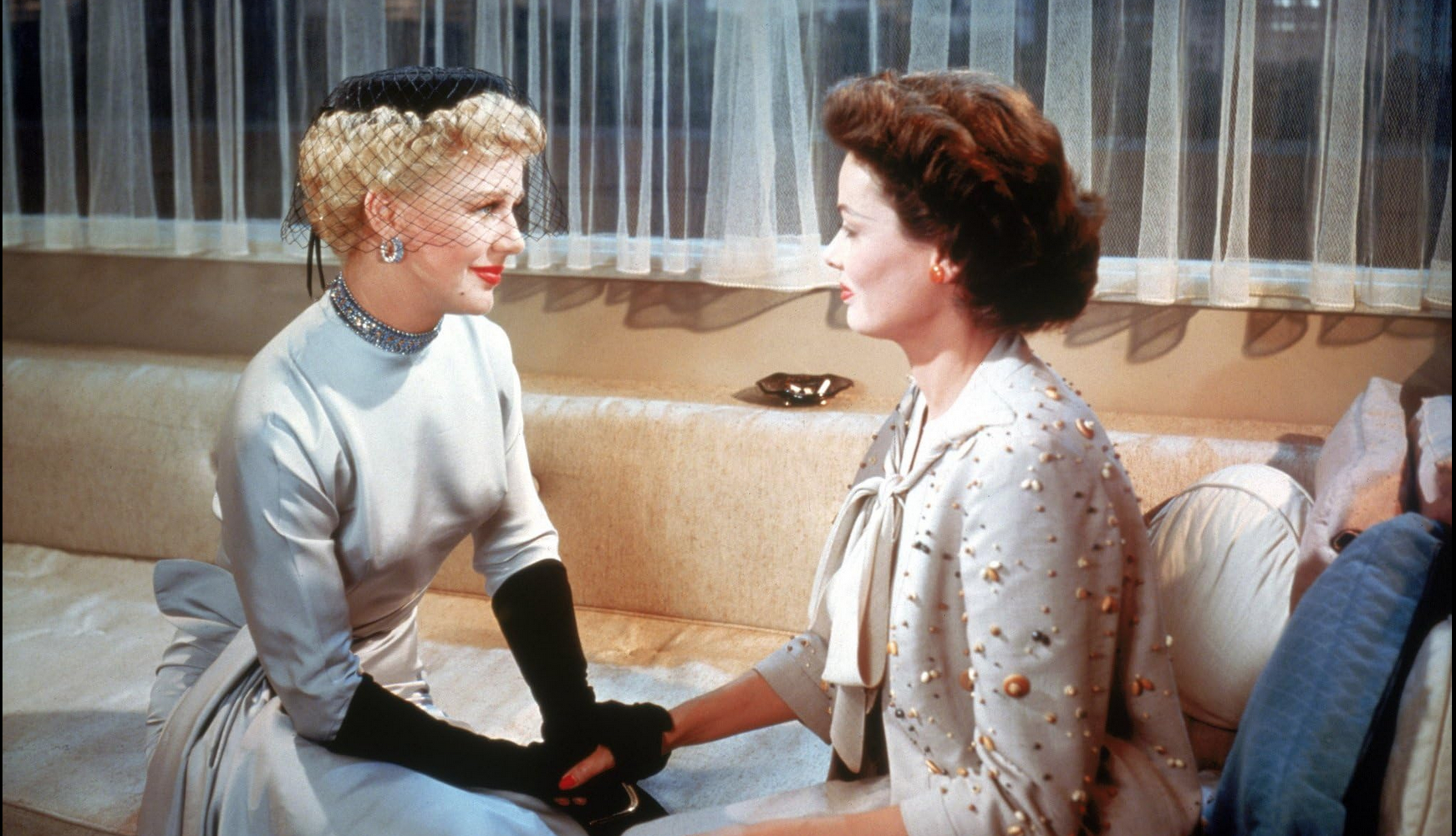
The whole thing started when we saw Black Widow (1954), a mystery/thriller filmed in sumptuous DeLuxe Color. It’s a movie of dazzling wardrobe and sets, with actors to match.
So it seems counterintuitive to suggest all that spectacle be reduced to black and white.
But it should.
Black Widow is a Whodunit with a sartorially superior ensemble cast. Ginger Rogers stars as a snide Broadway Actress whose unique talent is finding fault in everyone else. Reginald Gardiner plays her husband, a Kept Man who has long suppressed his internal ambitions.
Van Heflin is here, too, a Broadway producer turned Man-on-the-Run accused of murder, and Gene Tierney is his wife, a woman who finds it increasingly difficult to believe her husband.
In addition to George Raft as a no-nonsense detective, future film and television producer Aaron Spelling has a nice role in this film, delivering a monologue that brings New Information to Light about the murder. Spelling, in his brief but crucial role, proves to be a credible actor.
Then we have the murder victim, played by Peggy Ann Garner, a seemingly unpretentious young woman who is Anything But. Rogers, unsurprisingly, refers to Garner as “that dingy little creep.”
What a terrific assortment of characters, each with a juicy Motive. It’s too bad the whole thing masquerades as a soapy melodrama.
Van Heflin wants answers. Image: spacemov.site
Not that there’s anything wrong with melodramas; 1950s filmmakers produced some of the best.
Then why would Black Widow be better in toned-down black and white?
It’s the story.
Black Widow, for its expensive cast and exquisite wardrobe, is thin of plot and suspense. As we discover the tawdry goings-on between the characters, we feel a disconnect between the business at hand and the beauty of the film.
For example, the police investigation takes far longer than anticipated, giving us more time, we assume, to appreciate the actors in their Travilla fashions.
Colour film sets us up with different expectations than trimmed-down black and white. There’s so much to gaze at: the sets, the hairstyles, the clothes, but an audience needs More. We need Suspense and Intrigue.
To do that, filmmakers must stay On Task. Black and white film, in our opinion, offers fewer distracting eye candies and helps us focus on Theme and Message. Think of the most famous photographs of WWII: They were black and white for a reason, even though colour film was available.
If, in this movie, filmmakers had dropped the illusion of a CinemaScope spectacle, milked the characters’ agendas, and torqued the suspense, it would be a much better affair.
As it is, Black Widow is entertaining, but not memorable.
Peggy Ann Garner asks, Whatever Shall I Do? Image: IMDb
Colour cinema film really came into its Own in the 1950s, and you can’t blame filmmakers for glomming on to it. At the time, they were competing with booming TV sales, despite small screens and sometimes dodgy reception. As Jack Warner famously pointed out, Why pay to see an actor at the theatre when you can see him at home for free?
Black Widow was filmed in DeLuxe Color (later known as Color by DeLuxe), which became a staple for colour television shows in the 1960s, especially at Twentieth Century-Fox, where Black Widow was made.
DeLuxe Color was a brand of Eastman Color, à la Eastman Kodak, and it was a faster process than the widely-used three-strip Technicolor. Eastman Color not only developed (pun intended) DeLuxe Color, it also gave us Metrocolor, WarnerColor, PathéColor, and, after 1954, a new version of Technicolor – first used in 1916.
(Wikipedia has a terrific list of colour film systems, beginning in 1899.)
As for Black Widow, it is worth viewing if you don’t hope for too much. It’s not a tightly-wound film, but it does offer excellent performances, especially Ginger Rogers as a woman you love to hate.
Black Widow starring Ginger Rogers, Van Heflin, Gene Tierney. Directed by Nunnally Johnson. Written by Nunnally Johnson, Hugh Wheeler & Richard Webb. Twentieth Century-Fox, 1954, DeLuxe Color, 95 mins.
I found Black Widow a surprisingly entertaining little Neo-Noir film. I can see the film working just as well in Black & White as in Color as the mood, tone, and atmosphere compliment what Black & White offers up. The French auteur Jean-Pierre Melville shot his color films in a muted style, almost Black & White, with only hints of color, and that style may have worked well for Black Widow. Yeah, the story and characters are kind of thin, but a cast like Ginger Rogers, George Raft, Van Heflin, & Gene Tierney really does up the ante in how everything unfolds, especially Rogers and Raft.
If it wasn’t in color and Cinemascope, no one would watch it. The trappings are exactly the point of the film. It was made by Fox to demonstrate how Cinemascope in color could expertly showcase a glamorous New York setting and its upper-level denizens. The lightweight murder mystery plot was just an excuse for the rest. I especially loved all the artwork on display in the various apartments, which is all seen to much better advantage in color and ‘scope. And Peggy Ann Garner in her cute pink outfit was icing on the cake.
I so agree with you Ruth, this film should be in Black and White for sure. Is it just me or was the use of shadows in this a bit off putting in this film? When I was reviewing Rebecca (1940), I noticed someone had added a colourised trailer, why do this. I remember reading they used to do separate awards for black and white movies, perhaps they should revisit this idea. Anyway… thanks for joining the Aaron Spelling blogathon and added you to the final day.
BTW M. Delon is up, with chunky jumper mention of course, be wrong not to – btw saw an episode of Hart to Hart yesterday and let’s say Robert Wagner is not chunky cardigan (or cravat) material…
A very interesting post, Ruth. I see your point. This suspense movie would have been more true to itself filmed in black and white, but it’s understandable it was filmed in DeLuxe Color when it was the trend at the time.
The DeLuxe Color is incredibly beautiful, but more suited to a melodrama or comedy. However, like you said, you can’t blame filmmakers for choosing it.
I don’t think I’ve ever seen Spelling in an acting role, so I’m definitely curious. For some reason I always picture him playing a screenwriter or a playwright.
He’s credible in this role, and handles his monologue well. He does have some much-needed info for the investigation, though, which begs the question: Why didn’t you go to the police sooner?
I’ll be looking for this one, it is new for me. But I get where you are going with this, and I heartily agree it is often true, perhaps like many things we glomp on to the new and shiny, and do not know how good we have it already








 Silver Screenings
I found Black Widow a surprisingly entertaining little Neo-Noir film. I can see the film working just as well in Black & White as in Color as the mood, tone, and atmosphere compliment what Black & White offers up. The French auteur Jean-Pierre Melville shot his color films in a muted style, almost Black & White, with only hints of color, and that style may have worked well for Black Widow. Yeah, the story and characters are kind of thin, but a cast like Ginger Rogers, George Raft, Van Heflin, & Gene Tierney really does up the ante in how everything unfolds, especially Rogers and Raft.
LikeLiked by 1 person
Oh yeah, the cast here is amazing, isn’t it? I love Ginger Rogers in this role.
Thanks for the insight re: Jean-Pierre Melville. Am a bit embarrassed to say I’ve not yet seen any of his films.
LikeLiked by 1 person
Sounds intriguing. Will have to check this out!
LikeLiked by 1 person
It is an intriguing film, with a twist I didn’t expect. However, someone with your film knowledge might see it coming a mile away!
LikeLiked by 1 person
Oh, very interesting, I’ve not heard of this one before, will have to check it out.
LikeLiked by 1 person
Such a great cast, and a twist I didn’t see coming. It’s just not a study in gripping tension.
LikeLiked by 1 person
If it wasn’t in color and Cinemascope, no one would watch it. The trappings are exactly the point of the film. It was made by Fox to demonstrate how Cinemascope in color could expertly showcase a glamorous New York setting and its upper-level denizens. The lightweight murder mystery plot was just an excuse for the rest. I especially loved all the artwork on display in the various apartments, which is all seen to much better advantage in color and ‘scope. And Peggy Ann Garner in her cute pink outfit was icing on the cake.
If you wanted black-and-white murder mysteries, there were plenty around back then. And patient viewers could wait three years for the premiere of “Perry Mason” on CBS in 1957, where you got a black-and-white Academy ratio murder case every week for the next nine years! Here’s my blog post on BLACK WIDOW: https://briandanacamp.wordpress.com/2012/12/30/black-widow-1954-manhattan-murder-mystery-in-cinemascope-2/
LikeLiked by 1 person
Thank you for sharing the link. I will check it out.
LikeLike
I do love black and white, especially for photography. I’m currently going through a murder mystery phase and this one sounds like fun!
LikeLiked by 1 person
You might like this one. It’s sleek and doesn’t talk down to the audience.
LikeLiked by 1 person
I so agree with you Ruth, this film should be in Black and White for sure. Is it just me or was the use of shadows in this a bit off putting in this film? When I was reviewing Rebecca (1940), I noticed someone had added a colourised trailer, why do this. I remember reading they used to do separate awards for black and white movies, perhaps they should revisit this idea. Anyway… thanks for joining the Aaron Spelling blogathon and added you to the final day.
BTW M. Delon is up, with chunky jumper mention of course, be wrong not to – btw saw an episode of Hart to Hart yesterday and let’s say Robert Wagner is not chunky cardigan (or cravat) material…
LikeLiked by 1 person
Glad you agree, Gill. Even though this film is smart, it would have a lot more atmosphere in black and white, wouldn’t it?
Thanks for the tip re: Alain Delon post. You did a marvelous job on it.
LikeLiked by 1 person
I got that vibe as well just reading the plot, it just seemed rather garish.
Thanks re M Delon, I know I still owe you an actors in chunky jumpers post and be wrong not to mention those.
LikeLiked by 1 person
Gill, you are the Best.
LikeLiked by 1 person
Likewise, I do love our discussions about menswear and who pulled it off better etc…
LikeLiked by 1 person
No one compares to you in this area.
LikeLiked by 1 person
Credit where credit due, you started the whole discussion off with James Garner…
LikeLiked by 1 person
As all jumper discussions should.
LikeLiked by 1 person
Definitely!
LikeLiked by 1 person
A very interesting post, Ruth. I see your point. This suspense movie would have been more true to itself filmed in black and white, but it’s understandable it was filmed in DeLuxe Color when it was the trend at the time.
LikeLiked by 1 person
The DeLuxe Color is incredibly beautiful, but more suited to a melodrama or comedy. However, like you said, you can’t blame filmmakers for choosing it.
LikeLiked by 1 person
I don’t think I’ve ever seen Spelling in an acting role, so I’m definitely curious. For some reason I always picture him playing a screenwriter or a playwright.
LikeLiked by 2 people
He’s credible in this role, and handles his monologue well. He does have some much-needed info for the investigation, though, which begs the question: Why didn’t you go to the police sooner?
LikeLiked by 2 people
Yeah, that’s a little funny. Oh, the things writers do to keep a story going… 🙂
LikeLiked by 2 people
You had me at “Gene Tierney.” 😉
LikeLiked by 2 people
Haha! Yes, she’s beautiful – and criminally underused. It’s a shame she doesn’t have more screen time.
LikeLiked by 1 person
I’ll be looking for this one, it is new for me. But I get where you are going with this, and I heartily agree it is often true, perhaps like many things we glomp on to the new and shiny, and do not know how good we have it already
LikeLiked by 2 people
So good, loved it. I saw it a second time with hubs, and he liked it too
LikeLiked by 3 people
Yay! So glad you liked it. Ginger Rogers is great in that role, isn’t she?
Sorry for the delay in responding. Life has been getting in the way these days…
LikeLiked by 1 person