Marlene Dietrich plays a deeply religious woman (cough). Image: Posteritati
Well, here’s a complete mess of a movie.
The Garden of Allah (1936) is a little-known film these days, and for good reason. The leads are miscast, the dialogue is stilted and overwrought, and there is, frankly, no point to the thing.
However, if you watch in a spirit of mockery, it might make for a better experience. Many reviewers say this flick borders on Camp, and they’re not wrong.
Let us explain. The Garden of Allah stars screen siren Marlene Dietrich as a sad, deeply religious woman. When she visits her old convent-run school, the Mother Superior advises her to go to the African desert to Find Herself.
Apparently, life’s answers become clearer with hot, dry air and sand.
Anyhoo, Dietrich scampers to Africa to embrace the Sahara, and meets the handsome Charles Boyer, a former Trappist monk who’s escaped the monastery to pursue life of liberty and happiness.
But there’s no happiness for Boyer on the Outside. He’s a troubled soul, because he hasn’t made peace with his decision to leave his religious order. It’s hard to see why Dietrich falls in love with this basket case, but she does, and they marry, which makes her blissfully happy for some reason.
But! Boyer’s sudden departure from the monastery could mean the ruination of that organization, and he knows it. What will he do? Will guilt force him to abandon Dietrich? Does he always leave others in the lurch?
And what of Dietrich? She went to the Sahara to find purpose in Life, and now it could be wrenched from her! Deceived by a monk, no less! What are the chances!
Alas, the shadow of the Trappist community looms large in this film. Despite everything, Dietrich and Boyer are, each in their own way, married to the monastery.
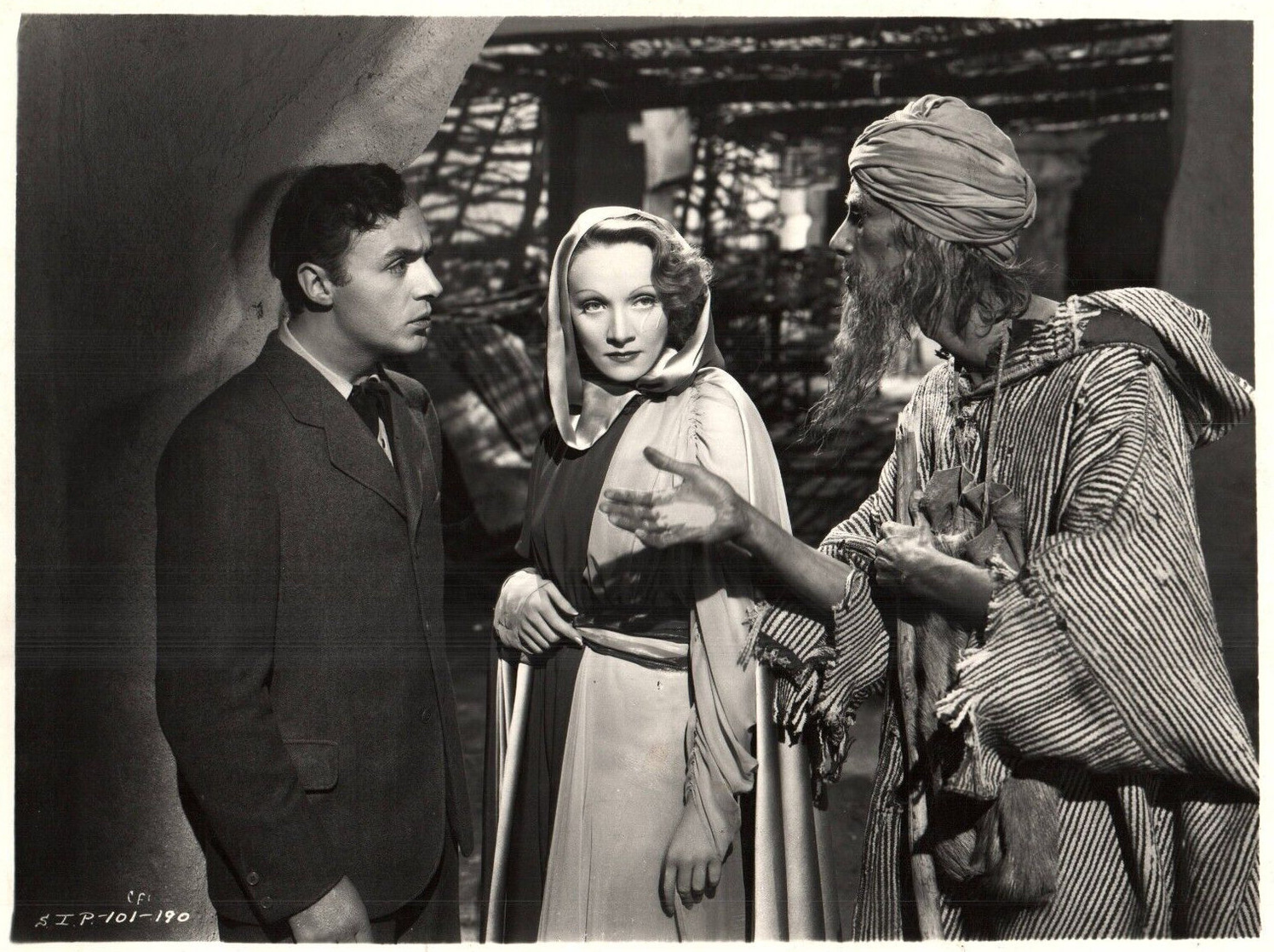
Charles Boyer (L) is a wayward monk. Image: Listal
The Garden of Allah is meant to pull at your heartstrings, to cheer for star-crossed lovers caught in an Impossible Situation. The title refers to the desert itself, meaning the desert is the garden of Allah.
We also learn sand can be used as a fortune-telling tool, and a sand diviner tells Dietrich “great joy” is waiting for her. However, the desert is also angry because winds are rising.
(Be warned. The desert giveth, and the desert taketh away.)
We hope we don’t give you the impression we’re disparaging the cast. The performances are top-notch, including those of Dietrich and Boyer, even though we (yours truly) didn’t buy them as an ultra-pious pair.
The cast also includes Basil Rathbone and C. Aubrey Smith, the only two who make the unwieldy dialogue sound natural. Smith, who plays a Catholic priest, sports a terrific beard + hair in the grand style of Old Testament movie prophets.
There are also interesting close-ups of extras, real people who aren’t studio-slick glamorous, and to look at them is almost a relief from the staged posing of the leads.
The Garden of Allah was made by Selznick International Pictures, the folks who brought us Gone With the Wind, and there are some shots that make you wonder if this film was a dry run for the Scarlett O’Hara extravaganza.
Which leads us to the most important part. This is a colour film, and that is the best thing about it.
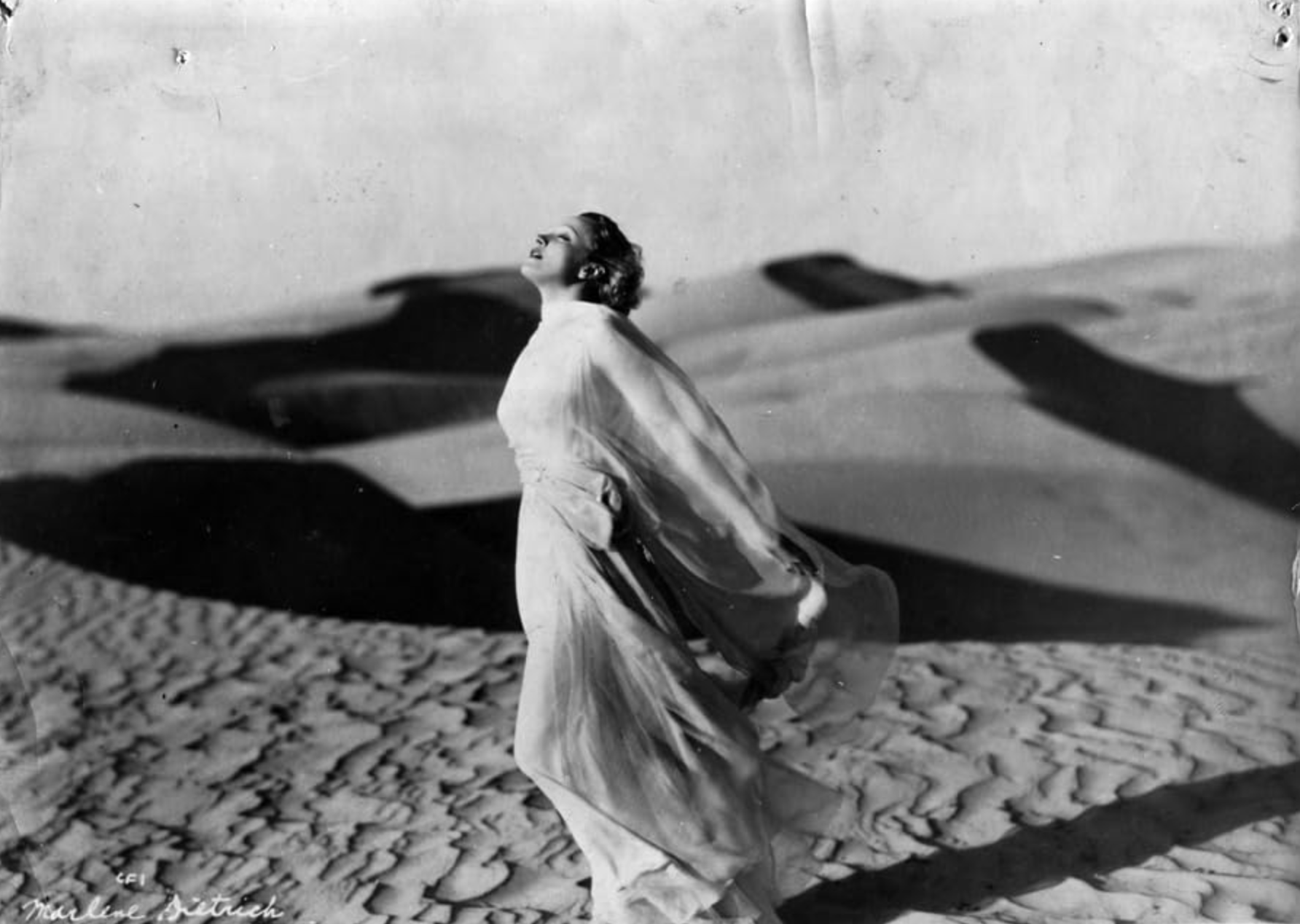
Dietrich can’t get enough of the desert. Image IMDb
The Garden of Allah was made in three-strip Technicolor, and it needs to be in colour because (A) the incredible desert exteriors, and (B) Dietrich’s sumptuous wardrobe.
The colours are beautiful, with a palette of rich tones similar to those used by the Dutch masters. If we were ever to watch this film again, we’d mute the sound, just to concentrate on the visuals.
Three-strip photography was introduced in the early 1930s with the invention of the remarkable three-strip camera. According to the Eastman Museum:
Light entered the camera through the lens and was divided by the beam-splitting prism into two paths. One strip of film recorded the green record onto black-and-white film, while the other two records were exposed onto two black-and-white film strips in “bipack” (sandwiched together); the front film was blue-sensitive only, while the back film was sensitive to red.
—”Three Strip Camera”, Eastman Museum website
It sounds a bit primitive, using three colours, but the technology created incredibly plush, realistic tones. Gone With the Wind and The Wizard of Oz are two more examples of this process.
As for The Garden of Allah, we can’t recommend it unless you’re a Marlene Dietrich or Charles Boyer completist. The colours are beautiful, though, but even they can’t save this muddle.
The Garden of Allah starring Marlene Dietrich, Charles Boyer, Basil Rathbone. Directed by Richard Boleslawski. Written by W.P. Lipscomb & Lynn Riggs. Selznick International Pictures, 1936, Technicolor, 70 mins.
I kind of liked it, but then I love those early Technicolor movies, and I consider myself a fan of Marlene (did she do something with her voice? Her accent isn’t as thick as usual). It IS stilted, there isn’t a hair out of place, but I’m a sucker for pretty melodramas.
Excellent points! And you’re right about the hair coiffage. Despite the heat and any wind, the lead actors look crisp and fresh, with maddeningly perfect hair.
Tell me: Did you think Basil Rathbone was criminally underused here?
Rathbone was criminally underused here, and throughout most of his career. He had the charisma, talent, and looks of a leading man, yet he was relegated to supporting roles in A pictures and cast as a lead only in B movies. Even so, he frequently stole the show from the principal actors.
This film is kind of a grind to get through, but it has gorgeous visuals, not the least of which is Marlene Dietrich’s wardrobe. Thanks for dropping by!




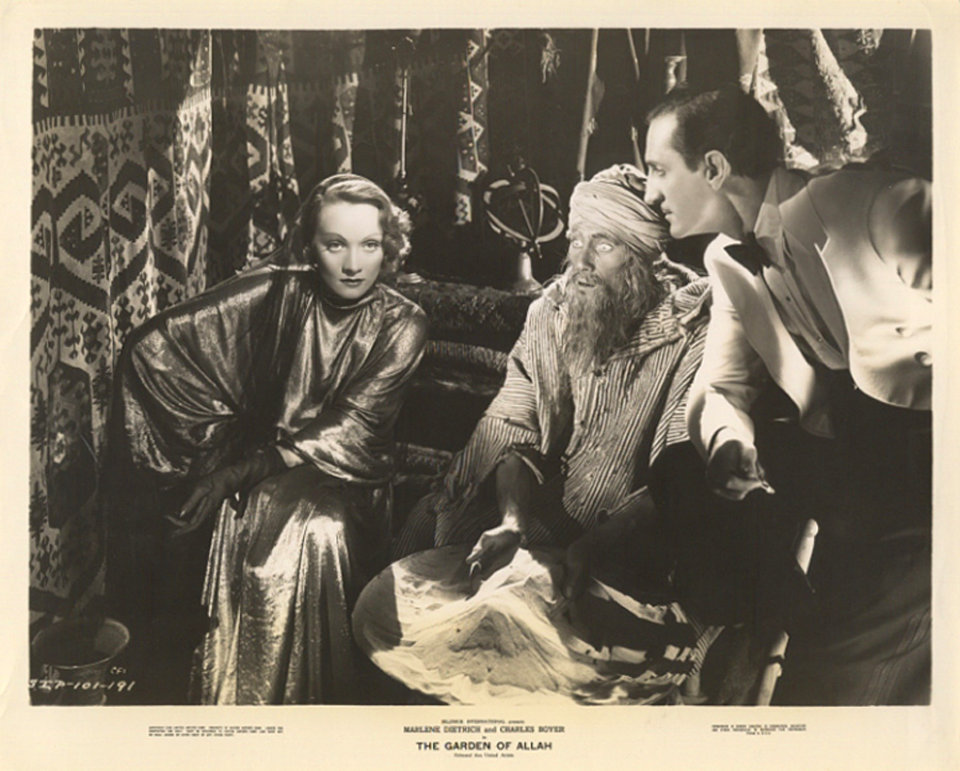


 Silver Screenings
I found it on YouTube, though you have me hesitating to watch it 🙂 Might be worth it just because it has 3 actors I love in it
LikeLiked by 2 people
It’s a beautiful film to look at, and Marlene’s wardrobe alone is something to see. But you might like it if you go in with low expectations.
LikeLiked by 2 people
I kind of liked it, but then I love those early Technicolor movies, and I consider myself a fan of Marlene (did she do something with her voice? Her accent isn’t as thick as usual). It IS stilted, there isn’t a hair out of place, but I’m a sucker for pretty melodramas.
LikeLiked by 2 people
Excellent points! And you’re right about the hair coiffage. Despite the heat and any wind, the lead actors look crisp and fresh, with maddeningly perfect hair.
Tell me: Did you think Basil Rathbone was criminally underused here?
LikeLiked by 2 people
Rathbone was criminally underused here, and throughout most of his career. He had the charisma, talent, and looks of a leading man, yet he was relegated to supporting roles in A pictures and cast as a lead only in B movies. Even so, he frequently stole the show from the principal actors.
LikeLiked by 2 people
True! He was an expert scene stealer.
LikeLiked by 2 people
Wow! I have never seen or heard of this Dietrich film. What a hoot. Thanks for the descriptions. Thanks for the like on my comment.
LikeLiked by 2 people
This film is kind of a grind to get through, but it has gorgeous visuals, not the least of which is Marlene Dietrich’s wardrobe. Thanks for dropping by!
LikeLiked by 2 people
I love her films. She was magnetic on screen. Thanks.
LikeLiked by 2 people
This sounds like a cross between so bad it’s good movie and a curiosity for the great cast. Where are you leaning?
LikeLiked by 3 people
It’s definite candidate for the So-Bad-It’s-Good awards.
LikeLiked by 2 people
Taking Up Room has just announced this one… this year going where bloggers fear to tread… Mommie Dearest…
LikeLiked by 1 person
Whoa! Will check it out. Thanks!
LikeLiked by 1 person
Can’t wait to see your choice…
LikeLiked by 1 person
Likewise!
LikeLiked by 1 person
Hilarious. Dietrich can’t help but be smoldering, even in a role like this. Need to see it.
LikeLiked by 1 person
Haha! So true!
LikeLike