The Lemon Drop Kid (1951) is a movie about con men, lemon drops, and substantial debts at Christmas.
It’s not an obvious holiday theme, but someone did have the Bright Idea to mix a Damon Runyon* short story with seasonal decorations and the comedian Bob Hope.
Hope stars as The Lemon Drop Kid, a racetrack tout who inadvertently causes a big-time gangster to lose $10,000. The gangster tells Hope he has until December 24 – about three weeks – to cough up the $10,000. Or Else.
Hope, who plays a smarter character here than in most of his films, develops an elaborate scheme to raise the dough. He “borrows” a temporarily-closed casino to establish a “Home for Old Dolls”, and invites down-and-out elderly women to stay there.
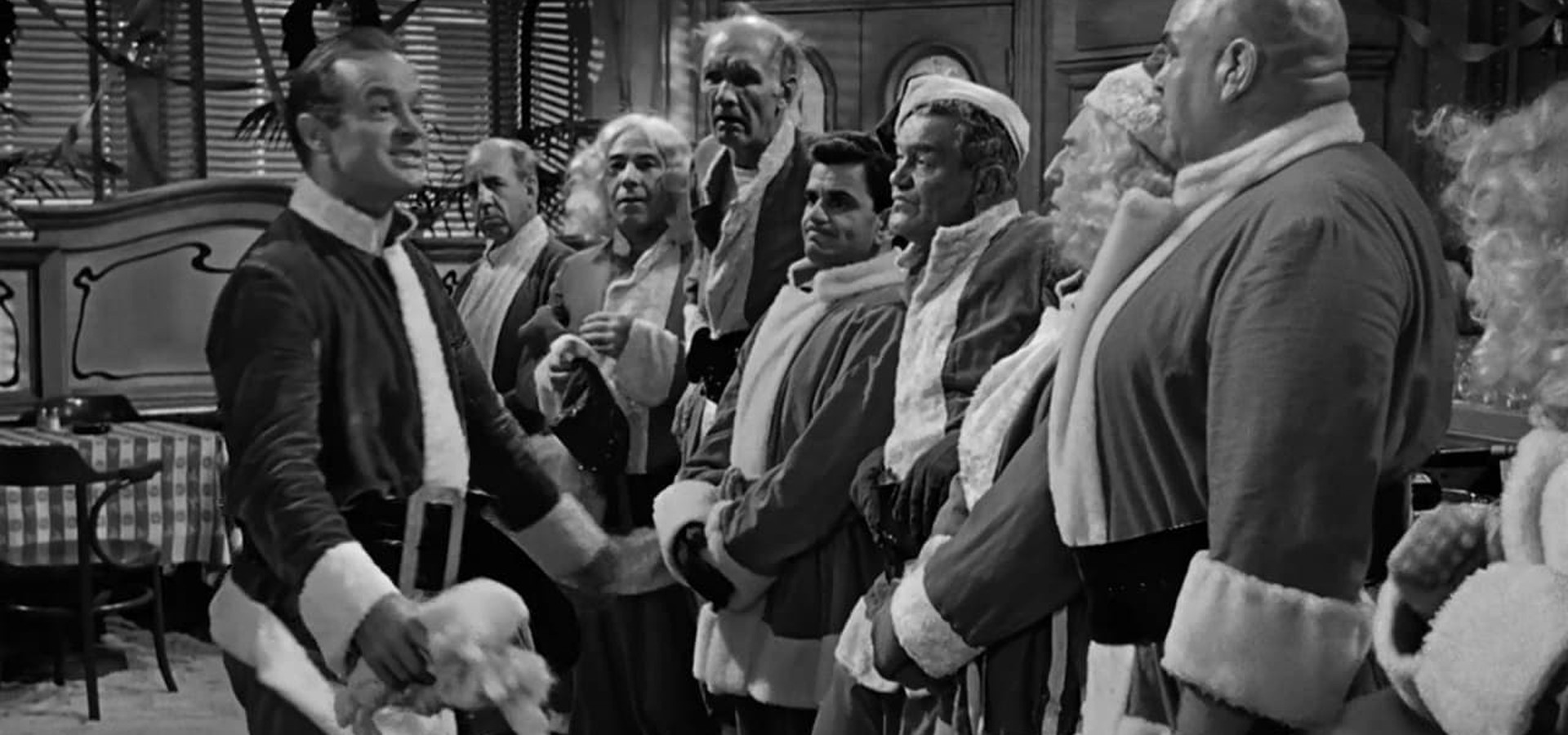
The home is a front for his real activity, though, which is enlisting Broadway con men to act as sidewalk Santas. They are the ones who will raise the $10,000 for his “charity”. The men dress in natty Santa costumes and carry old tin collection pots but, curiously, have access to genuine silver bells.
It’s very impressive, but never mind that on December 25, after the 10,000 clams have been tallied, the old dolls in the home will be turned out Into the Street.
Does Hope’s character have a Crisis of Conscience when it comes to using these women? Not really. He’s had a lifetime of suppressing his conscience, but it flares up when he’s nearly completed the caper.
He’s falling for his own scam, which shows us how susceptible we all are to a con under the right conditions.
Telling con men how to work the streets. Image: Just Watch
Meanwhile, the Clock is Ticking. We frequently see signs and newspaper ads reminding us that December 24th – a.k.a. the date of Hope’s demise – looms large. For example, a sign in a Pawn Shop says, “One More Hocking Day Till Christmas.”
Time is running out for Hope’s adversaries, too. They see how successful his, uh, charity campaign is, and they want In on the Action.
One gangster, Oxford Charlie, is puzzled by Hope’s achievements. He asks the question we’ve all been pondering: “What does that guy got that makes everybody jump through a hoop? The crazier he schemes, the higher they jump.”
Indeed. Hope’s character is Audacious. He teaches his Santa army how to act whilst soliciting funds on the sidewalk, e.g. by singing and ringing the silver bells. This supposedly puts shoppers and pedestrians in a good mood and – more importantly! – eases money out of their wallets.
One Santa creates his own song, to the tune of “Silver Bells”:
Silver bells, silver bells Let’s put some dough in the kitty. Chunk it in, dunk it in, Or Santa will give you a mickey.
Hope is mildly horrified at these lyrics. “To mention money at Christmas time is vulgar,” he says. “You gotta be subtle, delicate.”
He then launches into the song “Silver Bells”, the version we’re familiar with today, and soon the entire sound stage is singing it. Hope is proven right: Donations flood the tin pots. There’s hardly room for all the money!
Which leads to a moment of knowing recognition on our part. We know the song is used to swindle money, but we fall under its spell anyway, with its lyrics about smiling people and laughing children.
Marilyn Maxwell (L) and Jane Darwell are the women in Hope’s life. Image: Stardust and Shadows
The song “Silver Bells” was written by Paramount Studios’ songwriting team, Jay Livingston and Ray Evans. The pair had been working at Paramount since the mid 1940s, and had won Oscars for their songs “Buttons and Bows” and “Mona Lisa”.
Although “Silver Bells” was written specifically for The Lemon Drop Kid, which didn’t hit theatres until 1951, a recording by Bing Crosby was released during the 1950 holiday season. Naturally, it became an Instant Classic.
(The song was originally, and innocently, titled “Tinkle Bells”, until Livingston’s mother-in-law tactfully suggested changing it.)
We recommend The Lemon Drop Kid, even if you’re not a big fan of Bob Hope. It has fresh dialogue and characters with terrific nicknames and plenty of Motive. It’s a funny, clever film.
*Damon Runyon (1880-1946) was an American journalist who became famous for writing stories about gamblers, bookies, etc., on the seedier side of Broadway. Although the movie version of The Lemon Drop Kid is based on Runyon’s short story, it has a completely different plot.
Damon Runyon’s The Lemon Drop Kid starring Bob Hope, Marilyn Maxwell, Lloyd Nolan. Directed by Sidney Lanfield & Lloyd Tashlin. Written by Edmund Beloin, Irving Elinson & Edmund L. Hartmann. Paramount Pictures, 1951, B&W, 95 mins.
“Silver Bells” is a favorite in my household and I remember being blown away when it appeared in this movie! I think I only watched until that point in the plot as I had to run to an event or something and it was on TCM, but ever since I’ve wanted to see the ending and how everything worked out. Thanks for the reminder that this exists!
Oh yes, I hope you’ll have the chance to watch the whole film uninterrupted. I can’t believe it took me this long to see it! I really like the savvy Bob Hope character here. It’s a nice change from his usual shtick.






 Silver Screenings
I don’t think I saw this one, I’ll have to change that!
Merry Christmas…
LikeLiked by 1 person
Oh yes! I hope you get the chance to see it. It’s a funny, delightful film. (However, you will be humming “Silver Bells” for the rest of the day…)
LikeLiked by 1 person
Wonderful and a good film for the holiday season. Wishing you a very merry Christmas and here’s to a great New Year! 🙂
LikeLiked by 1 person
Thanks so much! Wishing you and yours the best for this holiday season and in 2026.
LikeLiked by 1 person
Maybe people need to watch and learn from more old movies about scammers.
LikeLiked by 1 person
Ha! Excellent point!
LikeLike
Merry Christmas!
LikeLiked by 1 person
Same to you. 🙂
LikeLike
Good review, and I watched it. You’re right, he is much smarter in this film than in others. A fun yarn
LikeLiked by 1 person
It’s fun time, isn’t it?
Will you be humming Silver Bells for the rest of the day?
LikeLiked by 1 person
Most assuredly 🙂
LikeLiked by 1 person
I’ve always loved Bob Hope. That take on Silver Bells is so funny!
LikeLiked by 1 person
Ol’ Bob is much more clever in this film than he is in most of his others. It’s quite refreshing.
It’s a neat story behind Silver Bells, a cherished holiday favourite that was just another deadline for songwriters at the studio…
LikeLiked by 1 person
Yes, I never knew that!
LikeLiked by 1 person
I should revisit this one! It’s been such a long time. I had no idea about “Silver Bells” either! How cool.
LikeLiked by 1 person
Oh yes, time to see it again. I love the smart Bob Hope in this movie.
Best wishes to you, Kristen, for 2026.
LikeLike
“Silver Bells” is a favorite in my household and I remember being blown away when it appeared in this movie! I think I only watched until that point in the plot as I had to run to an event or something and it was on TCM, but ever since I’ve wanted to see the ending and how everything worked out. Thanks for the reminder that this exists!
LikeLiked by 1 person
Oh yes, I hope you’ll have the chance to watch the whole film uninterrupted. I can’t believe it took me this long to see it! I really like the savvy Bob Hope character here. It’s a nice change from his usual shtick.
LikeLike