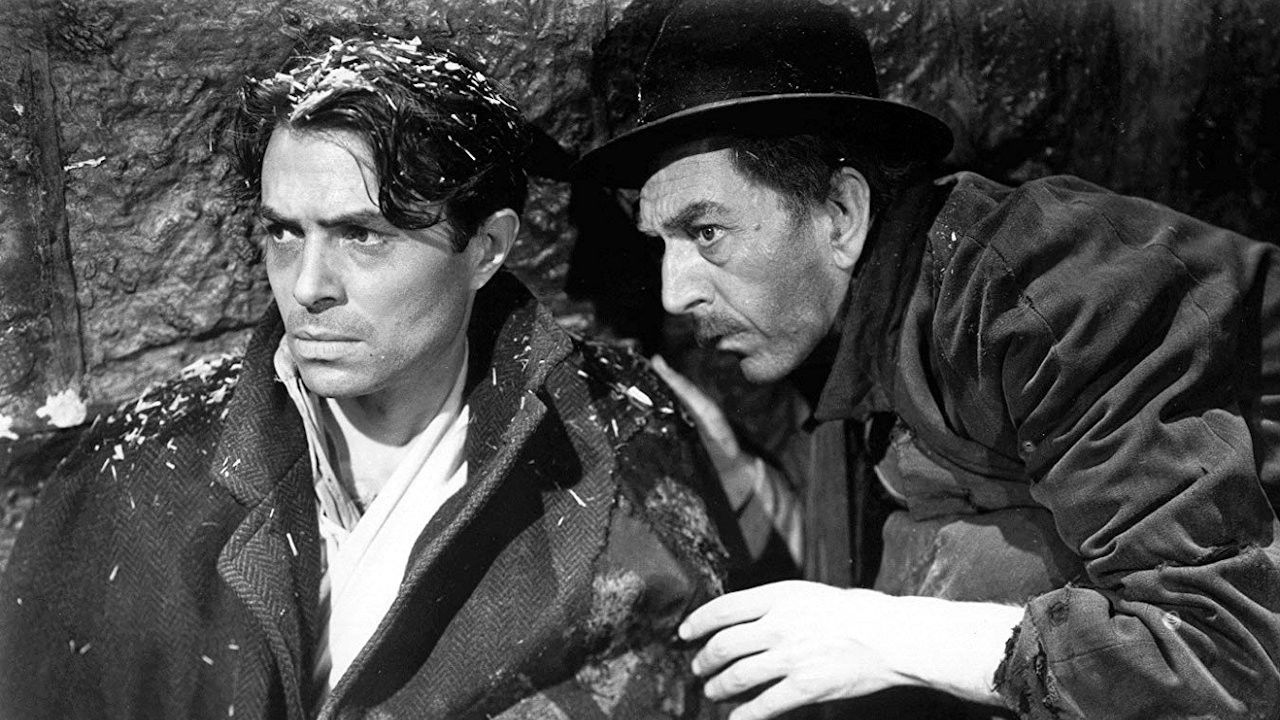
James Mason (L) has a price on his head. Image: The Movie Database
Here’s a film you can’t easily shake.
Odd Man Out (1947) is a gritty British film, made in the shadow of political conflict in Northern Ireland. It’s a rare kind of movie that impresses you visually, confronts you intellectually, and – dare we say – challenges you spiritually.
James Mason stars as the leader of a Irish political group (that Shall Not Be Named) based in Belfast. Mason’s character seems, at his core, a decent chap, although he is an escaped convict who’s been in hiding for six months.
He’s been busy during his sabbatical, though, plotting the robbery of a local mill to raise funds for the Cause. It’s a straightforward plan: He and two of his cohorts are to enter the mill’s accounting office, pull guns on employees, rob the safe, and make their Getaway. Easy peasy.
Yet, before the heist, one of the men tells Mason, “You’re not fit for a job like this. Let me go.” Mason refuses, it’s his plan, everything’s organized, he can handle it.
Alas, it’s a disaster. An employee is killed, and a wounded Mason falls out of the get-away vehicle and is forced to hide out in a bomb shelter.
In telling this story, the film sets a wide snare, catching several characters who struggle to make a life in Belfast. This is not a society of Upward Mobility. It’s difficult to be successful, either in business or crime. Despair and futility settle in and make themselves comfortable, like an unwelcome guest.
You can even see it in the children. They sass policemen, play violent games, and don’t flinch when a man is shot on the sidewalk. Just another day in the neighborhood.
Like foliage, hope and love do not flourish here in a world of brick, cement, and leftover rubble from German bombs.
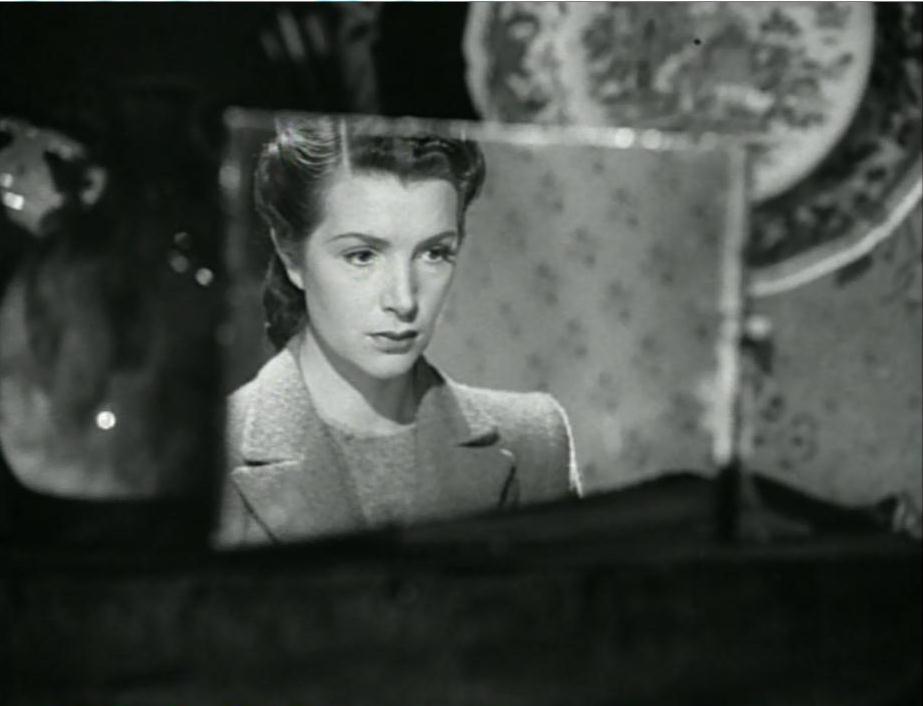
Poor Kathleen – hopelessly in love with a tragic hero. Image: Films Worth Watching
Odd Man Out was directed by Carol Reed, who later (and famously) directed The Third Man (1949). Many comparisons are made between the two movies, with themes of post-war aftermath and subversive activity.
As brilliant as The Third Man is, we (yours truly) think Odd Man Out is the superior film. In an atmosphere of desperation and loss, characters illustrate the things we value: love, faith, hope.
The last part of the movie feels allegorical, and dreamy, all the while bringing the Big Issues of life into sharp focus.
One of these issues is loyalty. Mason’s character has a £1,000 price on his head, but of all the characters who interact with him, only one is interested in that moola. This is remarkable, considering what £1,000 could do in these people’s lives. But it also illustrates how people are willing to sacrifice for the Cause.
You maybe wondering about any romance, and there is a lass (Kathleen Ryan) who’s in love with Mason. In many ways she’s the most shocking character in the film.
She swears the police will not catch Mason, and tells her priest she’ll kill him before the police get a hold of him. The priest, who spends a troublesome night negotiating and counseling, reprimands her: “You have neither the power nor the right to do this thing.”
But Ryan is a girl who will decide for herself, and her actions at the end of the film are so startling, it’s obvious the film censor had to Step In and Tone Things Down.
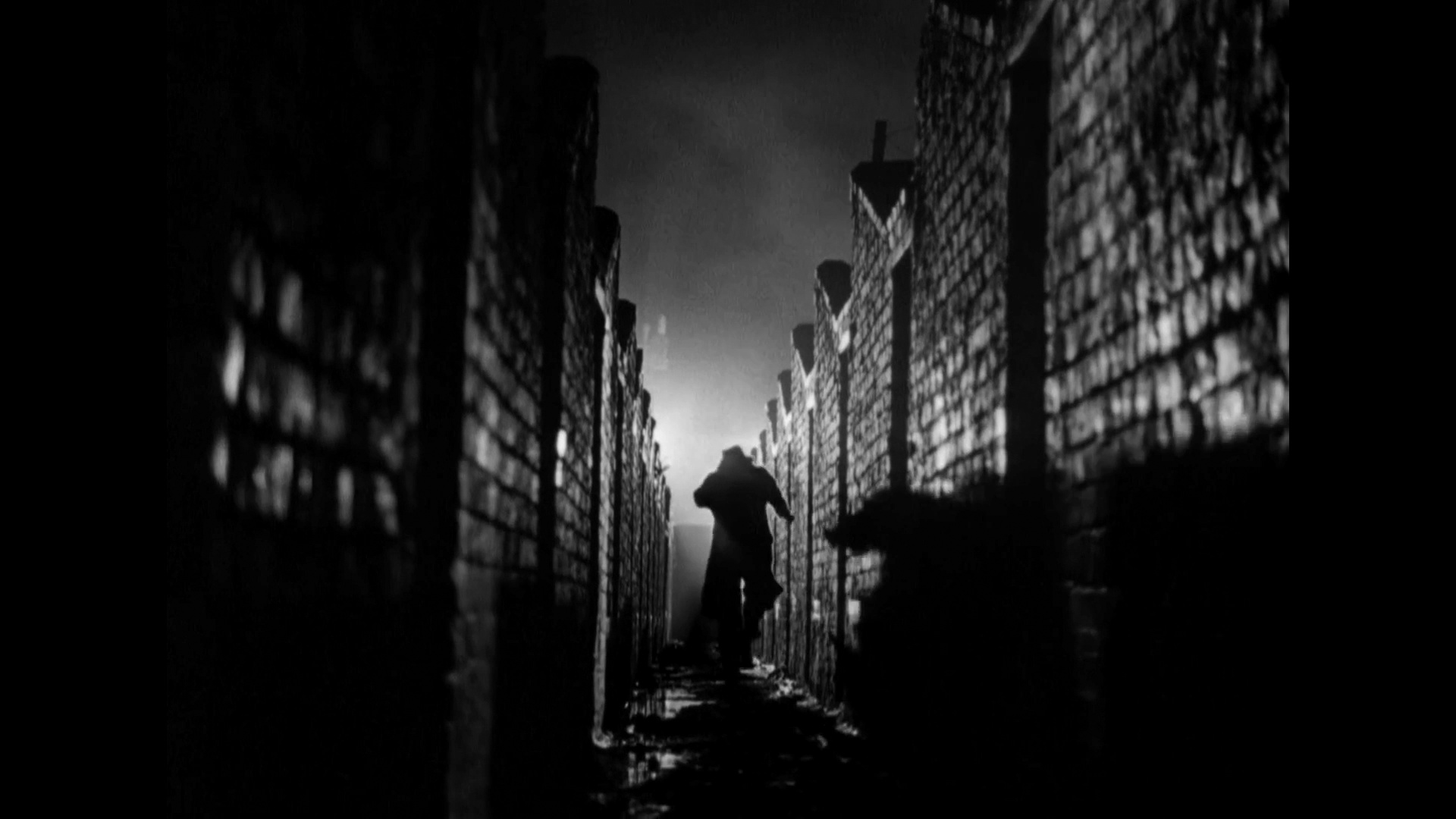
Note the stark light/dark contrast. Image: IMDb
Odd Man Out takes place during the course of one day, and it feels somewhat like a documentary. Indeed, director Reed did produce documentaries for the British army during WWII. One film, True Glory (1945) won an Oscar.
You can see Reed’s war and documentary expertise in our film today, with innovative camera angles and the breathtaking interplay of light and shadow. These are elements he would use again in The Third Man.
Odd Man Out was nominated for an Oscar for Best Film Editing, and was awarded a BAFTA for Best British Picture. It was also a box office success, and a career-defining role for James Mason.
Have you seen Odd Man Out? If not, we urge you to view it. This is a film that won’t easily let you go.
Odd Man Out starring James Mason, Robert Newton, Cyril Cusack. Directed by Carol Reed. Written by F.L. Green & R.C. Sherriff. Two Cities Films, 1947, B&W, 116 mins.
Sometimes when I write a poem that is very honest and hard, someone will comment that it is too much, that they were almost assaulted by it. That is how I felt (and still feel) after watching this movie, especially the end.
Perhaps there are those brave ones who fought against romanticising WWII, because there was nothing romantic about what was happening there.
Well said. There really was nothing romantic about WWII, as this film shows. I don’t think I’ll ever watch this film again, the images and themes are so vivid.
…thanks so much for the heads up! I like these movies. Done so well on all fronts. It’s cool it covers essentially a day. Imagine if someone felt called to remake it and they did it in one shot. Gonna watch it for sure. Keep ’em coming! Thanks!
I’ll put that on the list, thank you. Some of those 1930/40s films were quite dark. Your post reminded me of one called The Informer with Victor McLaglen.
Oh yes, The Informer! I have yet to see that one, but I know what you mean about some of the films from the 1930s and 40s. They tackled some hard-hitting topics.
I love seeing Odd Man Out get attention. It’s such a haunting film- both a political thriller and a deeply human story about guilt, fate, and redemption. The atmosphere and pacing really stay with you long after it ends.
A nice appraisal. I lived in Belfast myself for a number of years when I was a student back in the 1990s and when there was still a lot of violence taking place. I don’t know when I first saw the movie, it would have been on TV for sure, maybe some time in the 1980s but it appealed to me very much at the time. Watching it again as I got a bit older, I was hugely affected by the doomed romanticism of Mason and Ryan, the snow and the railings and the emotional power that came from his asking “is it far?”
Essentially, I’ve always loved the movie and it still affects me deeply. I too think it’s arguably Reed’s best piece of work.
Oh yes – the way Mason asks, “Is it far?” breaks your heart.
When you lived in Belfast, was there a lot of apprehension about any violence that did take place? Did the mood of the city somewhat mirror the film at times?
Yes indeed. It wasn’t an ongoing thing in terms of intensity but it was always there . Growing up in Northern Ireland through the 1970s, 80s and on into the 90s from the so-called ‘Bandit Country’ of South Armagh and then Belfast the awareness never left you although it became just another aspect of life too. One couldn’t go on day to day otherwise. At certain times, that awareness was undoubtedly heightened of course, following on from one of the more spectacular atrocities from one side or the other, or during periodic sectarian tit-for-tat attacks.
I like how you highlighted Kathleen’s role. Her devotion to Johnny makes the moral tension in Odd Man Out even more powerful, especially in those final moments.
So true! A viewer senses, from the opening scene, that Kathleen is on an impending train wreck. You want to warn her away, but you also don’t want her to give up on Johnny. An unforgettable performance.






 Silver Screenings
This film sounds intriguing! You’ve convinced me to keep my eye out for this!
LikeLiked by 5 people
Oh yes, you’ve got to see it. But note it’s not an uplifting film…
LikeLiked by 2 people
I’ve heard good things about Odd Man Out, and this piece now makes me want to check it out. Great review! 🙂
LikeLiked by 4 people
As much as I like The Third Man, I like Odd Man Out better. One of the most impactful films I’ve seen.
LikeLiked by 2 people
So glad you enjoyed it, Ruth. It’s one of the best of the 1940’s for sure. I also love the cinematography and James Mason’s performance.
LikeLiked by 4 people
Absolutely. This film is well done in every way.
LikeLiked by 2 people
Sometimes when I write a poem that is very honest and hard, someone will comment that it is too much, that they were almost assaulted by it. That is how I felt (and still feel) after watching this movie, especially the end.
Perhaps there are those brave ones who fought against romanticising WWII, because there was nothing romantic about what was happening there.
LikeLiked by 5 people
Well said. There really was nothing romantic about WWII, as this film shows. I don’t think I’ll ever watch this film again, the images and themes are so vivid.
LikeLiked by 2 people
…thanks so much for the heads up! I like these movies. Done so well on all fronts. It’s cool it covers essentially a day. Imagine if someone felt called to remake it and they did it in one shot. Gonna watch it for sure. Keep ’em coming! Thanks!
LikeLiked by 4 people
This is an unforgettable film. It’s surprising it’s not more well-known these day.
LikeLiked by 1 person
Just reading the name of the article reminded me about the Troubles.
LikeLiked by 4 people
Thank for stopping by.
LikeLiked by 1 person
Great 👍
LikeLiked by 5 people
It’s such good movie. Very powerful.
LikeLiked by 2 people
I’ll put that on the list, thank you. Some of those 1930/40s films were quite dark. Your post reminded me of one called The Informer with Victor McLaglen.
LikeLiked by 2 people
Oh yes, The Informer! I have yet to see that one, but I know what you mean about some of the films from the 1930s and 40s. They tackled some hard-hitting topics.
LikeLiked by 1 person
Adding it to the list 🖤
LikeLiked by 2 people
This is an incredible, haunting film. I hope you get the chance to see it.
LikeLiked by 1 person
I love seeing Odd Man Out get attention. It’s such a haunting film- both a political thriller and a deeply human story about guilt, fate, and redemption. The atmosphere and pacing really stay with you long after it ends.
LikeLiked by 3 people
Absolutely! I still think about this film, even weeks later. It blew me away.
LikeLike
That one’s going on my list of things to watch.
LikeLiked by 3 people
It’s a remarkable, haunting film. I hope you get the chance to see it soon.
LikeLike
😍
LikeLiked by 1 person
Great post! It sparked my interst of a film I knew very little of. Thanks
LikeLiked by 5 people
I hope you get the chance to see it. It stays with you for a long time.
LikeLiked by 1 person
A nice appraisal. I lived in Belfast myself for a number of years when I was a student back in the 1990s and when there was still a lot of violence taking place. I don’t know when I first saw the movie, it would have been on TV for sure, maybe some time in the 1980s but it appealed to me very much at the time. Watching it again as I got a bit older, I was hugely affected by the doomed romanticism of Mason and Ryan, the snow and the railings and the emotional power that came from his asking “is it far?”
Essentially, I’ve always loved the movie and it still affects me deeply. I too think it’s arguably Reed’s best piece of work.
LikeLiked by 2 people
Oh yes – the way Mason asks, “Is it far?” breaks your heart.
When you lived in Belfast, was there a lot of apprehension about any violence that did take place? Did the mood of the city somewhat mirror the film at times?
LikeLiked by 1 person
Yes indeed. It wasn’t an ongoing thing in terms of intensity but it was always there . Growing up in Northern Ireland through the 1970s, 80s and on into the 90s from the so-called ‘Bandit Country’ of South Armagh and then Belfast the awareness never left you although it became just another aspect of life too. One couldn’t go on day to day otherwise. At certain times, that awareness was undoubtedly heightened of course, following on from one of the more spectacular atrocities from one side or the other, or during periodic sectarian tit-for-tat attacks.
LikeLiked by 2 people
I like how you highlighted Kathleen’s role. Her devotion to Johnny makes the moral tension in Odd Man Out even more powerful, especially in those final moments.
LikeLiked by 2 people
So true! A viewer senses, from the opening scene, that Kathleen is on an impending train wreck. You want to warn her away, but you also don’t want her to give up on Johnny. An unforgettable performance.
LikeLike