Have you ever acted in community or professional theatre?
We (yours truly) have never done so due to a lack of talent. Plus, we can’t be bothered memorizing lines. Our time is better spent in other ways, such as sampling pastries and shopping for books we’ll never read.
However, we were able to live the thea-tah experience vicariously with the British film, Curtain Up (1952). This farce looks at a professional theatre company located in what the film describes as a “murky industrial city.”
The troupe is itself industrious. They stage a new play every week, and while one play runs at night, they rehearse a second during the day.
(We cannot imagine memorizing double sets of lines for two separate plays. Do thespians never get their dialogues mixed up?)
We meet the troupe on a Monday morning as they look over a new script – a play written by the aunt of one of the theatre bigwigs. The play is awful, and the director (Robert Morley) loathes it instantly. “Remove the first 27 pages!” he barks.
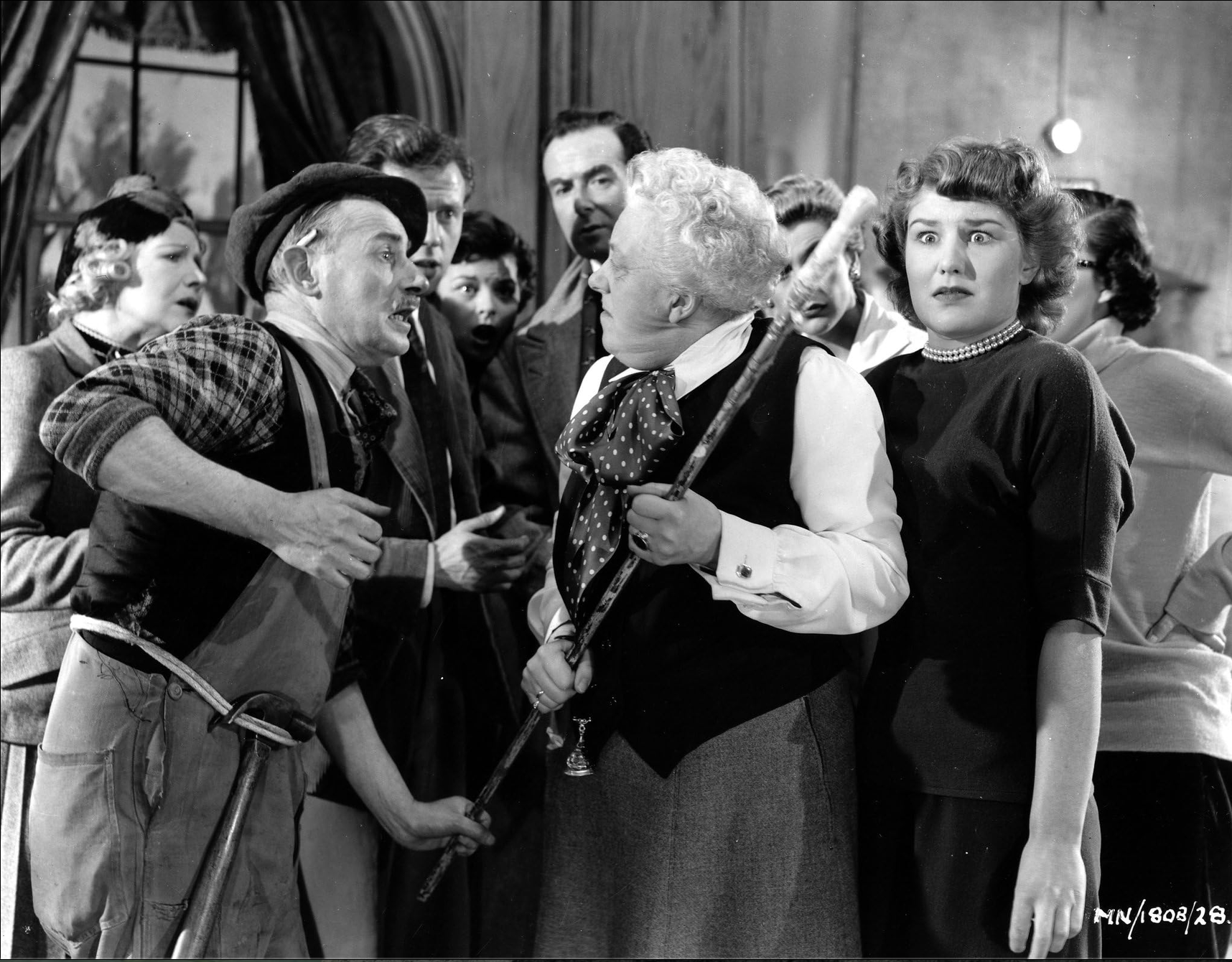
To make matters worse, the author herself (Margaret Rutherford) turns up, uninvited, at rehearsal and meddles with sets and costumes, and insists on rambling backstories for the characters.
Alas, there is no alternative. The company is committed to the script, and they press on, distractions notwithstanding.
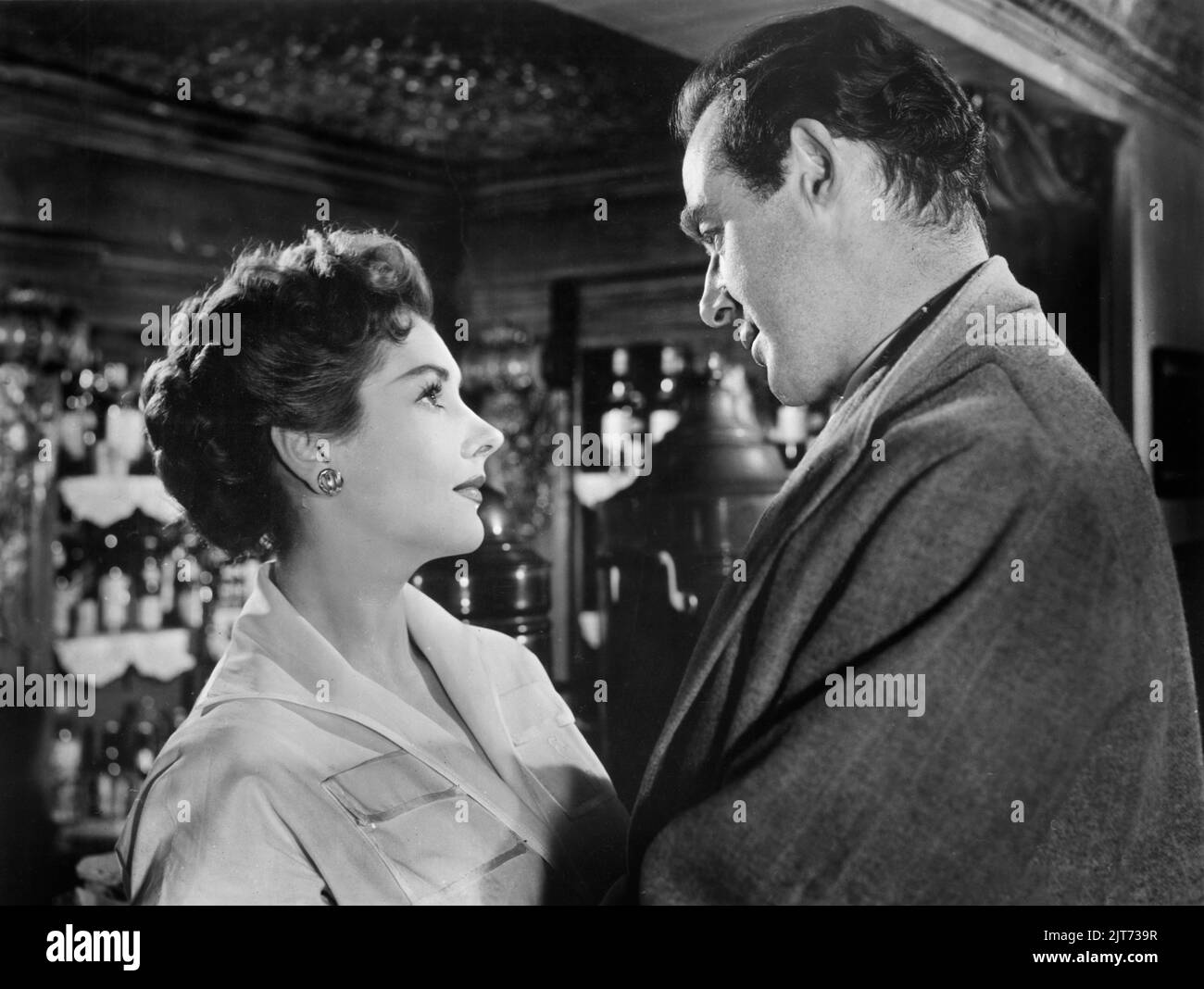
I love you, as long as you’re not more famous than me. Image: Alamy
Curtain Up is based on the stage play-within-a-play, On Monday Next, by British playwright Philip King. King’s work, “…with its fast-paced misunderstandings and quintessentially English humour, kept alive the tradition of British stage farce and influenced the post-war comedic scene,” says Concord Theatricals. “His plays became staples of repertory theatres and amateur companies…”¹
King wrote for, and acted on, the stage, and he knew the quirks and complexities involved thereof.
There are many such complexities in the Curtain Up group. The married lead actor (Liam Gaffney) enjoys the attentions of an investor’s wife, while his actress wife (Kay Kendall) tries to preserve their marriage. The couple is shocked when she’s offered a contract with a film studio – something Gaffney desires more than anything else.
Meanwhile, Morley wants to fire one of the actresses but, for all his bluster, lacks the nerve. He does, however, have the courage to tell Rutherford to re-write the entire first act, and have it ready by this afternoon.
There’s also a spark of romance between two of the younger actors, but their ardour suddenly cools when the girl’s father, a vicar, unexpectedly arrives for a visit.
You can see this is a madcap movie that plants lots of seeds, but doesn’t always let them sprout. At first glance, the whole thing seems a mess, because everything is left on the table.
But that’s where brilliance lives. This is one Monday in the life of a theatre company, and we’re invited as spectators. We don’t know how this group will sort itself out, but we later discover – SPOILER! – the play is a success.
We also realize, for all their foibles, these people are professionals who know their craft and See Things Through. You can’t help but admire them for it.
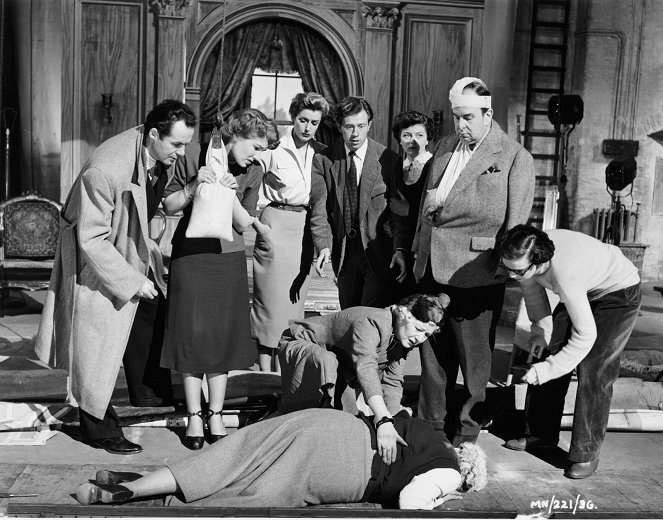
Author down! Image: csfd(dot)cz
They say the 1950s was the decade British theatre changed, with the appearance of dramas such as the absurdist Waiting for Godot (1953) and the kitchen sink* drama Look Back in Anger (1956).
According to the site Scribd, stage works presented before the 1950s were “safe”. They reflected the values of middle-class audiences and didn’t challenge widely-held beliefs.
Playwright Harold Pinter said, of those days, “[Audiences] didn’t want anything else, they were perfectly happy to put their feet up. That was what going to the theatre was normally about…going through various procedures which were known to the audience.”²
This can be seen in Morley’s reaction to Rutherford’s dreadful script. Although this audience may not have been the sophisticated London Smart Set, they knew bad writing when subjected to it. Morley’s insistence on reworking the script in an unexpected way was a bit of genius.
At the time, British theatre faced the same threats from films and television that American stages were facing – and these other, newer entertainments were much cheaper.
“The declining imperial status of Britain, economic disadvantages, and the emergence of the welfare state made society unstable,” says the International Journal of Innovations & Research Analysis. “This made way for a new generation of playwrights who did not subscribe to the genteel tastes of previous dramas.”³
But there’s nothing wrong in comfort entertainment. Who among us doesn’t have a favourite book or movie that we turn to when we crave something predictable?
Curtain Up is a frenetic film that feels like it’s traipsing off in all directions at once. This is not flaw; this is a reflection of the way life is sometimes, whether you’re in the theatre or not.
This post is part of THE 13th ANNUAL RULE, BRITANNIA BLOGATHON, hosted by A Shroud of Thoughts.
Curtain Up starring Robert Morley, Margaret Rutherford, Kay Kendall. Directed by Ralph Smart. Written by Michael Pertwee & Jack Davies. Constellation Films., 1952, B&W, 81 mins.
I’ve been in non professional theatre for some years now, both with adults and with kids, so I can easily understand how things can go messy and crazy on and off stage!
This reminds me of that wonderful line in Shakespeare in Love, when the producer is asked how all this chaos will work out, and he says he doesn’t know; it’s a mystery. Such a fun post. I’m also in awe of all that memorization!
That is such a good line, about the mystery of chaos sorting itself out. When I read your comment, I watched that scene again on YouTube and realized it’s been too long since I’ve seen that film.
We have community theatre in our area, and those hard-working folks do an excellent job, especially with memorizing lines. In the last production, one woman had about 60-70% of all the lines and she pulled it off. Impressive!
Have you ever been involved with community or professional theatre?
No, never have. Last time I was in anything of the kind was high school, and last time I had a line was middle school. I have so much respect for those who take part in it!
I started acting in my children’s school theatre with many other parents, some teachers and a nun, then I ended writing the script and helping the directer, but I like to go on stage and act, even for small roles (like Santa’s reindeer for example). The I help another director in the kid’s theatre and write that script too. It’s an amatorial thing but we have a chorus, a choreographer and dancers, and sometimes putting it all together is a real challenge!
That is awesome! Those productions sound like a lot of work, but worth it in the end, hey? And the memories & skills you’re giving the children is marvellous. I’m so impressed your plays include dance/choreography. You are a person of many talents!
You had me at Margaret Rutherford! I found Curtain Up and I’m planning on watching it tonight.
I did community theater one summer. I was Fruma Sarah in Fiddler on the Roof, also a villager dancing in the wedding scene. At the end of the summer I went to the doctor and they said, “You are exhausted,” which I didn’t even know was a diagnosis outside of old novels. I considered trying out for a musical about Sasquatch someone was putting on last month, thought about “being exhausted” back in 2012, and decided to just go see the musical instead.
Oh wow, that scene where Dame Margaret bursts through the backdrop at the end was so funny I made a reaction gif out of it. Thanks for bringing Curtain Up to my attention!
This seems like a quintessentially British sort of film, and a very good choice for the blogathon. Being shy, retiring, and more than a little lazy, I can’t imagine subjecting myself to the chaos of even one day in the life of a troupe like this, but it sounds like it makes for a charming and amusing film.
These actors and stage hands are true pros and, for the most part, very hard working. They know the biz, which I find inspiring in a way. But I agree with you about the work it would take. It wears me out just thinking about it!
This sounds like one I’d like, and I’d love to see this cast. (And totally agree about the pastries and books still to read having just spent some dosh on books on le Delon, they are in French but such lovely photos from the La Piscine etc…)
Being a huge fan of Noises Off, which is also about a nutty theater troupe, I think I would really like this one. It sounds delightful! Thanks for the review!
I had never heard of this movies but it sounds fascinating! Like you, I lack the talent to act, but luckily not to write about others acting. And you gave a perfect definition of a kitchen sink drama.
That is so true, Le. You definitely do have talent to write about actors’ performances.
Speaking of acting, I watched part of a streaming show yesterday where the main actor was so bad, you couldn’t take your eyes off her. However, having said that, I couldn’t do any better.







I’ve been in non professional theatre for some years now, both with adults and with kids, so I can easily understand how things can go messy and crazy on and off stage!
LikeLiked by 2 people
It must be truly satisfying to see the production come together if the rehearsal process has been chaotic. Do you act? Direct? Or do both?
LikeLiked by 2 people
This reminds me of that wonderful line in Shakespeare in Love, when the producer is asked how all this chaos will work out, and he says he doesn’t know; it’s a mystery. Such a fun post. I’m also in awe of all that memorization!
LikeLiked by 2 people
That is such a good line, about the mystery of chaos sorting itself out. When I read your comment, I watched that scene again on YouTube and realized it’s been too long since I’ve seen that film.
We have community theatre in our area, and those hard-working folks do an excellent job, especially with memorizing lines. In the last production, one woman had about 60-70% of all the lines and she pulled it off. Impressive!
Have you ever been involved with community or professional theatre?
LikeLike
No, never have. Last time I was in anything of the kind was high school, and last time I had a line was middle school. I have so much respect for those who take part in it!
I love Shakespeare in Love.
LikeLiked by 1 person
I started acting in my children’s school theatre with many other parents, some teachers and a nun, then I ended writing the script and helping the directer, but I like to go on stage and act, even for small roles (like Santa’s reindeer for example). The I help another director in the kid’s theatre and write that script too. It’s an amatorial thing but we have a chorus, a choreographer and dancers, and sometimes putting it all together is a real challenge!
LikeLiked by 1 person
That is awesome! Those productions sound like a lot of work, but worth it in the end, hey? And the memories & skills you’re giving the children is marvellous. I’m so impressed your plays include dance/choreography. You are a person of many talents!
LikeLiked by 1 person
Ghghgh, you are too kind, I have wonderful collaborators for music, dance, custumes, lights and scenography, nothing could be done without them!
LikeLiked by 1 person
You had me at Margaret Rutherford! I found Curtain Up and I’m planning on watching it tonight.
I did community theater one summer. I was Fruma Sarah in Fiddler on the Roof, also a villager dancing in the wedding scene. At the end of the summer I went to the doctor and they said, “You are exhausted,” which I didn’t even know was a diagnosis outside of old novels. I considered trying out for a musical about Sasquatch someone was putting on last month, thought about “being exhausted” back in 2012, and decided to just go see the musical instead.
LikeLiked by 2 people
What a great experience to be part of Fiddler on the Roof! But I can imagine it would have been taxing.
A musical about Sasquatch?! I want details!
LikeLiked by 1 person
Oh wow, that scene where Dame Margaret bursts through the backdrop at the end was so funny I made a reaction gif out of it. Thanks for bringing Curtain Up to my attention!
LikeLiked by 1 person
Haha! That’s awesome!
LikeLiked by 1 person
This seems like a quintessentially British sort of film, and a very good choice for the blogathon. Being shy, retiring, and more than a little lazy, I can’t imagine subjecting myself to the chaos of even one day in the life of a troupe like this, but it sounds like it makes for a charming and amusing film.
LikeLiked by 1 person
These actors and stage hands are true pros and, for the most part, very hard working. They know the biz, which I find inspiring in a way. But I agree with you about the work it would take. It wears me out just thinking about it!
LikeLike
This sounds like one I’d like, and I’d love to see this cast. (And totally agree about the pastries and books still to read having just spent some dosh on books on le Delon, they are in French but such lovely photos from the La Piscine etc…)
LikeLiked by 1 person
One is helpless in matters of love, pastries, and books – even those in another language – n’est-ce pas?
LikeLiked by 1 person
Oui, c’est vrai, ja Le Delon on très très très formidable… Oh mon coeur!
LikeLiked by 1 person
Je suis d’accord!
LikeLike
Being a huge fan of Noises Off, which is also about a nutty theater troupe, I think I would really like this one. It sounds delightful! Thanks for the review!
LikeLiked by 1 person
Ooh – and thanks for the Noises Off recommendation. Will watch for that one. I learn about some really interesting films from you.
LikeLiked by 1 person
I just love Noises Off (1992), and I hope you like it too. It’s such a great Valentine to theater troupes.
LikeLiked by 1 person
I had never heard of this movies but it sounds fascinating! Like you, I lack the talent to act, but luckily not to write about others acting. And you gave a perfect definition of a kitchen sink drama.
Thanks for the kind comment!
Le
LikeLiked by 1 person
That is so true, Le. You definitely do have talent to write about actors’ performances.
Speaking of acting, I watched part of a streaming show yesterday where the main actor was so bad, you couldn’t take your eyes off her. However, having said that, I couldn’t do any better.
LikeLike